What is the Ghost Festival in China and how should foreigners behave?
Quick answer
The Ghost Festival (中元节, Zhōngyuán Jié) falls on the 15th day of the 7th lunar month. It is a serious ancestral ritual day — not a fun Halloween equivalent. Foreigners should observe quietly, not photograph roadside offerings or burning rituals, and avoid scheduling loud celebrations on this day. It's not a day to participate in, but a day to respectfully step back.
What Is the Ghost Festival?
The Ghost Festival (中元节, Zhōngyuán Jié) — also called Hungry Ghost Festival — is the day Chinese tradition holds that the gates of the underworld open, and the spirits of the dead return to the living world for a month (the entire 7th lunar month, with the 15th day as the peak).
The closest Western parallel is All Souls' Day rather than Halloween. This is not a costume party or a horror movie. It is a serious, emotionally significant ritual day focused on caring for deceased ancestors and appeasing wandering spirits who have no living family to tend to them.
The tone is one of respectful fear, genuine grief, and protective ritual — not entertainment.
The Date
| Year | Date |
|---|---|
| 2025 | September 10 |
| 2026 | August 27 |
| 2027 | September 17 |
No public holiday. But the atmosphere in many communities — especially southern chinese cities, China Taiwan, and Southeast Asia — shifts noticeably during the entire 7th lunar month.
What Chinese People Do
Burn Paper Offerings (烧纸钱)
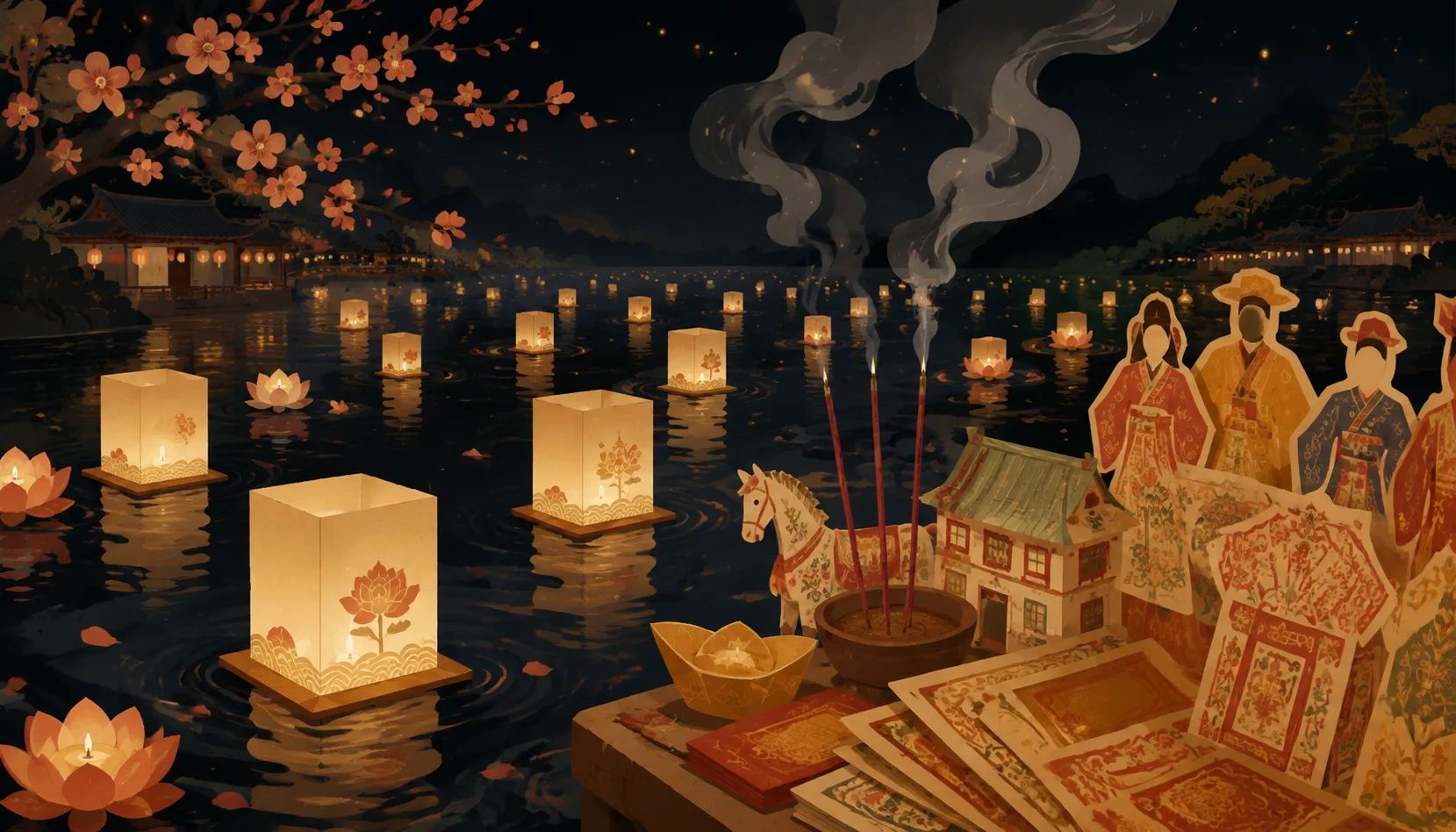
The most visible ritual: paper printed to look like money, or paper replicas of houses, cars, phones, and clothes, burned in fires on sidewalks, intersections, or in designated areas. The smoke carries these "gifts" to the spirit world.
If you see a roadside fire with people crouching around it in August or September, this is what's happening. Walk past. Don't photograph, don't linger, don't ask questions.
Set Out Food Offerings (祭祖)
Families place food, incense, and candles on tables outside their homes or businesses — offerings for both their own ancestors and any wandering spirits nearby. Restaurants sometimes have a small altar near the entrance this month.
Release River Lanterns (放河灯)
In cities near water, paper lotus lanterns with small candles are floated on rivers and lakes at night — guiding the spirits of the dead back to the afterlife after their earthly visit. This is genuinely beautiful to watch from a respectful distance.
Community Rituals (普渡, Pǔdù)
In some communities — particularly in Fujian, Taiwan, and among overseas Chinese communities — large-scale communal ceremonies are held to feed and appease the wandering spirits. Tables of food are laid out for spirits with no living family to tend them.
Superstitions During the 7th Lunar Month
Many Chinese people — not just traditionally-minded ones — observe a range of precautions during the entire Ghost Month:
| Behavior | Reason |
|---|---|
| Avoid swimming at night | Spirits of the drowned may pull you under |
| Don't move house or start a new business | Bad timing to make major life changes |
| Don't hang laundry outside after dark | Spirits may enter the clothing |
| Don't whistle at night | Attracts spirits |
| Don't step on roadside offerings | Direct disrespect to the spirit receiving them |
You don't need to follow these rules. But knowing they exist helps you understand why a Chinese colleague might decline a late-night swim or seem subdued about a new business launch during this period.
What Foreigners Should Do
- Observe quietly. River lantern ceremonies, in particular, are visually stunning and perfectly appropriate to witness from the bank.
- Step around, not through, any roadside offerings or burn circles. This is basic spatial respect.
- Accept if a Chinese friend declines invitations to night events this month. Ghost Month restrictions on evening activities are taken seriously by many people.
What Foreigners Must NOT Do
- ❌ Photograph people burning paper at roadside rituals. This is an intimate family moment, not a cultural spectacle for your social media.
- ❌ Express mockery or skepticism about these beliefs in front of Chinese people. Even those who don't fully believe the supernatural aspects take the ritual dimension seriously.
- ❌ Wear red on this day. Red is a celebration color — wearing it during a mourning/protection ritual is inappropriate.
- ❌ Pick up or take any roadside offering items. Even empty containers, fruits left out, or scattered paper money — these belong to the spirit world.
- ❌ Tell ghost stories expecting Chinese people to find it fun. On Ghost Festival day and during Ghost Month, many people are actively avoiding reminders of death and spirits.
Ghost Festival vs Qingming: Key Difference
Both are ancestral remembrance days. The distinction:
- Qingming (spring, April): visits to specific family graves, personal and family-centered.
- Ghost Festival (summer, 7th lunar month): rituals to appease all spirits — both family ancestors and unrelated wandering souls. More communal, more atmospheric, more rooted in fear of spirits who may cause harm if neglected.
What Chinese People Actually Say
- 烧纸 | shāo zhǐ | burning paper money to appease ghosts | Only burn in designated areas; never do it indoors
- 祭祀 | jìsì | ancestor worship ritual | Show respect by keeping quiet and following local customs
- 放河灯 | fàng hé dēng | releasing lanterns on water to guide lost souls | Use biodegradable materials; avoid modern plastic lanterns
2026 Reality Check
2026 Reality Check: Core rituals—burning paper money and offerings at ancestral sites—remain widespread, but enforcement varies. Most younger Chinese view Ghost Festival as cultural heritage rather than strict superstition.
Gen Z vs. Older Generations: Seniors still observe traditional taboos (no whistling at night, avoiding near-water areas after dark). Gen Z largely treats it as a photo-worthy holiday or social media event, though many still participate in family burning rituals to please elders.
Big Cities vs. Small Cities: Beijing and Shanghai have secularized the festival significantly—it's mostly a long weekend for mall promotions. Smaller cities and rural areas maintain stronger observance, with visible street burnings and temple visits.
For foreigners: Don't join street burnings without invitation, avoid mocking rituals, and skip late-night waterfront activities. Most Chinese will appreciate respectful curiosity over ignorance.
Frequently asked questions
When exactly is the Ghost Festival in 2026 and how is the date calculated?
In 2026, the Ghost Festival falls on August 27. It's always the 15th day of the 7th lunar month. Because the lunar calendar shifts yearly, the Gregorian date changes — it can land anywhere from mid-August to mid-September. Check a Chinese lunar calendar app to confirm the exact date each year.
What should I do if I accidentally step on or walk through roadside offerings?
If you accidentally disturb paper money, food, or incense left on sidewalks or near curbs, apologize sincerely — even a quiet verbal apology is appreciated. Don't try to clean it up or move it. Step away calmly. Locals understand accidents, but showing respect by apologizing and not lingering demonstrates cultural awareness.
Can I take photos of the burning rituals or paper offerings from a distance?
No. Photographing or filming any Ghost Festival rituals is considered highly disrespectful, even from afar. These are sacred acts meant to appease wandering spirits. Taking photos is seen as capturing spirits or mocking the ritual. Put your phone away entirely during the evening of the festival, especially near residential courtyards or street corners.
Is it okay to eat at restaurants or order food delivery on Ghost Festival night?
Yes, restaurants and delivery services operate normally. Many Chinese people eat out as usual. However, avoid dining outdoors at night near offering sites, and don't sit at tables left empty with food for spirits. If you notice a restaurant has set aside an empty table with food, don't touch it — it's an offering.
Why do some Chinese people avoid swimming, dating, or moving house during the Ghost Festival?
The 7th lunar month is called Ghost Month, when spirits are believed to roam the living world. Swimming is avoided because water spirits may drag people under. Dating and moving house are postponed to avoid bad luck or attracting unwanted spiritual attention. These are folk beliefs, not official rules, but respecting them shows cultural sensitivity.
What if my Chinese colleagues or neighbors invite me to join their Ghost Festival activities?
Politely decline with a sincere thanks, saying you don't want to disturb the ritual. Chinese people rarely expect foreigners to participate. If you live in a community where residents burn offerings, simply stay indoors that evening and keep lights on. Don't offer to help or watch closely — your respectful distance is the best participation.
Try our tools
Related guides
Chinese Superstitions in Everyday Life: What Foreigners Should Know
Several Chinese superstitions remain genuinely active in modern life — especially around gifts (clocks, pears, green hats), numbers (4 = death, 8 = prosperity),…
Read the guide →
5 Chinese Holidays Foreigners Often Miss: Lantern Festival, Teachers' Day, Chongyang, Winter Solstice & Women's Day
Beyond Spring Festival, Golden Week, and Mid-Autumn, five smaller Chinese holidays matter for foreigners in Chinese social and professional life: Lantern Festiv…
Read the guide →
Dragon Boat Festival China: Zongzi, Dragon Boats & What Foreigners Must Know (2026)
Dragon Boat Festival (端午节, Duānwǔ Jié) falls on the 5th day of the 5th lunar month. Eat zongzi (sticky rice dumplings wrapped in bamboo leaves), watch or join d…
Read the guide →