Chinese New Year Greetings 2026: Phrases, Pinyin, and When to Use Each One
Quick answer
Five phrases cover 90% of your Spring Festival social needs: 1. 新年快乐 (Xīnnián kuàilè) — Happy New Year. Universal. 2. 恭喜发财 (Gōngxǐ fācái) — Wishing you prosperity. Adults, business. 3. 身体健康 (Shēntǐ jiànkāng) — Good health. Elderly — always safe. 4. 万事如意 (Wànshì rúyì) — May everything go as you wish. General. 5. 大吉大利 (Dàjí dàlì) — Great luck and great profit. Casual, cheerful. Use these in sequence when entering a home: "恭喜发财,身体健康,万事如意!" — you will be loved.
Quick Answer
Five phrases cover 90% of your Spring Festival social needs:
- 新年快乐 (Xīnnián kuàilè) — Happy New Year. Universal.
- 恭喜发财 (Gōngxǐ fācái) — Wishing you prosperity. Adults, business.
- 身体健康 (Shēntǐ jiànkāng) — Good health. Elderly — always safe.
- 万事如意 (Wànshì rúyì) — May everything go as you wish. General.
- 大吉大利 (Dàjí dàlì) — Great luck and great profit. Casual, cheerful.
Use these in sequence when entering a home: "恭喜发财,身体健康,万事如意!" — you will be loved.
Why Greetings Matter So Much at Spring Festival
In most of your interactions in China, getting by with English or limited Chinese is fine. Spring Festival is different. When you walk into a Chinese home on New Year's Eve and deliver warm, correct Chinese greetings to grandparents who speak no English — you have just done something memorable.
The act of a foreigner bothering to learn and say Chinese New Year phrases, with genuine warmth, registers as: "This person respects us deeply." It's the kind of moment that gets retold to other family members.
Conversely, greeting an elderly Chinese grandmother with "Happy Chinese New Year!" in English on New Year's Eve while she's dressed in red waiting to celebrate with her grandchildren — technically polite, but missing the mark.
The Core Five Greetings
1. 新年快乐 — Happy New Year
Pinyin: Xīnnián kuàilè Literal: New year / happy English equivalent: Happy New Year Use: Everyone, always, any moment during the Spring Festival period. The safest, most universal phrase. Completely appropriate for strangers, colleagues, elders, children.
When to say it: First sentence when seeing anyone during the holiday period (approximately 2 weeks before through 2 weeks after).
2. 恭喜发财 — Wishing You Prosperity
Pinyin: Gōngxǐ fācái Literal: Congratulations / become wealthy English equivalent: May you prosper / Wishing you wealth and success Use: Adults, business contacts, people who are working or running businesses. This is the most quintessentially "Spring Festival" greeting — you will hear it constantly during the holiday.
When to say it: When entering someone's home, at a business dinner, to colleagues, to business partners. It's slightly more adult-coded than 新年快乐 — don't say it to small children (it sounds odd to wish a 5-year-old prosperity).
Note for Cantonese regions: Cantonese speakers say "恭喜发财!利是逢迎!" (Gōngxǐ fācái! Lìshì féngyíng!) — wishing prosperity and lucky money to all. If you're in Guangdong, Hong Kong, or Macau, this is the correct full version.
3. 身体健康 — Good Health
Pinyin: Shēntǐ jiànkāng Literal: Body / health English equivalent: Wishing you good health Use: The single most powerful greeting for elderly people. If you say only one thing to a grandparent at a Spring Festival gathering, make it this.
When to say it: To anyone over 60, or anyone who has been unwell. Also appropriate for new parents (wishing health for the baby and mother). Also good as a closing sentence after any longer greeting.
Pro move: To the oldest person in the room: "祝您身体健康,长命百岁!" (Zhù nín shēntǐ jiànkāng, chángmìng bǎisuì!) — "Wishing you good health and long life!" They will love you.
4. 万事如意 — May Everything Go As You Wish
Pinyin: Wànshì rúyì Literal: All things / go as wished English equivalent: May everything you do succeed / All the best in everything Use: Universal. Can follow any other greeting as a closing flourish. "新年快乐,万事如意!" is a complete, warm, well-formed greeting sequence.
When to say it: As a concluding phrase after other greetings, or when you want to give one phrase that covers everything.
5. 大吉大利 — Great Luck and Great Profit
Pinyin: Dàjí dàlì Literal: Great luck / great profit English equivalent: Great fortune in all things Use: Casual, cheerful, works for anyone. Slightly more informal than 万事如意 but very widely used during Spring Festival. Works especially well during banquets and toasts.
When to say it: At a dinner table, when toasting, in casual social settings. Cheerful energy matches the mood.
The Extended Phrase Library
For Business Contacts
合作顺利 (Hézuò shùnlì) — May our cooperation go smoothly Use: To business partners and clients you see during the holiday season. Signal that the relationship is important and you're thinking of them professionally.
财源广进 (Cáiyuán guǎngjìn) — May wealth flow to you from all directions Use: For business owners, entrepreneurs. A prestigious compliment that says "may your business prosper abundantly."
步步高升 (Bùbù gāoshēng) — May you rise step by step Use: For someone who is climbing a career ladder. A specific, meaningful career wish — appropriate for ambitious colleagues or contacts who've just gotten a promotion.
For Specific Situations
岁岁平安 (Suìsuì píng'ān) — Peace year after year Use: General safety and wellbeing wish. Also the recovery phrase if you break something — the broken-thing sound (碎碎) sounds like this (岁岁).
恭贺新春 (Gōnghè xīnchūn) — Respectfully congratulating the new spring Use: Formal written greeting — for WeChat messages, cards, formal company communications. More dignified and formal than 新年快乐.
新春愉快 (Xīnchūn yúkuài) — Happy New Spring Use: Formal alternative to 新年快乐. Common in written context.
招财进宝 (Zhāocái jìnbǎo) — Attract wealth, receive treasure Use: Specific prosperity wish. Can say to business owners or at a dinner table. "Bring in money, bring in treasure" — very auspicious.
年年有余 (Niánnián yǒu yú) — Abundance year after year Use: When pointing to the fish at dinner (leave some on the plate!), or as a standalone wish. One of the most classic Spring Festival auspicious phrases.
阖家幸福 (Héjiā xìngfú) — Happiness for your whole family Use: For families. When entering a home or addressing a family group. Warm, inclusive.
心想事成 (Xīn xiǎng shì chéng) — May your wishes come true Use: Wishing someone that what they want actually happens. Good for people you know well who have specific hopes or goals.
The Zodiac Year Phrase
Each Spring Festival inaugurates a new animal year (Year of the Dragon, Snake, Horse, etc.). The specific phrase to use:
龙年大吉! (Lóngnián dàjí!) — Great luck in the Year of the Dragon!
Substitute the animal for the current year:
- 蛇年 (Shé nián) — Snake (2025)
- 马年 (Mǎ nián) — Horse (2026)
- 羊年 (Yáng nián) — Goat (2027)
Pro tip: Knowing and using the current year's zodiac animal phrase is a signal of genuine cultural engagement. It tells the listener: "I know what year this is, not just that it's Chinese New Year."
The Complete Greeting Sequences
For entering a home (most common use case)
Basic (30 seconds):
新年快乐!恭喜发财! (Xīnnián kuàilè! Gōngxǐ fācái!) "Happy New Year! Wishing you prosperity!"
Standard (60 seconds — covers everyone in the room):
新年快乐,恭喜发财,身体健康,万事如意! (Xīnnián kuàilè, gōngxǐ fācái, shēntǐ jiànkāng, wànshì rúyì!) "Happy New Year, wishing you prosperity, good health, and may everything go as you wish!"
Extended (for grandparents specifically):
祝您新年快乐,身体健康,长命百岁! (Zhù nín xīnnián kuàilè, shēntǐ jiànkāng, chángmìng bǎisuì!) "Wishing you a happy New Year, good health, and long life!"
For a business relationship:
新年快乐!恭喜发财!祝我们新的一年合作顺利,财源广进! (Xīnnián kuàilè! Gōngxǐ fācái! Zhù wǒmen xīn de yīnián hézuò shùnlì, cáiyuán guǎngjìn!) "Happy New Year! Wishing you prosperity! May our cooperation in the new year go smoothly and wealth flow abundantly!"
WeChat Message Templates
On the first day of the Spring Festival holiday, send a message to your key Chinese contacts. These templates are ready to copy:
Standard (formal contact):
新年快乐!恭贺新春!祝您新的一年身体健康,万事如意! "Happy New Year! Congratulating you on the new spring! Wishing you good health and all the best in the new year!"
Warm (close friend/colleague):
新年快乐![Name],祝你新的一年顺顺利利,财源广进,所有愿望都实现! "Happy New Year! [Name], wishing you a smooth year, abundant wealth, and may all your wishes come true!"
Business (client or partner):
[Company/Name], 新年快乐!感谢过去一年的支持与合作,祝贵司新的一年业务蒸蒸日上,合作顺利! "[Company/Name], Happy New Year! Thank you for your support and cooperation over the past year. Wishing your company a thriving business and smooth cooperation in the new year!"
First workday back (开工利是 context):
新年快乐!开工大吉!祝我们新的一年合作愉快,一切顺利! "Happy New Year! A prosperous start to work! Wishing our new year's cooperation a joy and everything smooth!"
What to Say When You Receive Greetings
When someone says "新年快乐" or "恭喜发财" to you, the expected response is the same phrase back, or an equally auspicious one:
| They say | You respond |
|---|---|
| 新年快乐 | 新年快乐!/你也是!(Nǐ yě shì! — You too!) |
| 恭喜发财 | 恭喜发财!大吉大利! |
| 身体健康 | 你也身体健康! (And you as well!) |
| 万事如意 | 万事如意!心想事成! |
The call-and-response pattern: In Cantonese culture specifically, the exchange is more call-and-response: one person says "恭喜发财!" and the other responds "利是逢迎!" (Lìshì féngyíng — may lucky money come your way). Learning this specific exchange in Guangdong/Hong Kong social contexts earns immediate delight.
FAQ
Q: My pronunciation isn't perfect. Will saying these phrases still work? A: Yes — emphatically. Imperfect tones with genuine effort and a warm smile read as more sincere than perfect tones delivered robotically. Chinese people understand that tones are difficult for non-native speakers. Your attempt is the entire point.
Q: Can I just say "Happy Chinese New Year" in English? A: You can, and no one will be offended. But you'll miss the entire point. The moment of a foreigner saying "恭喜发财!" to an elderly Chinese person who never expected it is a disproportionately warm social moment. English lets you be polite. Chinese lets you connect.
Q: Is there a phrase for bad luck wishes that I should avoid? A: No phrase is specifically bad luck. What you want to avoid is using forbidden words (死/完/坏/没/破) anywhere near your greeting. A greeting that includes "万事顺利,别坏了" would be jarring because of the 坏 (broken/bad). Keep all greeting language positive and forward-looking.
What Chinese People Actually Say
- 新年快乐 | xīn nián kuài lè | Happy New Year | Use as general greeting with anyone
- 恭喜发财 | gōng xǐ fá cái | Wishing you wealth and prosperity | Best for elders, business, and red envelopes
- 万事如意 | wàn shì rú yì | May everything go your way | Use in formal cards or to elders
2026 Reality Check
2026 Reality Check: Traditional CNY greetings are still widely used, but the way people use them has shifted significantly.
Gen Z vs. Older Generations: Older generations (40+) still prefer face-to-face greetings with formal phrases like "Gōngxǐ fācái" (恭喜发财) and "Wànshì rúyì" (万事如意). Gen Z largely treats these as obligatory scripts—sent via WeChat with emojis or replaced entirely with "Happy New Year" in English. Voice messages and short videos have replaced many written greetings.
Beijing/Shanghai vs. Smaller Cities: Tier-1 cities see more casual, abbreviated greetings (even just "新年快乐" or stickers). Smaller cities and rural areas still emphasize traditional, elaborate phrases—elderly relatives expect proper respect. The "red envelope" (hóngbāo) tradition remains strong everywhere, but digital red packets dominate in urban areas.
Bottom Line: The phrases survive, but formality is declining fast, especially among urban youth.
Frequently asked questions
Can I say 新年快乐 to my boss, or is it too casual?
Yes, 新年快乐 is universally safe, including for bosses and colleagues. However, if you want to show extra respect in a workplace setting, add 恭喜发财 (Gōngxǐ fācái) or 工作顺利 (gōngzuò shùnlì, 'smooth work'). Avoid 身体健康 for bosses unless they're elderly — it can sound oddly personal in a professional context.
What should I say to a Chinese friend's grandparents when I meet them for the first time?
Lead with 身体健康 (Shēntǐ jiànkāng) — it's the golden greeting for elders and always appreciated. Follow it with 万事如意 (Wànshì rúyì). Do not say 恭喜发财 to grandparents unless they're business owners; it can feel transactional. Smile, bow slightly, and deliver with both hands if handing a red envelope.
Is there a difference between saying 新年快乐 and 过年好 (Guònián hǎo)?
Yes. 新年快乐 is more formal and works from New Year's Eve through the first week. 过年好 is casual and colloquial, used mainly on the first few days when visiting homes. Locals often say 过年好 as a quick greeting in passing. You can't go wrong with either, but 过年好 feels warmer and more 'insider'.
What if I accidentally say a greeting on the wrong day, like before the actual New Year?
It's fine to start saying greetings from New Year's Eve onward, but saying them too early (like a week before) feels premature. If you slip up, laugh it off with a joke like '提前拜个早年' (tíqián bài gè zǎonián, 'paying an early New Year visit'). This phrase is actually a polite way to greet anyone in the week leading up to the holiday.
Are there greetings I should avoid saying during Chinese New Year?
Yes. Avoid anything mentioning death, illness, or bad luck — even words that sound similar. For example, don't say 四 (sì, 'four') because it sounds like 死 (sǐ, 'death'). Also avoid 送 (sòng, 'to give away') when handing gifts or money. Stick to positive, auspicious phrases, and you'll stay safe.
Do people in Hong Kong, Taiwan, or Singapore use different greetings than mainland China?
Mostly the same core phrases work everywhere, but there are regional twists. In Hong Kong and Cantonese-speaking areas, you'll hear 恭喜發財 (Gung hei fat choi) more often, and 新年快樂 is still standard. In Taiwan, 新年快樂 and 恭喜發財 are common, but 過年好 is less frequent. In Singapore, English mixed with Mandarin is typical, so 'Happy New Year' plus 恭喜發財 works perfectly.
Try our tools
Related guides
Chinese New Year Survival Guide for Foreigners: What to Do, What Not to Do (2026)
Spring Festival is China’s biggest holiday, a family reunion that dwarfs Western celebrations. If invited to New Year’s Eve dinner, arrive early, bring fruit or…
Read the guide →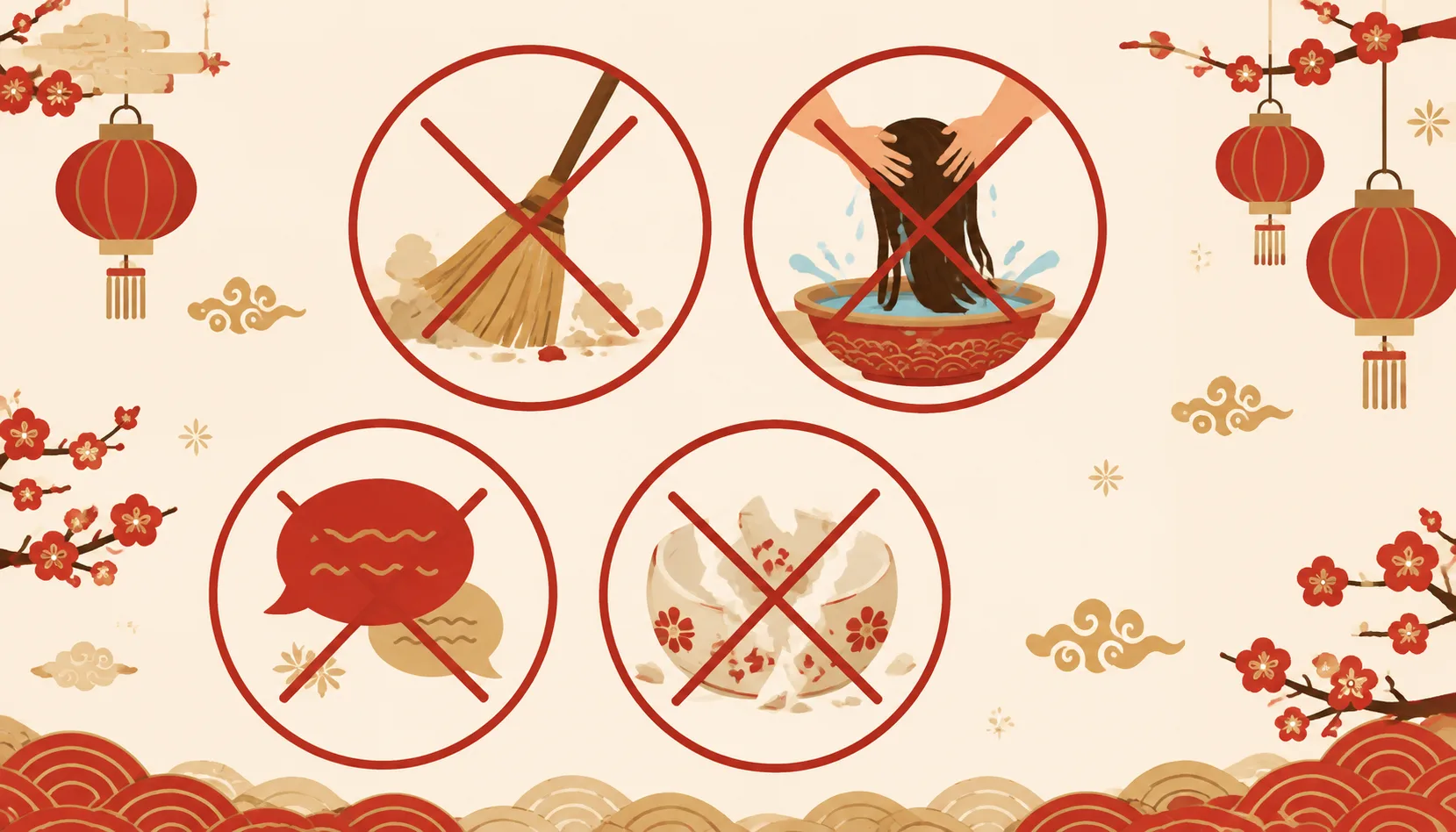
Chinese New Year Taboos: What You Cannot Do on Spring Festival Day (2026)
On Chinese New Year's Day (正月初一, Zhēngyuè chūyī), the major rules are: no sweeping, no taking out trash, no using knives or scissors, no washing hair or bathing…
Read the guide →
Invited to Chinese New Year's Eve Dinner? Complete Etiquette Guide for Foreigners (2026)
If a Chinese person invites you to their family's New Year's Eve dinner (年夜饭, nián yèfàn): this is rare, meaningful, and not to be declined. Bring a fruit baske…
Read the guide →