Drinking with Chinese Friends: What to Expect at Casual Gatherings
Quick answer
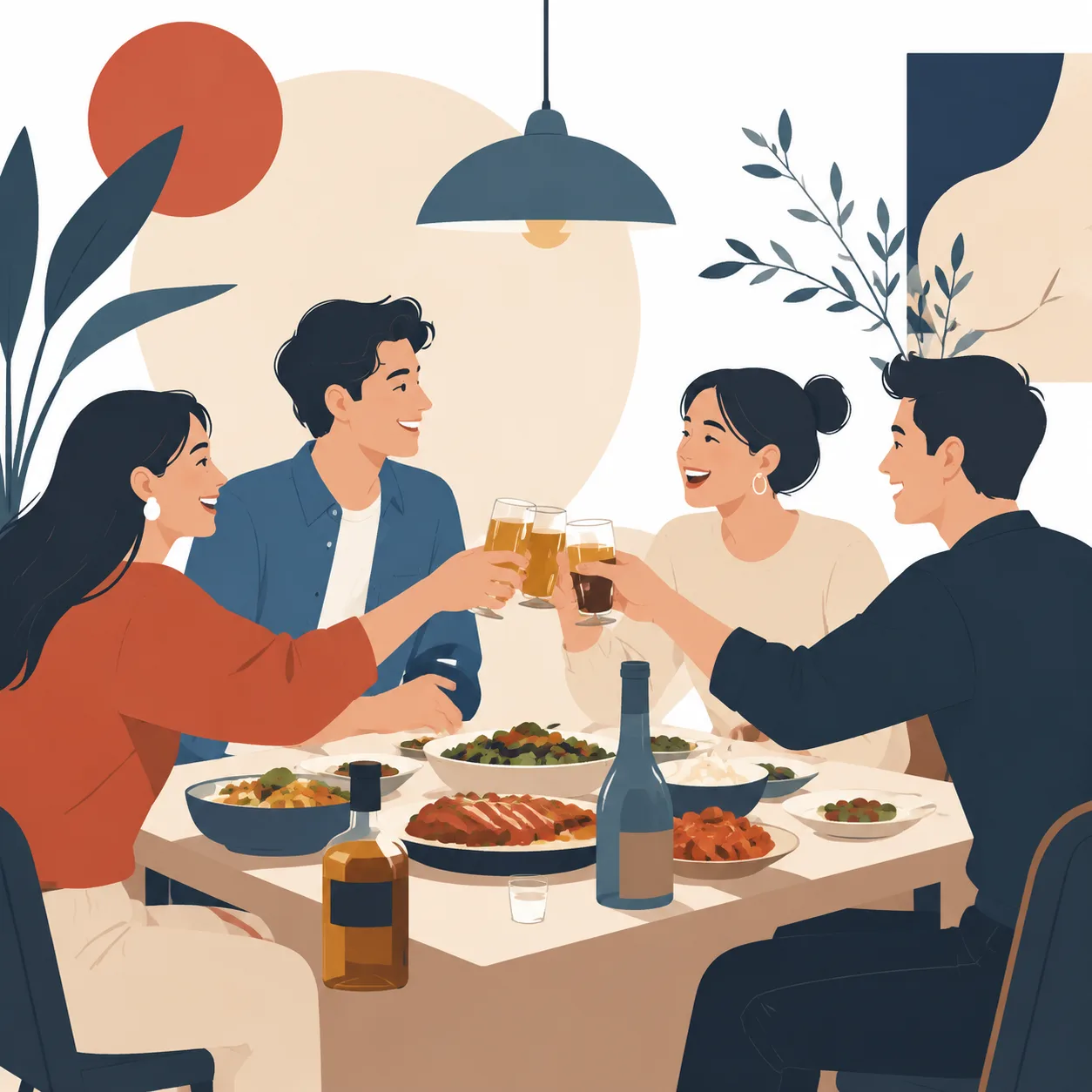
Drinking with Chinese friends is far more relaxed than a business banquet. Beer replaces baijiu, seating is flexible, games are common, and the general vibe is "have fun." But a few principles hold: whoever organized the dinner pays, the oldest person still gets some deference, and if you initiate a toast, you should mean it.
Quick Answer
Drinking with Chinese friends is far more relaxed than a business banquet. Beer replaces baijiu, seating is flexible, games are common, and the general vibe is "have fun." But a few principles hold: whoever organized the dinner pays, the oldest person still gets some deference, and if you initiate a toast, you should mean it.
DO
- Propose toasts freely — friends' dinners have no strict sequence
- Play drinking games if invited — refusing to join can feel anti-social
- Order beer, highballs, or wine — baijiu isn't required at casual dinners
- Eat constantly — the food is genuinely the point, not just a backdrop
- Let the dinner run naturally — there's no signal to leave, just go when energy winds down
- If you're the youngest at the table, pour drinks for others — it's a gesture of respect
- Laugh at the game losses — the whole point is fun, not winning
DON'T
- Don't suggest splitting the bill at the end — it's awkward and reads as "you're not my real friend"
- Don't stay completely silent and phone-scrolling — you're expected to be present
- Don't refuse every toast — even declining half with a smile is better than declining all
- Don't get so drunk you need to be carried out — losing composure is embarrassing for everyone
- Don't propose a toast to someone's face and then barely sip — mean what you offer
WHY Friends' Dinners Are Different
Confucian hierarchy still exists at friends' dinners — the oldest person gets first choice of food, younger people pour for older ones — but the atmosphere is genuinely warm and flexible. The shared goal is enjoyment and connection, not ritual performance.
Beer (啤酒, píjiǔ) is the social lubricant at most casual dinners, not baijiu. You can drink at your own pace. The toasting is frequent but informal — someone says ganbei, you drink whatever's in your cup, conversation continues.
The games are where it gets really interesting.
Common Chinese Drinking Games
Finger guessing (划拳, Huáquán): Two players simultaneously shout a number (0–10) while throwing out fingers on one hand. Both thrown fingers added together — whoever called the total correctly wins; the loser drinks. Extremely loud, fast, and surprisingly addictive. You don't need Chinese for this — numbers work in any language.
Dice shaking (骰子, Tóuzi): Each player has a cup with 5 dice, hidden from others. Players take turns guessing how many dice of a certain number exist across all cups combined. Call too high and you drink; call too low and you drink. Losers drink, correct callers are safe. This game can last hours.
Truth or drink: Someone asks a question; you answer or drink. The question is usually embarrassing or personal — "What's the most embarrassing thing you've done?" etc. Good for language learners because even struggling to answer is entertaining.
Phone stack (手机叠叠乐): Everyone puts their phone face-down in a stack at the start of dinner. First person to check their phone pays for the meal or drinks whatever the group decides. Simple but effective — promotes genuine conversation.
Beer Culture at Casual Dinners
Beer at Chinese friends' dinners is usually:
- Tsingtao (青岛) or Snow (雪花) — the most common
- Served in large bottles (600ml) shared at the table
- Poured into small glasses (not drunk from the bottle, except at barbecue spots)
- Drunk in ganbei gestures but not required to finish the glass each time
Local variation: In some regions (especially southern China and Guangdong), yum cha (drinking tea) culture means casual gatherings are increasingly tea-based, especially during the day.
Baijiu at friends' dinners: Still appears, especially in northern China, among older generations, and at birthdays or milestone occasions. But among urban 25–35-year-olds, baijiu is increasingly optional.
The Person Who Organized It Pays
This rule is absolute at friends' dinners, just like business:
Whoever said "let's have dinner" and made the reservation covers the bill. This isn't an imposition — it creates a cycle of reciprocity. Next time, someone else invites, and that person pays.
If you've been invited, you can:
- Make a token gesture toward paying (expected)
- Offer to cover the next one ("My turn next time")
- Order a round of drinks or dessert to contribute
If you genuinely want to split costs, the only time this is comfortable is when you explicitly organize it that way from the start: "Let's do a hotpot dinner — everyone chips in ¥80." This needs to be announced upfront, not sprung at the end.
Regional Variations in Friend Drinking
Northeast China (Dongbei) / Shandong:
- High-volume drinking culture — friends genuinely drink a lot
- Baijiu and beer both common
- Loud, enthusiastic, physically expressive toasting
- "I'll drink three cups if you drink one" offers are common
Sichuan / Chongqing:
- Hot pot + beer = the default setting
- Everyone sweating, everyone eating, very casual
- Less rigid hierarchy at the table
- Mahjong often follows dinner
Jiangsu / Zhejiang / Shanghai:
- More refined atmosphere even among friends
- Wine and craft beer increasingly popular
- Conversations can be more intellectual and measured
- Less pressure to drink heavily
Guangdong:
- Dim sum culture is the dominant social eating ritual
- Afternoon tea (yum cha) often replaces evening alcohol for many friendships
- When drinking does happen, it's often beer at a seafood restaurant
Real-Life Examples
- An American expat in Chengdu was invited to a hot pot dinner by his neighborhood WeChat group (15 people he barely knew). He sat down, had no idea what the games were, and watched for the first two rounds. On the third round he joined the dice game with enthusiastic enthusiasm despite losing immediately. He got applause. By midnight he'd made five close friends.
- A British teacher in Xi'an was at a dinner and the group started finger guessing. She watched twice, then said "Teach me!" in Chinese. Three people immediately started teaching her at once. She lost spectacularly. The table was delighted. She's still invited to that group's dinners three years later.
- An Australian couple in Shanghai split the bill at a dinner with Chinese friends by accident — they handed over a WeChat transfer for "our half" before the host could pay. Their Chinese friends were too polite to say anything, but one couple quietly told them later: "Next time, let us take turns — you'll host next month." This was the relationship-repair move.
FAQ
Q: What if I genuinely can't drink at all? A: Just say so upfront and participate in everything else with full energy. Order juice or tea, raise your cup for every toast, and be a fun presence. Your friends will not care — they want you there, not your alcohol consumption.
Q: Is it okay to bring extra people to a friends' dinner? A: Ask first. WeChat the organizer: "Can I bring [name]?" Don't just show up with someone. The organizer has planned for a group size and is paying — adding people is a financial and logistical decision.
Q: What time do these dinners usually end? A: Friends' dinners in China often run until midnight or later, especially if there's a move to KTV or mahjong afterward. If you have an early morning, say so at the start — "I have to leave by 11" — so nobody's surprised when you go.
Q: Is it rude to not eat something? A: No — just say "I'm allergic to X" or "I don't eat Y for personal reasons" and that dish will be noted. Trying everything else is the spirit of the table. You don't have to eat everything, but showing curiosity about the food is always warmly received.
Q: What do I bring? A: Nothing is required for casual dinners. But showing up with a six-pack of beer, a bottle of nice baijiu, or some snacks is always welcomed. "I brought something to share" immediately raises your status at the table.
What Chinese People Actually Say
- 干杯 | gān bēi | Cheers/Bottoms up | Say when raising glass for a toast; everyone drinks together.
- 我先干为敬 | wǒ xiān gān wéi jìng | I drink first as respect | Use to show politeness before others drink; shows humility.
- 感情深一口闷 | gǎn qíng shēn yī kǒu mèn | Deep friendship, one gulp | Said to close friends; means drink all at once to show bond.
2026 Reality Check
2026 Reality Check: Traditional Chinese drinking etiquette—mandatory toasts,refusing drinks as rude, and pressing baijiu on guests—is fading fast, especially in urban areas.
Gen Z vs. Older Generations: Young professionals (25-35) now often prefer casual beer or wine sessions. Pressuring someone to drink is increasingly seen as rude, not hospitable. Many skip alcohol entirely without judgment. Boomers and older Gen X still observe traditional rules, especially in business settings.
Beijing/Shanghai vs. Smaller Cities: Tier-1 cities have adopted Western-style relaxed drinking culture. Younger crowds split bills, skip toasts, and don't insist on finishing drinks. In smaller cities and rural areas, traditional etiquette persists stronger—refusing a drink can still cause social friction.
Bottom line: The old rules are weakening but not dead. Context matters—family gatherings, business dinners, and regional norms still carry weight. Always watch what locals do before drinking.
Frequently asked questions
Can I refuse a toast at a casual Chinese dinner without offending anyone?
Yes, absolutely. At casual gatherings, toasting is optional, not mandatory. Simply say 'sui bian' (casually) or hold up your drink and take a small sip. Friends won't pressure you like at business banquets. If you're driving or taking medication, just mention it — Chinese friends will understand and may even help you deflect further offers.
What games are commonly played while drinking with Chinese friends?
The most popular is 'guess fingers' (划拳), a hand-gesture game where you shout numbers. Another is dice games, especially in southern cities like Guangzhou or Shenzhen — players shake cups and guess total dice values. Losers drink small amounts of beer. You can also suggest simple games yourself; the point is fun, not skill.
How do I handle paying the bill at a casual Chinese dinner?
The person who invited everyone typically pays, and this is rarely split. If you want to show gratitude, offer to pay — but expect your friend to refuse. A common compromise: one person pays for dinner, another buys drinks or snacks afterward. Never insist too hard; it can create awkwardness. Just say 'next time, it's on me.'
Is it okay to drink less or slower than everyone else at a casual gathering?
Totally fine. Casual drinking in China is about atmosphere, not volume. You can sip your beer while others down glasses. If someone toasts you, raise your glass slightly lower than theirs and take a modest sip. Nobody will count your drinks at a friend's dinner. The only rule: don't fake drinking by pouring it out secretly — that's disrespectful.
What if I accidentally break a glass or spill a drink during the evening?
Don't panic. Spills happen, especially after a few rounds. Say 'duibuqi' (sorry) casually and help clean up. Breaking a glass is sometimes seen as good luck in Chinese culture, so friends may laugh it off and even say 'sui sui ping'an' — a blessing for safety. The host will handle the mess; just don't make it a big deal.
Can I bring my own alcohol or snacks to a casual Chinese gathering?
Yes, but it's optional. Bringing a bottle of craft beer or a dessert shows thoughtfulness, especially if you're visiting someone's home. However, at a restaurant gathering, it's more common to just show up. If you bring something, don't expect it to be opened immediately — the host may save it for later. In northern China, bringing extra alcohol is seen as generous; in the south, it's less expected.
Try our tools
Related guides
How Ganbei Works in China: Toasting Guide for Foreigners
Ganbei (干杯, gānbēi) means "empty the cup." When someone says it to you directly, finish your drink. When proposing a toast, always hold your cup lower than the …
Read the guide →
Chinese Drinking Culture Explained: A Foreigner's Complete Survival Guide
Chinese drinking culture is a structured social ritual, not just a meal. The table becomes a live map of relationships, respect, and trust — and knowing the unw…
Read the guide →
Baijiu Guide for Foreigners: What It Is, How to Drink It, What to Expect
Baijiu (白酒, báijiǔ) is China's national spirit — clear, 50–60% alcohol, and intensely flavored. At a formal banquet, you will very likely encounter it. The key …
Read the guide →