Chinese Company New Year Party (年会) Guide for Foreigners: Toasting, Performances, and Prizes
Quick answer
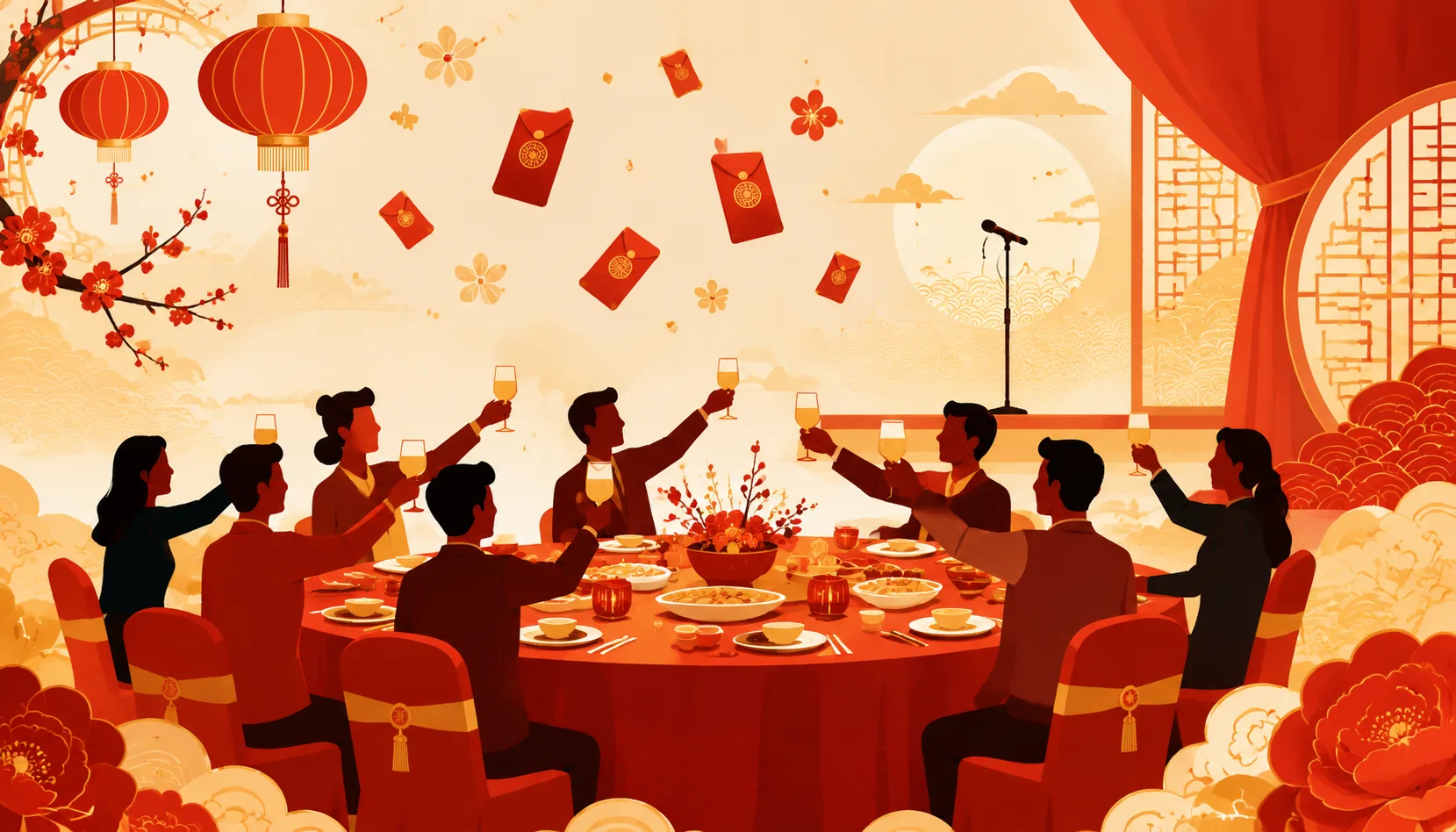
China's company New Year party (年会, Nián Huì) is a combination of: leadership speeches, employee performances, a banquet with toasts, and a prize draw. If you're asked to perform — do it. Refusing marks you as unsociable. When toasting with managers: stand up, hold your glass with both hands, keep your glass rim lower than theirs. If you win a prize: react with visible, enthusiastic happiness. This is a "be seen" event, not just dinner.
Quick Answer
China's company New Year party (年会, Nián Huì) is a combination of: leadership speeches, employee performances, a banquet with toasts, and a prize draw. If you're asked to perform — do it. Refusing marks you as unsociable. When toasting with managers: stand up, hold your glass with both hands, keep your glass rim lower than theirs. If you win a prize: react with visible, enthusiastic happiness. This is a "be seen" event, not just dinner.
What Is the 年会?
One to two weeks before Spring Festival, most Chinese companies hold an annual party. The 年会 is simultaneously:
- A closing ceremony for the work year
- A company loyalty event
- A structured social ranking display
- An opportunity for individuals to build goodwill with colleagues and leadership
The Western equivalent: Imagine your office Christmas party, but with a talent show enforced by management, a seating chart that reflects organizational hierarchy, a required toast sequence, and the entire company watching to see who stands out (positively or negatively).
The 年会 is not optional. Attendance is expected. Your behavior there is observed and remembered.
Before You Go: The Basics
Dress Code
Semi-formal + festive. This is not a black-tie dinner and it's not casual Friday.
- Men: collared shirt + blazer is the baseline. A dark suit with a red tie or pocket square is excellent. A red sweater under a blazer is completely appropriate.
- Women: a dress, smart separates, or a qipao (旗袍, traditional Chinese dress) if you want maximum cultural points.
Add red. At minimum: a red tie, red scarf, red accessories. Red at a Spring Festival event signals cultural awareness and celebratory spirit. It's noticed and appreciated.
Avoid: Full black, full white (mourning associations), or anything that reads as deliberately casual (jeans, sneakers).
Timing
Arrive on time or slightly early. The 年会 typically starts with leadership speeches — being late is visible and poorly noted.
The Program: What Happens and When
Most 年会 follow a similar structure:
1. Opening: Leadership Speeches (领导讲话)
The senior leadership of the company will speak — thanking employees, reviewing the year, setting tone for the next year. This section requires your full attention. No phone. No side conversations. Nod at appropriate moments.
You're not expected to speak. But if a senior leader directly acknowledges you ("我们还有来自XX的Jack"), stand up, smile, and say "谢谢,新年快乐!" (Xièxie, xīnnián kuàilè!) — short and warm.
2. Employee Performances (节目表演, Jiémù biǎoyǎn)
This is the cultural stress point for foreigners. Chinese companies routinely ask employees to prepare and perform short acts — singing, dancing, comedy sketches, magic tricks, group dances.
If you are asked to perform:
Do not refuse. Declining a performance request at a company New Year party is the single most socially costly move you can make. The Chinese concept of "合群" (héqún — fitting in with the group) is central to workplace relationships. A foreigner who participates — even badly — is remembered as warm and fun. A foreigner who refuses is remembered as cold and aloof.
What to do: Prepare something. Options:
- Sing a Chinese song (月亮代表我的心 — "The Moon Represents My Heart" is universally known and beloved; singing even one recognizable verse in any form will bring the house down)
- Teach the audience a song or dance from your country (frame it as cultural exchange)
- Tell a short joke about cultural differences (foreigner-in-China humor lands very well)
- Do a "magic trick" (even a basic card trick is fine)
The power move: Sing one Chinese song (月亮代表我的心 or 甜蜜蜜 / 恭喜恭喜). You don't need to know the whole song — knowing one verse and the chorus is enough. The audience's reaction to a foreigner singing a Chinese classic with any competence is disproportionate delight.
If truly stuck: Get a Chinese colleague to teach you a group dance in the 2–3 days before. Doing it badly with genuine enthusiasm is completely fine.
3. The Banquet (聚餐, Jùcān)
Dinner is served at round tables. Seating is typically hierarchical — you may or may not be seated near leadership, but be aware that where you sit reflects how you're regarded.
Table etiquette during 年会:
- Wait for leadership to be seated and to indicate eating can begin
- Don't start drinking before the first toast
- Drink in moderation — being visibly drunk at a company event is a serious reputation risk
4. The Toast Sequence (敬酒, Jìng Jiǔ)
The toast protocol at a 年会 is structured and important.
When leadership comes to your table to toast:
- Stand up when they approach
- Pick up your glass with both hands
- As they raise their glass, tilt yours so your rim is lower than theirs — this is the single most important physical signal of respect in Chinese drinking culture
- Say: "感谢领导!新年快乐!" (Gǎnxiè lǐngdǎo! Xīnnián kuàilè!) — "Thank you, [title]! Happy New Year!"
- Drink the amount indicated (a sip is acceptable; a full drink shows enthusiasm)
If you don't drink alcohol: "我不喝酒,以茶代酒,敬您!" (Wǒ bù hē jiǔ, yǐ chá dài jiǔ, jìng nín!) — This is completely accepted and respected. The gesture matters, not the alcohol.
Toasting others at your table: Go around your table after leadership has done their round. Toast your colleagues. Say "新年快乐!合作愉快!" (Xīnnián kuàilè! Hézuò yúkuài!) — "Happy New Year! Pleasure working together!" This builds peer relationships and is noticed by leadership as socially skilled behavior.
5. The Prize Draw (抽奖, Chōujiǎng)
Most 年会 include a prize draw. Prizes range from cash and electronics to household items, gift cards, and bottles of liquor.
If you win:
React visibly and enthusiastically. Walk to the front, accept the prize with both hands, face the room, and smile broadly. If there's a microphone: say something brief — "新年大吉!谢谢公司,谢谢大家!" (Xīnnián dàjí! Xièxie gōngsī, xièxie dàjiā!) — "Great luck for the New Year! Thank you company, thank you everyone!"
Why this matters: In Chinese social culture, winning a prize and reacting flatly (a Western "cool" response) reads as ingratitude. The company has spent money and effort on this event. Your enthusiasm is a social gift back to the organizers. Your excitement is their reward. Perform it generously.
If you don't win: Clap enthusiastically for those who do. The quality of your audience behavior when others win is also observed.
The Moments That Build Your Reputation
High-impact moves:
- Perform at the talent show without complaining (even badly)
- Hold your glass lower than leadership during toasts
- Deliver 2–3 lines of Chinese at the right moment ("感谢领导!新年快乐!合作愉快!")
- Show genuine enthusiasm when others perform or win
- Stay for the full event (leaving early = signals the company event isn't worth your time)
Reputation-damaging moves:
- Refusing to perform when asked
- Holding your glass higher than leadership's during toast
- Being on your phone during speeches
- Being conspicuously drunk
- Leaving before the prize draw
The Day-After Follow-Up
The first workday after New Year's break: say "开工大吉!" (Kāigōng dàjí!) — "A prosperous start to work!" to your colleagues. This is the correct greeting for the first day back.
Your manager may distribute 开工利是 (Kāigōng lìshì — first-workday red envelopes). Accept with both hands and say "谢谢,开工大吉!" (Xièxie, kāigōng dàjí!). Don't refuse; don't open it in front of them.
FAQ
Q: I was told the 年会 talent show is optional. My manager said "don't worry if you don't want to." Is it actually optional? A: The spoken "it's optional" and the socially observed "it's optional" can differ. Ask your closest Chinese colleague privately: "你觉得我真的不表演会不会有影响?" (Do you really think it will affect anything if I don't perform?) Trust their honest answer. In most companies, participation is strongly preferred, even if officially framed as voluntary.
Q: What if I genuinely cannot perform anything? I have no talents. A: Everyone has something. Read a poem. Do 5 pushups as a "feat of strength." Draw a (possibly bad) portrait of your manager. Teach the audience to say "Happy New Year" in your language and have everyone repeat it together. The silliest acts often get the best response — the audience is not judging competence, they're judging enthusiasm and willingness.
Q: The 年会 is using a lot of baijiu for toasting. I really cannot drink it. What do I do? A: Be upfront and proactive. Before the toasting starts, tell the person next to you: "我对白酒过敏,我用茶代酒,希望领导理解。" (I'm allergic to baijiu — I'll use tea to toast, I hope leadership understands.) Most managers will completely respect a stated allergy or tolerance issue. Just don't claim an allergy if you simply prefer not to drink — that's different from a genuine limit.
What Chinese People Actually Say
- 敬酒 | jìng jiǔ | to toast/cheers | Raise glass and say when initiating toasts at tables
- 抽奖 | chōu jiǎng | prize draw | Used when announcing or participating in prize drawings
- 拜年 | bài nián | New Year greeting | Say when greeting colleagues and superiors
2026 Reality Check
Toasting Etiquette: The "dry cup" (干杯) tradition is fading in big cities. In Beijing and Shanghai, younger workers often just sip. Gen Z sees forced drinking as outdated. But in smaller cities and with older leadership, finishing your drink still matters—refusing can look disrespectful.
Performances: Mandatory talent shows are declining in 2026. Many companies now offer optional activities or skip them entirely. Gen Z prefers casual gatherings over forced karaoke. Tier-2 and Tier-3 cities still hold onto the tradition more than Shanghai.
Prize Draws: Still popular everywhere. Cash and gadgets remain the top prizes. Digital red envelopes (digital hongbao) have largely replaced physical gifts in tech companies.
Bottom Line: Formalities are softening in urban, younger workplaces. Traditional expectations persist where hierarchy is stronger. When in doubt, watch your host.
Frequently asked questions
What should I do if my Chinese boss asks me to perform at the year-end party?
Say yes enthusiastically, even if you're terrified. A simple song, a magic trick, or even a short comedy skit works. Colleagues expect foreigners to do something memorable — a bad performance is still better than a refusal. Prepare something simple in advance, and if you truly can't perform, offer to co-host or tell a short story.
How do I properly toast my Chinese manager at the annual party?
Stand up, hold your glass with both hands, and make sure your glass rim sits slightly lower than theirs. Look them in the eye, say a short blessing like 'gong xi fa cai' (happy new year) or 'xin ku le' (thanks for your hard work), then drink. Don't drain the glass unless they do — follow their lead.
Can I skip the party if I'm shy or busy?
Technically yes, but it's a bad career move. The 年会 is where managers notice who's a team player. If you skip, you'll be remembered as 'that foreigner who doesn't participate.' If you absolutely must miss it, tell your boss personally in advance, and offer to help with setup or a prize donation to show goodwill.
What happens if I win a big prize in the lottery draw?
React with loud, visible excitement — clap, cheer, maybe even do a happy dance. Winners who look disappointed or bored are seen as ungrateful and bad luck for the company. After the reaction, thank the boss and the organizer, and if it's a large cash prize, consider buying a round of drinks for your team to share the joy.
Is it okay to drink alcohol if I don't drink or am driving?
Yes, but you must handle it socially. When toasting, raise your glass, touch it to theirs, and take a tiny sip or just wet your lips. Don't announce you're not drinking — that kills the mood. If pressed, say 'dui bu qi, wo zai chi yao' (sorry, I'm on medication) or 'wo kai che' (I'm driving). Nobody will force you after that.
How is the 年会 different in big cities versus smaller companies?
In big cities and tech companies, the party can be a huge production — rented venues, professional hosts, and expensive prizes like iPhones. In smaller cities or traditional firms, it's more intimate: a restaurant banquet, homemade performances, and modest gifts like red envelopes. Regardless of scale, the social rules are the same — participation and enthusiasm matter more than the budget.
Try our tools
Related guides
Chinese New Year Survival Guide for Foreigners: What to Do, What Not to Do (2026)
Spring Festival is China’s biggest holiday, a family reunion that dwarfs Western celebrations. If invited to New Year’s Eve dinner, arrive early, bring fruit or…
Read the guide →
Chinese Workplace Culture: The Complete Guide for Foreigners
Chinese workplaces run on three hidden pillars: 先做人后做事 (build relationships before doing business), 面子 mianzi (public face and dignity), and 关系 guanxi (relation…
Read the guide →
How to Communicate with Your Chinese Boss: A Practical Guide
Never challenge your Chinese boss publicly, even when you're right. Use a three-step private formula — affirm the overall idea, add your suggestion, then lower …
Read the guide →