What should foreigners know about Chinese weddings, cǎilǐ, and wedding photo culture?
Quick answer
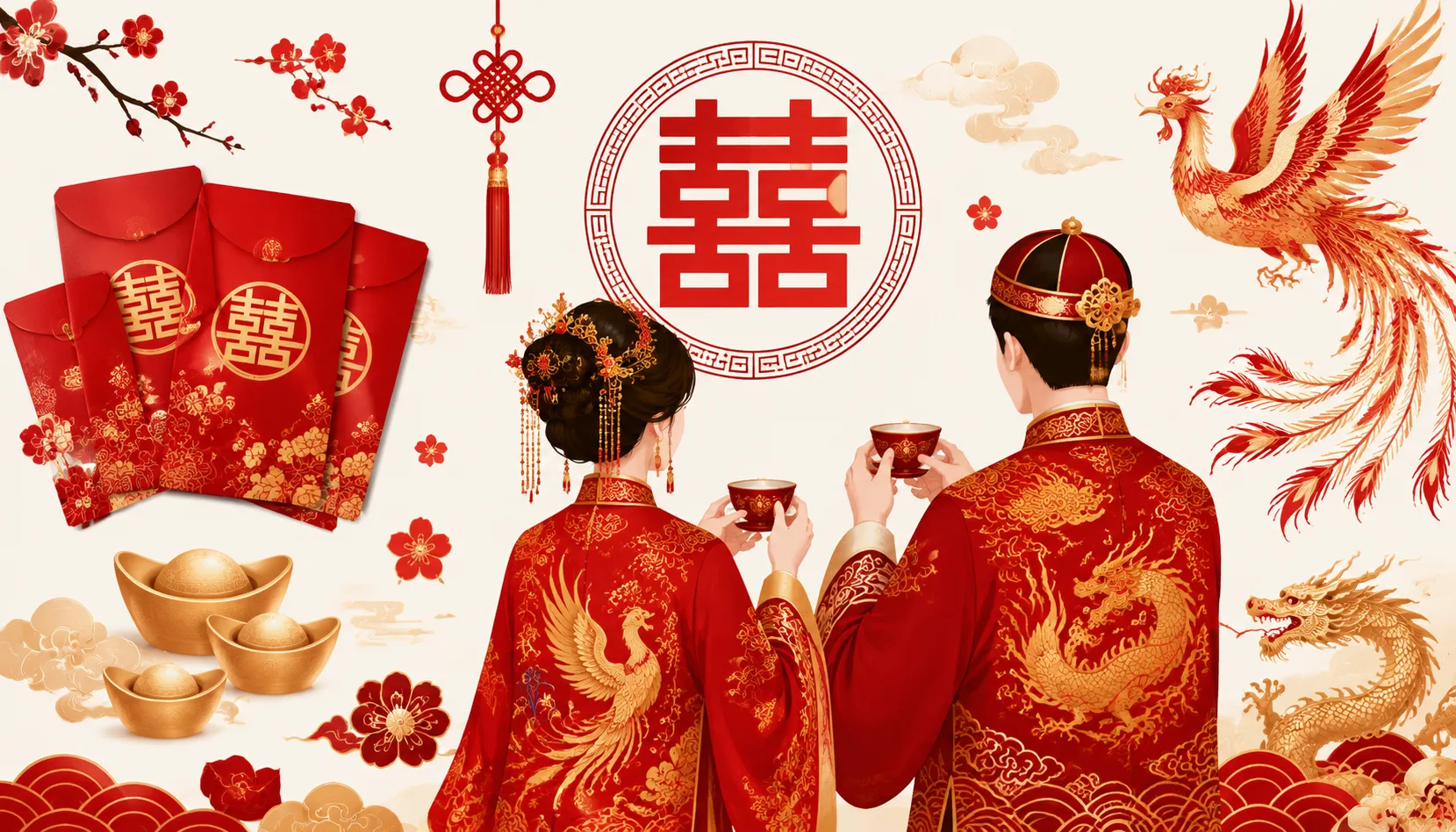
Chinese weddings involve rituals foreign partners rarely expect: cǎilǐ (bride price), elaborate pre-wedding photo shoots, multiple toasting rounds, and sometimes two ceremonies (one in each country). The most important principle is that the couple aligns privately first, then presents a united position to both families.
The Chinese Wedding Banquet: What You're Actually Walking Into
A Chinese wedding reception is not a quiet sit-down dinner. It is a banquet — loud, celebratory, and built around a specific social logic. Guests are seated by relationship tier (family first, then friends, then colleagues). The couple moves table to table offering toasts throughout the evening, which means they often eat very little themselves.
Key things to know as the foreign partner:
- Arrive on time or slightly early. Unlike some Western weddings where guests drift in, a Chinese banquet starts at a defined time and empty seats are noticed.
- The envelope (红包, hóngbāo) replaces gifts. Cash in a red envelope is the standard wedding gift. Amount depends on your relationship and your city — in Beijing or Shanghai, ¥500–1000 per person is typical for friends, more for close family.
- Be prepared to gānbēi. The couple will toast you. Drink, or at minimum raise your glass and sip respectfully.
- Do not wear white or black — both are associated with mourning in traditional Chinese culture. Red, gold, and bright colors are safe choices.
Cǎilǐ: Understanding the Bride Price
彩礼 (cǎilǐ) — the bride price — is a tradition in which the groom's family provides money or gifts to the bride's family before marriage. It exists across China but varies dramatically by region, family expectations, and generation.
In some rural areas, cǎilǐ can be ¥100,000–500,000 or higher. In urban, educated families, it may be symbolic or not requested at all. For cross-cultural couples, it is often negotiated based on mutual understanding rather than strict tradition.
How to navigate it as a foreigner:
- Ask your partner directly what their family expects — do not guess or assume it does not apply to you.
- If cǎilǐ is expected and you are willing, frame it as a gesture of commitment and family respect, not a transaction.
- If your values conflict with the concept, discuss this privately with your partner first and present a unified response to both families — not separate conversations that create inconsistency.
The rule that matters most: whatever you agree, agree together before talking to either family.
Pre-Wedding Photo Shoots: A Non-Negotiable Ritual
In China, 婚纱照 (hūnshā zhào) — pre-wedding photography — is as expected as the ceremony itself. Couples typically spend ¥8,000–30,000+ on a full-day or multi-day professional shoot, often at scenic locations, sometimes traveling to another city or country for iconic backdrops.
For foreign partners, this may feel excessive. For Chinese families, it is the visual record of the marriage — displayed at the reception, printed large for the family home, and referenced for decades.
Practical notes:
- This is usually scheduled weeks or months before the wedding day itself.
- The photography package typically includes styling (hair, makeup, multiple outfit changes).
- If budget is a concern, have that conversation early — skipping this entirely is harder to navigate than negotiating a smaller package.
Two Weddings, Two Countries
Many cross-cultural couples hold two ceremonies — one in China (for the Chinese family) and one in the foreign partner's home country. This is increasingly common and generally well-understood by both sides.
What makes it work:
- Decide which is the legal ceremony and which is the celebration early — and communicate this clearly to both families so there is no ambiguity about which event "counts."
- The Chinese ceremony typically comes first, as the bride's family in China expects this. The overseas celebration can follow later.
- Budget separately. Two weddings = two budget conversations. Do not let one family assume the other is covering everything.
- Brief both families on what to expect at the other's ceremony. Your Chinese in-laws at a Western church service and your Western family at a Chinese banquet both need context to feel comfortable and included.
What Chinese People Actually Say
- 恭喜发财 | gōngxǐ fācái | "Congratulations and prosperity" | Used in red envelopes; say when giving gifts or toasting.
- 百年好合 | bǎi nián hǎo hé | "Wishing you a hundred years of harmony" | Traditional wedding blessing; written on scrolls or cards.
- 早生贵子 | zǎo shēng guì zǐ | "May you soon have a precious son" | Common toast; implies blessing for children (politely avoid if couple prefers).
2026 Reality Check
2026 Reality Check: Traditional Chinese wedding customs are fading fast, especially in major cities. The big red ceremonies still happen, but many rituals are now optional or simplified.
Gen Z vs. Older Generations: Young couples increasingly skip traditional elements like tea ceremonies, door games, or the elaborate "hua gai" (bridal veil) rituals. They prefer intimate ceremonies or destination weddings. Parents still push for some traditions, but compromise is common. About 40% of urban Gen Z weddings now blend Chinese and Western elements.
Big Cities vs. Smaller Cities: Beijing and Shanghai couples treat traditions as suggestions—red envelopes (hongbao) are still given, but the amounts are smaller and less ceremonial. In smaller cities and rural areas, traditional customs remain stronger, especially the tea ceremony and bride-fetching rituals. However, even there, younger generations are pushing back against excessive spending and outdated gender roles.
Frequently asked questions
How much money should I expect to pay as cǎilǐ (bride price) in China?
There is no fixed amount — it varies wildly by city and family. In rural areas, sums can range from ¥30,000 to ¥100,000, while in tier-1 cities like Shanghai or Beijing, families often treat cǎilǐ as symbolic, returning it to the couple as a house down payment or gift. Always discuss privately with your partner first, and let them negotiate with their family.
Can we skip the traditional Chinese wedding ceremony and just sign papers?
Technically yes, but be prepared for pushback. Many parents view the banquet and ceremony as essential social proof — it's how they 'recover' gift money they've given to others over the years. A compromise is a small ceremony in China for close family, then a bigger celebration in your home country. Discuss expectations early.
What happens during the multiple toasting rounds at the wedding banquet?
At each table, the couple (or groom) toasts guests, often with baijiu (white liquor), beer, or tea. Guests may stand, drink, and offer blessings. You don't need to finish every glass — sipping is acceptable, and many couples have a 'designated drinker' among friends. Pace yourself; there can be 10–20 tables.
Is it rude to decline a toast or not drink alcohol at a Chinese wedding?
Not necessarily rude, but you should explain politely. Say 'I'm allergic' or 'I'm driving' (even if not true) and raise a tea or water glass instead. The key is to show respect by standing and making eye contact. Your partner should pre-warn their family if you're a non-drinker to avoid awkward pressure.
When should we take the pre-wedding photos, and do we need to wear traditional Chinese clothing?
Book the shoot 3–6 months before the wedding — peak season (spring and autumn) fills up fast. You'll typically have 2–4 outfit changes: a white gown, a qipao or hanfu, and casual wear. Studios provide everything, including makeup and props. You don't need to buy anything; just bring your partner and an open mind.
How do we handle two ceremonies if our families are in different countries?
Common approach: hold the Chinese banquet first (for the Chinese side), then a smaller reception abroad. Plan the legal marriage in whichever country is simpler, but know that China requires both partners to be present at the civil affairs bureau. Budget for two events — the Chinese one is often the pricier, with venue, food, and photography dominating costs.
Try our tools
Related guides
Visiting a Chinese Home: Etiquette Guide for Foreigners
Bring a small gift, arrive 5 minutes late (never early), remove shoes at the door, wait for the host to assign your seat, and let the eldest eat first. Follow t…
Read the guide →
Meeting Your Chinese Partner's Parents: A Foreigner's Guide
Meeting Chinese parents is a major milestone — it signals the relationship is marriage-track. Bring a quality gift (¥300–800), expect interview-style questions …
Read the guide →
Chinese Wedding Gift Money (份子钱): How Much to Give
At many mainland Chinese weddings, guests commonly give cash in a red envelope (份子钱, fènzi qián), but the amount depends on the relationship, location, invitati…
Read the guide →