What do foreigners need to know about China's National Day Golden Week?
Quick answer
China's National Day Golden Week (国庆黄金周) runs October 1–7 — 7 days of public holiday. Almost everything non-essential stops: vendors, many service businesses, and most Chinese colleagues disconnect completely. Plan nothing work-related during this period. Book travel months ahead if you want to go anywhere. The country genuinely goes into a different mode.
What Is National Day Golden Week?
October 1 marks the founding of the People's Republic of China in 1949. The resulting public holiday — 7 days off — has grown into what Chinese people simply call 黄金周 (Huángjīn Zhōu, Golden Week): the longest national holiday of the year and China's biggest domestic travel event.
To calibrate the scale: during Golden Week, roughly 1 billion trips are taken inside China. Tourist sites overflow. Transportation systems strain. Hotel prices in popular destinations triple or quadruple. And nearly every non-essential Chinese worker — from factory worker to middle manager — disconnects completely.
The Dates (Fixed Every Year)
National Day is always October 1. The 7-day holiday is adjusted around it with weekend compensation days — meaning one nearby weekend day becomes a regular workday to extend the break.
| Year | Holiday Period |
|---|---|
| 2025 | October 1–7 |
| 2026 | October 1–7 |
The compensation day: A Saturday or Sunday before or after Golden Week becomes a mandatory workday. Check China's official holiday calendar (published each November) for the exact schedule.
What Actually Happens During Golden Week
Mass Domestic Tourism
Golden Week is China's domestic tourism moment. The Great Wall gets queues hundreds of meters long. West Lake in Hangzhou becomes a sea of selfie sticks. Zhangjiajie, Guilin, Lijiang, Chengdu — everywhere on the Chinese tourist trail is at absolute maximum capacity.
Foreigners who try to travel domestically during this week without booking 2–3 months in advance will find: no train tickets, no hotel rooms at normal prices, and tourist sites that are genuinely unpleasant due to crowds.
The Flag-Raising Ceremony at Tiananmen
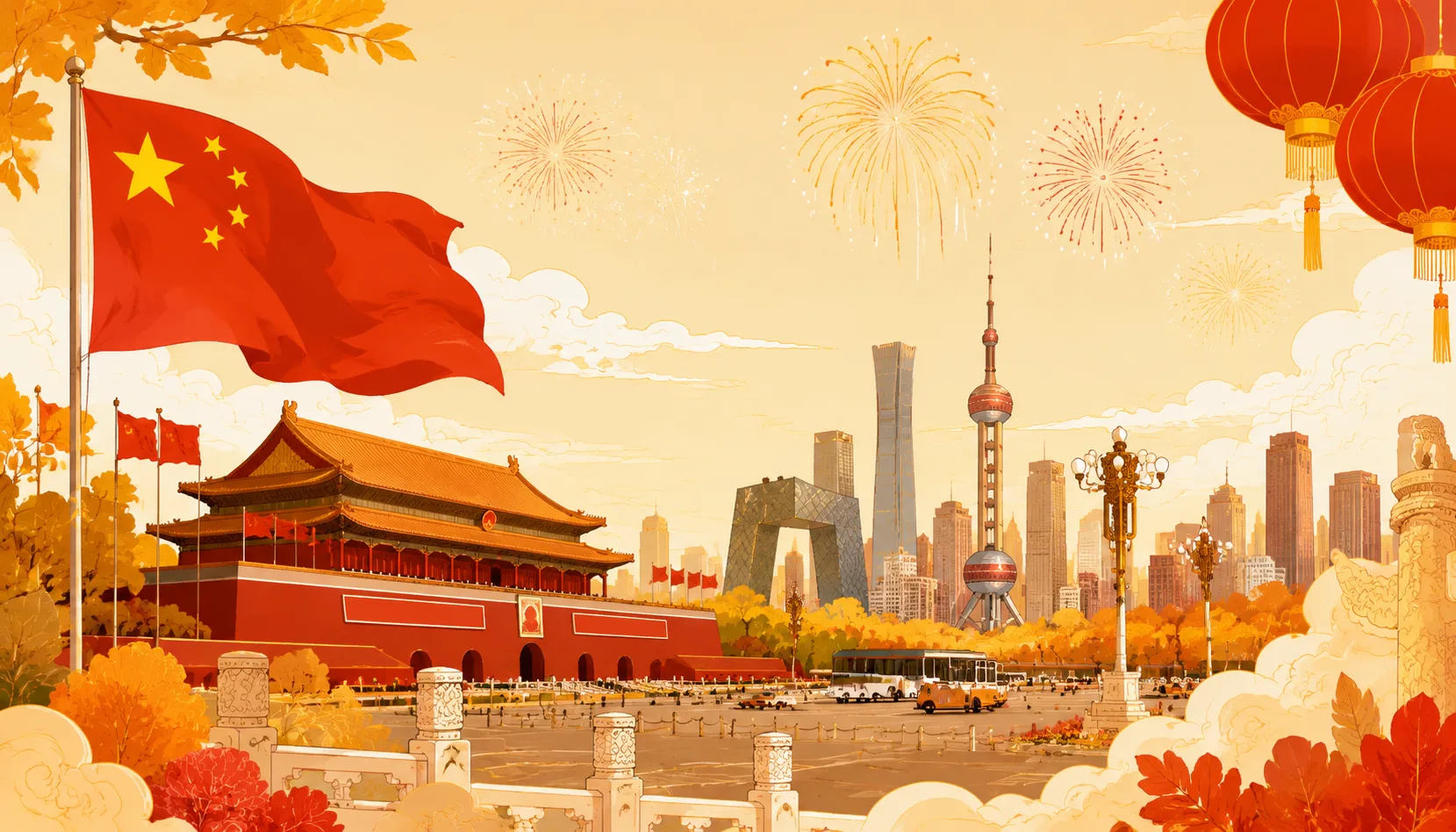
On October 1, the flag-raising ceremony at Tiananmen Square in Beijing happens at dawn (exact time varies with sunrise — typically around 6:00–6:10 AM). Tens of thousands of people gather. If you want to experience it, arrive by 4:30 AM and accept standing in a very large crowd.
The National Mood
Streets fill with national flags. Red decorations appear everywhere. There is a genuine surge of patriotic feeling — not performative, not cynical. For many Chinese people (especially those from smaller cities), National Day is the one time of year their national identity is felt physically and collectively.
As a foreigner, be a respectful observer. This is not the time to debate politics, make comparisons, or be visibly unimpressed. Treat it the way you'd hope someone would treat your country's independence celebration.
How Golden Week Affects Your Work Life
This is the most practically important section for foreigners working with Chinese partners or teams:
| Period | What's Happening | What to Do |
|---|---|---|
| 2 weeks before | People booking travel, minds partly elsewhere | Front-load approvals and decisions you need |
| Week before | Urgency peaks — finishing work before the break | Finalize anything time-sensitive by Sept 28 |
| Oct 1–7 | Near-total disconnect. Emails may not be read | Send nothing non-urgent. Don't chase people. |
| First week back | Slow restart, holiday lag | Gentle re-engagement, not high-pressure asks |
The single most common mistake foreigners make: scheduling an important meeting, deadline, or product launch near Golden Week — then being frustrated when Chinese colleagues don't engage. Plan your annual calendar around Golden Week from the start.
What Foreigners Should Do During Golden Week
- Travel somewhere, but choose wisely. Avoid the obvious Chinese tourist hotspots unless you enjoy crowds. Lesser-known cities — Chengde, Datong, Pingyao, Yangshuo — offer the holiday atmosphere with manageable crowds.
- Experience the national mood. Walk through a decorated shopping district. Watch the flag-raising on TV. The collective energy is genuinely worth witnessing once.
- Plan completely in advance. Accommodation, transport, restaurant reservations in popular cities — everything. Same-day decisions lead to expensive, frustrating outcomes.
- Enjoy the pace. If you don't travel, your city may actually feel calmer. Many Chinese migrant workers return to their hometowns, leaving city centers slightly emptier and quieter.
What Foreigners Must NOT Do
- ❌ Schedule important business meetings Oct 1–7. No one will come. Those who do come won't be mentally present.
- ❌ Send non-urgent work messages during Golden Week. You'll get no response and you'll seem oblivious to how China works.
- ❌ Express contempt or disinterest in the national celebration — even if it's not your holiday, basic respect costs nothing.
- ❌ Try to travel to top destinations without a reservation — you will pay 3× the price and stand in queues for hours.
Golden Week vs Spring Festival: The Key Difference
| Golden Week | Spring Festival | |
|---|---|---|
| Duration | 7 days | 7–10 days (officially), 3–4 weeks (practically) |
| Who travels | Everyone, mostly for tourism | Migrant workers returning home |
| Businesses closed | Tourist and leisure businesses; offices on holiday | Almost everything, for much longer |
| Tone | Celebratory, patriotic, fun | Family obligation, intense, emotional |
| Gift-giving? | No | Absolutely yes |
What Chinese People Actually Say
- 黄金周 | huáng jīn zhōu | Golden Week (Oct 1-7 national holiday) | Use when referring to the entire holiday period
- 人山人海 | rén shān rén hǎi | People mountain people sea (huge crowds) | Use to describe popular tourist spots during holidays
- 错峰出行 | cuò fēng chū xíng | Travel off-peak (avoid rush times) | Use as advice to avoid crowds during Golden Week
2026 Reality Check
2026 Reality Check: Golden Week travel restrictions are largely relaxed. Domestic travel is fully open, though peak-season prices remain high. The "golden week" concept is softening as more workers get flexible paid time off.
Gen Z vs. Older Generations: Younger Chinese increasingly skip the "return to hometown" obligation, preferring overseas trips or staycations. Older generations still prioritize family reunions, though video calls have reduced the pressure to travel physically.
Beijing/Shanghai vs. Smaller Cities: Major cities see mass exodus as workers flee to smaller cities or tourist spots. Smaller cities experience massive traffic jams and hotel shortages. In 2026, many younger workers now "reverse migrate" — staying in big cities to avoid the chaos.
The Bottom Line: The tradition is fading but not dead. The "obligation" to visit family remains strong for those over 35, while Gen Z treats it as just another holiday option.
Frequently asked questions
What actually closes during Golden Week in China?
Government offices, banks, schools, and most corporate offices close for the full 7 days. Many small shops, restaurants, and street vendors shut down, especially in smaller cities. However, large shopping malls, supermarkets, and major tourist attractions stay open — often with extended hours. Hospitals run reduced emergency-only services. If you need a specific service, call ahead to confirm hours before visiting.
Can I travel within China during National Day Golden Week?
Yes, but prepare for chaos. Train tickets sell out within minutes of going on sale — book at least 14 days in advance on 12306. Flights double or triple in price. Popular destinations like Beijing, Xi'an, and Zhangjiajie are packed with domestic tourists. If you must travel, choose less famous spots or travel on October 3-4 when crowds thin slightly. Avoid October 1 and 7, the peak travel days.
Is it true that Chinese colleagues completely disconnect during Golden Week?
Yes, for most people. WeChat messages often go unanswered for days, and email replies wait until October 8. This is a hard cultural boundary — work is rarely discussed. Exceptions exist for emergency roles like healthcare, IT operations, and some foreign-facing industries. Don't expect a response to non-urgent matters. If something is truly critical, send a message before the holiday starts and follow up on October 8.
How should foreigners plan their first Golden Week in China?
Decide early: either commit to a well-planned trip or stay put. If staying, stock up on essentials before October 1 — some neighborhood shops close entirely. Use the week for local exploration: parks, cafes, and museums that stay open are quieter than usual since locals travel out. If traveling, book everything by mid-September. Also prepare for crowds at every major site and bring patience — queues are unavoidable.
Are there any regional differences in how Golden Week is observed?
Yes, noticeably. Big cities like Shanghai and Shenzhen stay more active — international restaurants, expat bars, and delivery services often operate normally. Smaller cities and rural areas shut down more completely, with many shops closed for the entire week. Tourist-heavy provinces like Yunnan or Hainan gear up with festivals, but prices surge. Also note that some companies grant extra days off, extending the shutdown to 8-9 days.
What should I do if I need a visa extension or other government service during Golden Week?
You'll have to wait. Entry-exit bureaus and all government offices close for the full 7 days and reopen October 8. This is critical if your visa expires around this time — apply for an extension before September 25, as processing takes 5-7 working days. If you're already in an emergency situation, call the 12367 immigration hotline — it operates 24/7 but can only provide advice, not process documents.
Try our tools
Related guides
5 Chinese Holidays Foreigners Often Miss: Lantern Festival, Teachers' Day, Chongyang, Winter Solstice & Women's Day
Beyond Spring Festival, Golden Week, and Mid-Autumn, five smaller Chinese holidays matter for foreigners in Chinese social and professional life: Lantern Festiv…
Read the guide →
Chinese New Year Survival Guide for Foreigners: What to Do, What Not to Do (2026)
Spring Festival is China’s biggest holiday, a family reunion that dwarfs Western celebrations. If invited to New Year’s Eve dinner, arrive early, bring fruit or…
Read the guide →
Dragon Boat Festival China: Zongzi, Dragon Boats & What Foreigners Must Know (2026)
Dragon Boat Festival (端午节, Duānwǔ Jié) falls on the 5th day of the 5th lunar month. Eat zongzi (sticky rice dumplings wrapped in bamboo leaves), watch or join d…
Read the guide →