How does China's hospital system work for foreigners, and how do you choose between public, private, and international hospitals?
Quick answer
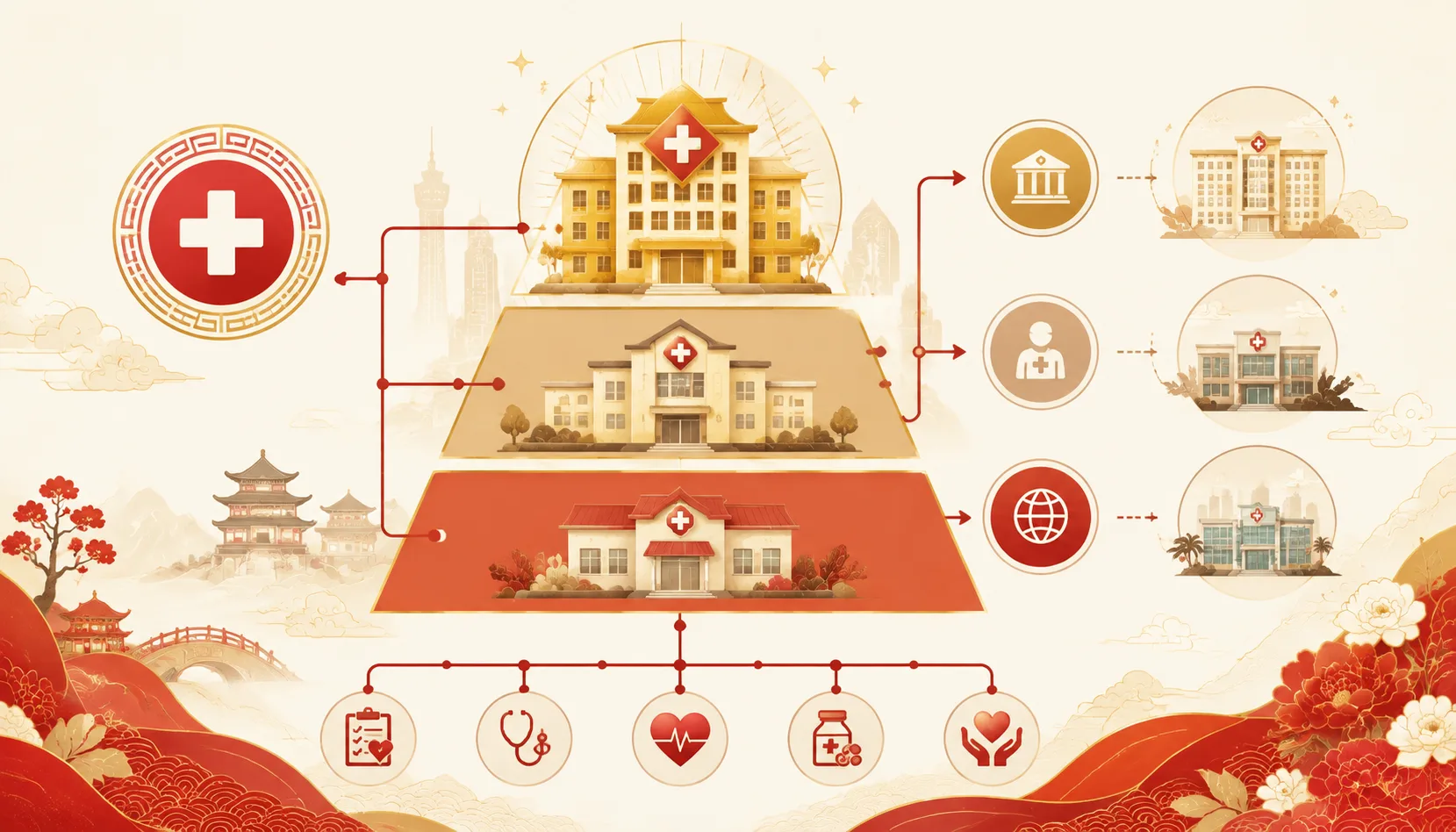
China's hospitals are tiered from Grade 3-A (top-tier, crowded) to community health centers (basic, local). For foreigners, the smart move is often a Grade 2 hospital for common issues, a top-tier hospital's international department for complex care, and a private hospital like United Family for a comfort-first experience. Match your choice to your medical need, not the hospital's prestige.
China's Hospital Tiers: The Basics
When you first arrive in China, the hospital system can seem like a maze. But it's actually organized into a clear three-tier system that determines quality, cost, and crowd levels. Understanding this is your first step to smart healthcare choices.
Hospitals are classified into three grades, with each grade further divided into A, B, and C. The most important for you are the A-levels:
| Chinese | Pinyin | English | What It Means |
|---|---|---|---|
| 三甲 | Sān-Jiǎ | Grade 3-A | Top-tier: best specialists, advanced tech, but extreme crowds |
| 二甲 | Èr-Jiǎ | Grade 2-A | Regional: solid care, fewer people, good for common issues |
| 社区卫生服务中心 | Shèqū wèishēng fúwù zhōngxīn | Community Health Center | Neighborhood clinic: basic care, vaccinations, prescriptions |
Key tip: Don't assume bigger is better. For a cold or a sprained ankle, a Grade 3-A hospital will waste hours of your time. A Grade 2 hospital or community center is often faster and perfectly adequate.
The 三甲 Trap: Why Everyone Flocks There
In China, the 三甲 (Sān-Jiǎ) hospitals are the crown jewels of healthcare. They have the best doctors, the newest equipment, and the most research. But that reputation comes at a cost: extreme crowds.
Chinese patients often self-refer to 三甲 hospitals even for minor issues, because they trust the brand. This means you'll find hallways packed, queues that snake around corners, and doctors who see 100+ patients a day. You might wait 3 hours for a 5-minute consultation.
Here's the reality: For a common cold, a viral infection, or a minor injury, a 二甲 (Èr-Jiǎ) hospital is often the smarter choice. These regional hospitals have competent doctors, shorter waits, and are less overwhelming. You'll get in and out in under an hour for most issues.
Realistic scenario: You wake up with a fever and sore throat. Your Chinese colleague suggests the big 三甲 hospital downtown. Instead, you walk to the 二甲 hospital near your apartment. You register, see a doctor in 20 minutes, get a blood test, and leave with antibiotics — all within 90 minutes. Total cost: ¥200. At the 三甲, you'd have spent half a day and maybe ¥400.
Public vs. Private: The Full Comparison
Public hospitals are the backbone of China's healthcare, but private hospitals are growing fast, especially in major cities. Here's a head-to-head comparison to help you decide:
| Factor | Public (三甲/二甲) | Private (e.g., United Family) |
|---|---|---|
| Cost | Low (subsidized by government) | High (2-5x public, or more) |
| Wait time | Long (especially 三甲) | Short (appointments, minimal waiting) |
| English availability | Limited (but international depts exist) | Fluent English staff |
| Insurance compatibility | Varies; many international plans cover public | Direct billing with major international insurers |
| Environment | Functional, often crowded | Hotel-like, clean, comfortable |
Key insight: Private hospitals are not necessarily 'better medicine' — they offer a better service experience. The doctors are often trained at top Chinese institutions, but the real value is the convenience, language support, and comfort. If you have a complex condition, you might still want a 三甲 specialist.
International Departments: The Best of Both Worlds
Many top public hospitals have an 国际部 (Guójìbù) — an international department. This is a hybrid option that combines the expertise of China's best doctors with a foreigner-friendly experience.
For example, Peking Union Medical College Hospital (北京协和医院) has an international department where you can see top specialists with English-speaking staff, in a quieter, more comfortable setting. You'll pay more than the regular public rate, but significantly less than a full private hospital.
| Chinese | Pinyin | English |
|---|---|---|
| 国际部 | Guójìbù | International Department |
| 特需门诊 | Tèxū ménzhěn | Special Needs Clinic (another name for this) |
Practical tip: If you have a serious or complex condition, seek out the international department of a 三甲 hospital. You get the best medical minds, but with translation support and often direct billing with international insurance. It's a smart middle ground.
However, note that not all 三甲 hospitals have these departments, and they may require a referral or a higher fee upfront. Call ahead to confirm.
Private Hospitals: Comfort and Convenience at a Price
Private hospitals like United Family (和睦家) and Jiahui Health (嘉会) are the go-to for many expats, especially families. They offer a hotel-like experience: plush waiting areas, English-speaking doctors, and predictable pricing.
Here's what you get:
- Appointments that start on time
- Direct billing with most international insurance
- Pediatric care that feels like a Western clinic
- Maternity packages that are popular with expat mothers
But the cost is steep. A simple consultation can run ¥1,000-2,000, and a surgery can be tens of thousands. If you're on a budget, private hospitals are a luxury, not a necessity.
Important warning: The word 'international' in a hospital's name does not automatically mean better doctors. It means the process is more foreigner-friendly — language, billing, and comfort. The medical quality may be excellent, but it's not inherently superior to a top public hospital. For a complex condition, you might still be referred to a public 三甲 for specialized care.
Decision Matrix: Which Hospital for Which Situation
To make it easy, here's a quick guide to choosing the right type of facility based on your situation:
| Situation | Recommended Choice | Why |
|---|---|---|
| Emergency (e.g., accident, severe pain) | Nearest 三甲 or 二甲 emergency room | Public hospitals have 24/7 ERs with full facilities; private may not have ERs. |
| Common illness (cold, flu, infection) | 二甲 hospital or community health center | Fast, cheap, adequate for routine care. |
| Complex diagnosis (e.g., cancer, rare disease) | 三甲 hospital, ideally with international department | Best specialists and equipment; international dept for language support. |
| Chronic disease management (e.g., diabetes, hypertension) | Community health center or 二甲 | Easy access for regular check-ups and prescription refills. |
| Maternity | Private hospital (if budget allows) or 三甲 international dept | Comfort and continuity; private offers more Western-style care. |
Always carry your passport and insurance card. For emergencies, call 120 (ambulance) — but note that ambulances may take you to the nearest public hospital, not necessarily your preferred one.
Practical Tips for Navigating Any Hospital
No matter which hospital you choose, these tips will save you time and stress:
- Bring a Chinese-speaking friend or use a translation app. Even in international departments, staff may not be fluent in English for all procedures.
- Register early. Public hospitals often open registration at 7 AM; online via WeChat or apps like 114 can help you skip lines.
- Know your insurance. Check if your plan has direct billing with specific hospitals. Many international plans have a list of 'network' hospitals.
- Carry a list of your medications and allergies in Chinese. This is a lifesaver in an emergency.
- Don't be afraid to ask for a second opinion. It's common in China, and you can switch hospitals if you're not satisfied.
Finally, remember that the best hospital is the one that fits your specific need. A 三甲 hospital for a cold is overkill; a private hospital for a heart condition might be under-equipped. Use this guide to make an informed choice, and you'll navigate China's healthcare system with confidence.
What Chinese People Actually Say
- 挂号 | guà hào | to register/see a doctor | Always book ahead via app or phone; walk-ins have long waits.
- 医保 | yī bǎo | medical insurance | Bring your card—most public hospitals accept it directly.
- 门诊 | mén zhěn | outpatient department | For non-emergencies; serious cases go to急诊 instead.
2026 Reality Check
2026 Reality Check: Digital booking via apps (WeChat, Alipay) now dominates in major cities—physical queuing is rare in Beijing/Shanghai. Smaller cities still see some walk-ins, but mobile registration is spreading fast.
Gen Z vs Older Generations: Young people book appointments online, prefer private/international clinics for service, and value privacy. Older generations still favor public hospitals for trust, often requiring family accompaniment. The "red envelope" (hongbao) practice has declined significantly in urban areas but persists in some rural regions.
Beijing/Shanghai vs Smaller Cities: Tier-1 cities offer world-class private and international hospitals with English-speaking staff. Tier-2/3 cities rely heavily on public hospitals—wait times remain long, and quality varies. Telemedicine has expanded everywhere, but in-person visits still rule for serious conditions.
Key Etiquette Still Followed: Bringing own medications, respecting doctor time, and having a family member present for elderly patients remain standard across China.
Frequently asked questions
Can foreigners just walk into any public hospital in China without an appointment?
Yes, you can walk in, but expect long waits at Grade 3-A hospitals. For non-emergencies, bring your passport and register at the self-service kiosk or counter. Community health centers rarely require appointments, while top-tier hospitals often have same-day slots but limited English support. Download a translation app and carry cash or WeChat Pay for the registration fee, usually 10–50 RMB.
What is the difference between an international department and a private hospital like United Family?
International departments are wings inside public hospitals offering English-speaking doctors and faster service, but they still use public hospital facilities and can feel clinical. Private hospitals like United Family or Parkway provide a Western-style experience: private rooms, shorter waits, and comprehensive billing in English. The trade-off is cost—private hospitals can charge 3–5 times more for the same procedure.
How do I know if a hospital is Grade 3-A and why does it matter?
Grade 3-A is China's highest hospital rating, displayed on the hospital's sign or website. These are major teaching hospitals with the best specialists and equipment. They matter for complex conditions like cancer surgery or cardiac care. For a sprained ankle or flu, a Grade 2 hospital or community clinic is faster, cheaper, and perfectly adequate—avoid the 3-A crowds unless you truly need top-level expertise.
Is my foreign health insurance accepted at Chinese hospitals, or do I need to pay upfront?
Most public hospitals require upfront payment, even with insurance. You'll pay cash or card, then submit receipts to your insurer for reimbursement. Private hospitals and international departments often have direct billing agreements with major international insurers—ask your provider for a list. Always carry your insurance card and policy documents, and confirm coverage before any procedure to avoid surprise out-of-pocket costs.
What should I do if I have a medical emergency at night or on a weekend?
Head to the nearest hospital's emergency department (急诊室), not a clinic. Public hospital ERs run 24/7 and are equipped for serious cases. Bring your passport and emergency contact info. If you're in a big city, consider calling 120 for an ambulance, but be aware that English support is limited. Private hospitals like United Family have 24-hour emergency care with English staff, but they're pricier—weigh speed and language comfort against cost.
Can I get a prescription filled at any pharmacy, or do I need to use the hospital pharmacy?
You can take your prescription to any licensed pharmacy (药店), which often sells the same drugs at lower prices than hospital pharmacies. However, some controlled medications, like certain antibiotics or painkillers, may only be dispensed at the hospital where you were treated. For chronic conditions, ask your doctor for a long-term prescription (usually up to 30 days) to avoid repeat visits.
Try our tools
Related guides

Can You Give a Clock to a Chinese Person?
Traditionally, no. “Giving a clock” (送钟, sòng zhōng) sounds exactly like 送终 (sòng zhōng), an expression for attending to the dying — so clocks and watches are t…
Read the guide →
Buying Medicine in China: Pharmacy Guide for Foreigners
Look for pharmacies with a green cross sign (药). Most common OTC meds are available without a prescription, but antibiotics and many other drugs require a presc…
Read the guide →
Visiting a Sick Friend in China: Hospital Etiquette Guide
Visit in the afternoon or early evening, keep it to 20–30 minutes, and bring a fruit basket (avoid pears), quality tea, or a red envelope if you're close. Never…
Read the guide →