Can you give a clock to a Chinese person?
Quick answer
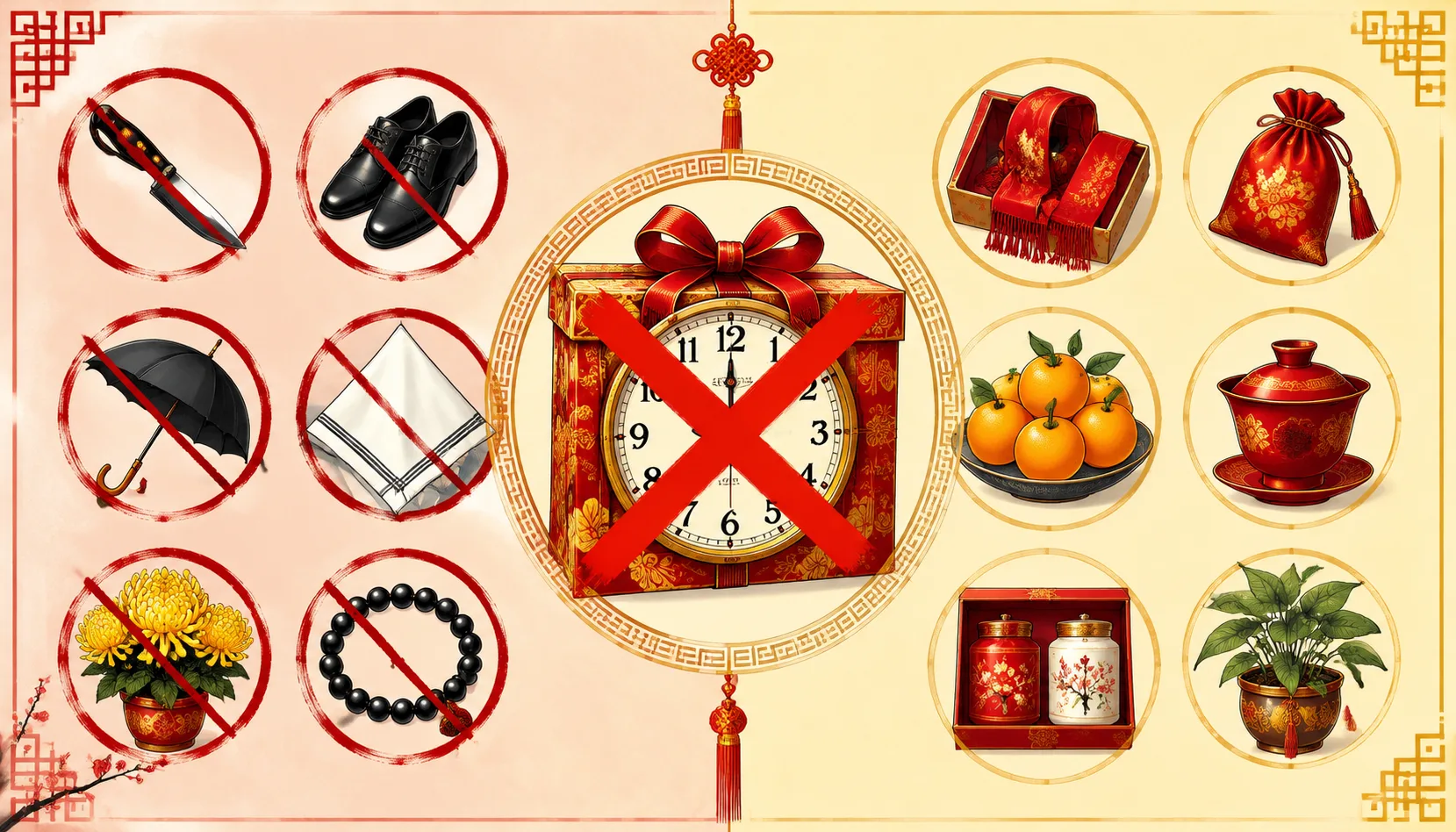
Traditionally, no. “Giving a clock” (送钟, sòng zhōng) sounds exactly like 送终 (sòng zhōng), an expression for attending to the dying — so clocks and watches are the classic unlucky gift, above all for elders’ birthdays. How strongly people feel varies by age, family, and region, but it remains the most famous gift taboo in China.
Don’t Give a Clock (or a Watch) as a Gift

Traditionally, no. In Mandarin, “giving a clock” (送钟, sòng zhōng) sounds exactly like 送终 (sòng zhōng), an expression for attending to the dying and arranging funeral rites — so clocks and watches are the classic unlucky gift, especially for elders’ birthdays. How strongly someone feels varies by age, family, and region, but it remains the most famous gift taboo in China.
Do
- Choose gifts with positive associations instead — quality tea, seasonal fruit, specialty foods, or wine/baijiu for elders.
- Give in even numbers where quantity applies — “good things come in pairs”.
- Wrap gifts in red or other bright colors rather than black or white.
Don't
- Avoid gifting clocks, wall clocks, alarm clocks, and watches — above all as birthday or longevity gifts for elders.
- Don’t give timepieces at openings or business celebrations either.
Why it matters
The taboo is a perfect homophone: 送钟 (sòng zhōng, “give a clock”) is indistinguishable in speech from 送终 (sòng zhōng, “to see someone off at the end of life”). A gift that says “I’ll attend your deathbed” is the last thing anyone wants at a birthday celebration — which is why clocks top every traditional list of gifts to avoid, particularly for older recipients.
What to do instead
- Quality tea or a nice tea set
- Seasonal whole fruit (arranged in even numbers)
- Specialty food or wine from your home region
- Wine or baijiu for elders — 酒 (jiǔ, “alcohol”) puns on 久 (jiǔ, “long-lasting”)
Real-life examples
- A foreign guest brings an elegant imported wall clock to a colleague’s housewarming. The colleague accepts graciously — then quietly asks a coworker later what it “meant”. The guest had unknowingly chosen the single most famous taboo gift.
- A grandfather receives an antique clock for his 80th birthday. Even family members who dismiss the superstition wince: on a longevity celebration, it is the worst-choice gift by tradition.
Traditional vs. modern
Traditional view
Homophone-based gift taboos are centuries old in Chinese culture; 送钟/送终 is the most cited example in etiquette teaching.
Modern reality
Many younger Chinese consider the taboo outdated for themselves — yet still avoid clock gifts out of respect for parents and grandparents. The practical rule: don’t choose one yourself; accept the variation when others do.
How much it matters varies
By region and family: Recognized wherever Mandarin homophones carry weight (mainland China, Taiwan, Singapore, Malaysia); Cantonese-speaking regions have a parallel version of the same taboo.
By generation: Elders and traditional families take it most seriously; among close young friends it may be laughed off — but why risk it when tea and fruit always work?
Chinese terms
Gifts With Unlucky Meanings: Pear, Umbrella, Shoes, Wallet, Cigarettes
Several everyday gifts carry unlucky homophones: pears (梨 lí sounds like 离, “to part”), umbrellas (伞 sǎn sounds like 散, “to scatter”), shoes (鞋 xié sounds like 邪, “evil”, and suggest walking away), wallets (you would be giving away your “wealth luck”), and cigarettes for elders’ birthdays (烟 yān evokes 咽, “to gasp one’s last breath”). Sensitivity varies, but these are the classics to avoid.
Do
- Choose gifts whose names or numbers sound auspicious — wine for elders (久, “long-lasting”), tea, fruit.
- Give in even numbers where quantity applies.
- Use bright, red-toned wrapping rather than black or white.
Don't
- Don’t give pears — above all during festivals and reunions, when “separation” is the last word anyone wants.
- Don’t give umbrellas as farewell or celebration gifts.
- Be careful with shoes around holidays and for elders.
- Don’t give cigarettes as birthday or longevity gifts for elders (“寿不送烟”).
- Avoid gifting your own wallet with money in it as a “lucky” gesture — tradition says the wallet carries the giver’s wealth luck away.
Why it matters
Chinese gift etiquette is dominated by homophones (谐音): the sound of a gift’s name matters as much as the gift itself. A pear says “parting”, an umbrella says “scattering”, shoes say “evil” and “walking away”, cigarettes to an elder say “last breath”, and a wallet carries your own fortune out the door. None of this is logical — it is symbolic language, and knowing it lets you speak it fluently.
What to do instead
- Quality tea — a safe, well-received gift nearly everywhere
- Seasonal fruit in even numbers (skip pears)
- Regional specialty foods
- Wine or baijiu for elders
Real-life examples
- A guest brings a box of pears to a Spring Festival family dinner. The host accepts them graciously but won’t serve them — 梨 sounds like 离 (“separation”), the exact opposite of a reunion festival.
- A manager gives an umbrella to a departing intern with a speech about “shelter on the road ahead”. A local colleague translates the goodwill — and quietly explains why the gift itself made everyone smile awkwardly.
Traditional vs. modern
Traditional view
The pears/umbrellas/shoes taboos are standard entries in traditional gift-giving etiquette, summarized in sayings like “喜不送伞,寿不送烟” (“no umbrellas at celebrations, no cigarettes at birthdays”).
Modern reality
Young urban Chinese often ignore these taboos among themselves, but for elders, in-laws, and formal occasions — weddings, festivals, business gifts — they still shape what people actually buy.
How much it matters varies
By region and family: Recognition is national through Mandarin homophones; southern dialects have their own variations, but the “avoid” list overlaps heavily.
By generation: The gap is generational more than regional: grandparents take these seriously, grandchildren mostly know the list for exams — and for choosing gifts for the grandparents.
Chinese terms
Never Visit a Chinese Home Empty-Handed

Yes — bringing a modest gift when visiting someone’s home is standard courtesy in China, rooted in 礼尚往来 (“courtesy demands reciprocity”). The gift doesn’t need to be expensive: fruit, tea, snacks, a specialty from your hometown, or wine for elders all work. Arriving empty-handed — especially on a first visit or a festival — can read as thoughtless.
Do
- Bring a modest gift: seasonal fruit, quality tea, snacks, or a regional specialty.
- Offer the gift with both hands when you arrive.
- Keep the value moderate — the gesture matters more than the price.
- For elders, wine or baijiu is a traditional hit (酒 puns on 久, “long-lasting”).
Don't
- Don’t show up empty-handed, especially for first visits, festivals, or formal occasions.
- Don’t overspend — an extravagant gift can embarrass the host and create obligation.
- Avoid the classic taboo gifts (clocks, pears, umbrellas) and black/white wrapping.
Why it matters
The Book of Rites states the principle outright: 礼尚往来 — courtesy flows both ways. Your host feeds you and opens their home; a gift restores the balance and signals that you value the relationship. That is why the tradition says the gift’s worth is in the 意 (thought), not the price tag.
What to do instead
- A fruit basket (even numbers of items, no pears)
- Nice tea leaves
- Specialty food from your home country or city
- Flowers are increasingly accepted in cities, though less traditional
Real-life examples
- An American student visits his tutor’s family for the first time carrying a box of California almonds. The parents later tell relatives: “he 懂规矩 — he knows the rules.” The gift cost little; the gesture did everything.
Traditional vs. modern
Traditional view
Host-guest reciprocity is one of the oldest continuously observed Chinese social rules, documented from the Book of Rites through countless later etiquette texts.
Modern reality
Fully alive today: urban Chinese still bring fruit, tea, or cake when visiting. Among very close young friends the formality may drop — but a first visit or a holiday visit without a gift still gets noticed.
How much it matters varies
By region and family: Practiced nationwide; what counts as a “good” gift varies (tea in Fujian, liquor in the north), but bringing something is universal.
By generation: Every generation expects it; only the close-friend exception is generational.
Chinese terms
Common mistakes foreigners make
- Assuming the taboo is “ancient superstition nobody notices” — many older hosts genuinely notice, even when they politely say nothing.
- Group-gifting a fancy watch for a colleague’s retirement without checking with a Chinese teammate first — retirement and birthday gifts are exactly where the taboo bites hardest.
- Trying to “fix” an accidental clock gift by giving money back for it. The folk workaround exists — treating the gift as a sale — but don’t rely on it; a different gift is the real fix.
What if you already gave one?
Stay calm and don’t over-apologize — that can make it more awkward than the gift itself. Most people, especially younger recipients, will laugh it off. A light “I’ve since learned what that means — sorry!” usually closes the subject entirely. The taboo is about the future: now you know what to choose instead.
Regional and Generational Fault Lines
The taboo isn't uniform across China. In northern cities like Beijing and Tianjin, older generations still flinch if a clock appears at a birthday dinner, but <a href="/business/what-chinese-leaders-look-for/">young professionals</a> in their 20s and 30s often shrug it off as an old wives' tale. In southern Guangdong and Fujian, where Cantonese and Hokkien speakers are hyper-sensitive to homophones, even some millennials avoid clocks as gifts — especially for weddings or new business openings. Meanwhile, in Shanghai's expat-heavy tech districts, many locals have encountered enough foreign colleagues to laugh off a clock mishap, provided the giver shows genuine ignorance rather than carelessness. The safest rule: when in doubt, ask a close Chinese friend or colleague about the recipient's family background before defaulting to a watch.
Real-World Clock Gift Scenarios
- A British expat in Shanghai brought a sleek wall clock to his Chinese girlfriend's father's 60th birthday. The room went quiet; the father smiled stiffly and set it aside. Later, the girlfriend explained that her Fujian-born grandparents took it as a death omen, and the relationship took months to recover.
- An American teacher in Chengdu gave a vintage pocket watch to a retired colleague as a farewell gift. The colleague, a 65-year-old Sichuan native, accepted it politely but never wore it. A mutual friend later told the teacher that the watch sat in a drawer, 'waiting for my funeral.'
- In Shenzhen, a German startup founder gifted smartwatches to his entire Chinese team of mostly under-30 engineers. Two employees quietly exchanged theirs for other gifts at a store, and HR later advised him to stick to cash bonuses or branded pens for future milestones.
- A Canadian consultant in Beijing, aware of the taboo, deliberately gave a high-end desk clock to a 50-year-old state-owned enterprise manager — but added a red envelope with 888 yuan 'for good luck.' The manager laughed, accepted it, and later told colleagues it was the first time a foreigner handled the taboo with style.
What the Chinese Host Thinks but Won't Say
When you hand over a clock, the recipient's face may stay neutral, but their inner monologue runs something like: 'Does this foreigner know what they're doing? If they do, are they cursing me? If they don't, should I educate them or just save face?' Most Chinese hosts won't call it out directly — that would be rude and embarrassing for both sides. Instead, they'll thank you, put the gift aside, and never display it. If you're close, a trusted friend might later whisper, 'Hey, maybe avoid clocks next time.' But in formal settings like a boss's birthday or a client's housewarming, expect polite distance for weeks. The worst part isn't the gift itself — it's the unspoken question about your intentions. That's why apologizing immediately, even briefly, can clear the air: it signals ignorance, not malice.
When Clocks Are Actually Fine
There are loopholes. Clocks are acceptable as housewarming gifts for a new apartment, because the homophone shifts to 'settling in' (安家, ān jiā) — though many still avoid it. For a new business, a wall clock can symbolize 'time is money,' but only if paired with a red envelope or a plant. And for close friends under 40 in cosmopolitan cities, a stylish watch is often seen as a fashion statement, not a curse. The key differentiator: if the recipient is over 50, from a traditional family, or from a southern province, skip clocks entirely. Otherwise, gauge their humor — some young Shanghainese will joke, 'Are you trying to send me off?' and laugh it off. When in doubt, ask a local colleague: 'Would this be weird for my boss?' That one question saves more face than any apology.
What Chinese People Actually Say
What Chinese People Actually Say
- 送钟 (sòng zhōng) – used when giving a clock as a gift, but it sounds like "送终" (to attend a funeral), so it's avoided.
- 不能送钟 (bù néng sòng zhōng) – a common warning meaning "you cannot give a clock," often said when someone plans to give a clock.
- 送钟不吉利 (sòng zhōng bù jílì) – literally "giving a clock is not auspicious," used to explain the superstition.
2026 Reality Check
2026 Reality Check
In 2026 the taboo against giving clocks (送钟, sòng zhōng) is fading, especially among Gen Z in first‑tier cities. Many younger Chinese see it as a superstition and are more concerned with the practicality of the gift. In Beijing and Shanghai, a clock is often accepted without hesitation, especially in professional or international contexts.
Older generations, particularly in rural or smaller towns, still observe the tradition, believing the sound of the clock reminds the recipient of death (终). In those areas, giving a clock can still cause discomfort or be refused.
Overall, the rule is loosening fastest among urban youth, while it remains stronger in conservative, family‑oriented settings. The shift is gradual, but the taboo is no longer a hard rule in most modern Chinese households.
Frequently asked questions
What if I already gave a clock by accident?
Most Chinese, especially younger people, will laugh it off. A sincere, light acknowledgment usually ends the matter — what matters is knowing for next time.
Are watches also taboo?
Often, yes. The taboo comes from the word 钟 (clock), and timepieces are grouped together as 钟表. Sensitivity varies — some people only avoid actual clocks — but for gifts to elders, assume watches carry the same weight.
Do young Chinese people care about this taboo?
Many urban twenty-somethings don’t believe it themselves — but they still often avoid clock gifts out of respect for parents and grandparents. That’s the practical pattern to follow.
Sources
- 《老祖宗留下的规矩》 — Rules Passed Down by Our Ancestors (site owner’s source material)
We mark items based on traditional material and ongoing verification — cultural rules vary by region, family, and generation.
Try our tools
Related guides
Medical Emergencies in China: What Foreigners Must Know
Call 120 (yāo-èr-líng) for life-threatening emergencies, or go directly to the nearest Grade 3-A hospital's emergency department (急诊科 Jízhěn Kē) for serious but…
Read the guide →
Buying Medicine in China: Pharmacy Guide for Foreigners
Look for pharmacies with a green cross sign (药). Most common OTC meds are available without a prescription, but antibiotics and many other drugs require a presc…
Read the guide →
Visiting a Sick Friend in China: Hospital Etiquette Guide
Visit in the afternoon or early evening, keep it to 20–30 minutes, and bring a fruit basket (avoid pears), quality tea, or a red envelope if you're close. Never…
Read the guide →