What should a foreigner do in a medical emergency in China, from calling for help to navigating the ER?
Quick answer
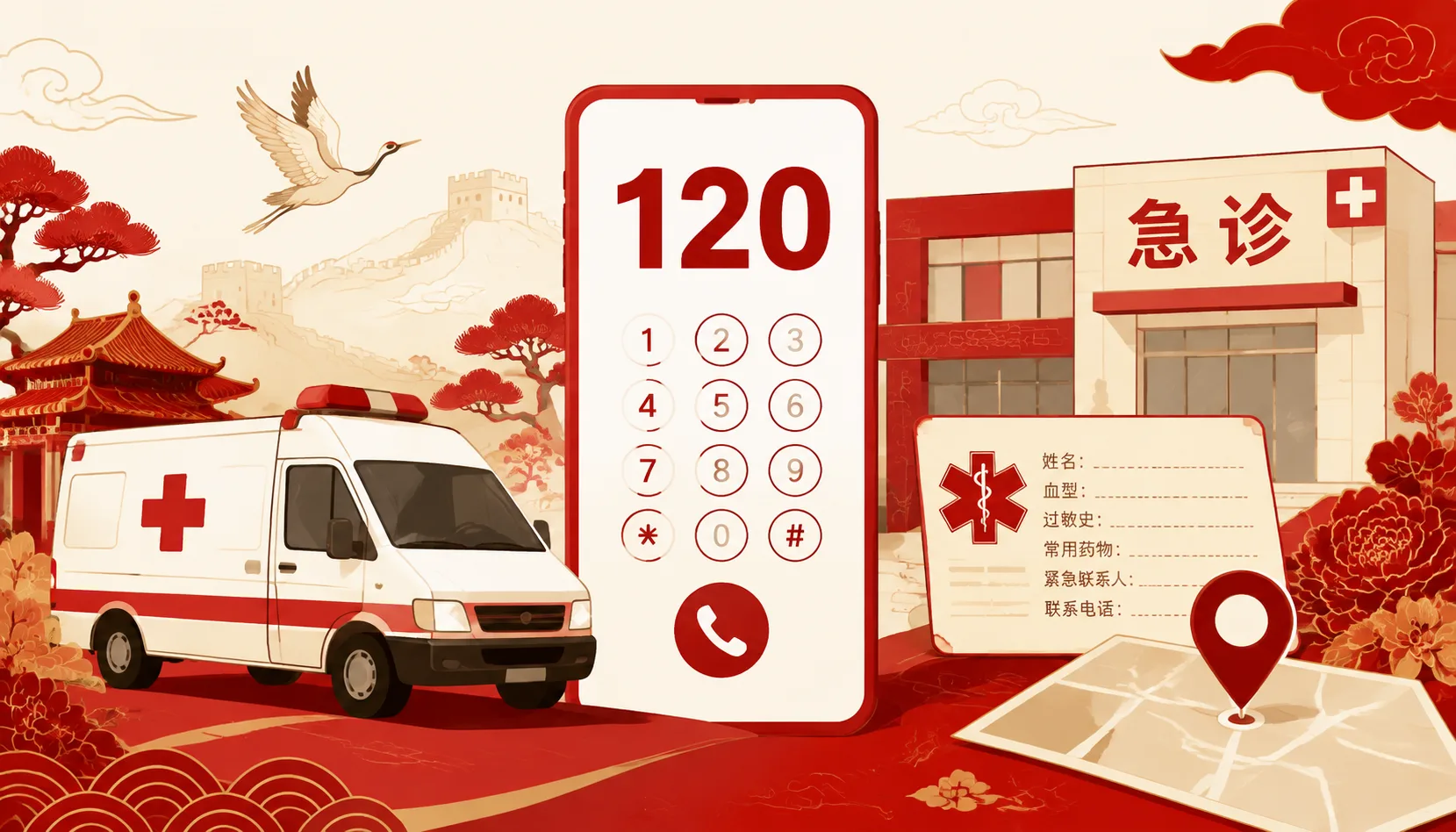
Call 120 (yāo-èr-líng) for life-threatening emergencies, or go directly to the nearest Grade 3-A hospital's emergency department (急诊科 Jízhěn Kē) for serious but stable conditions. Prepare a medical information card in Chinese on your phone, bring your passport and payment method, and call your insurance's emergency line as soon as possible.
First Things First: The Emergency Number 120
In China, the national emergency medical services number is 120 (yāo-èr-líng). It's free, available 24/7, and works nationwide. Do not call 110 (police) or 119 (fire) for medical emergencies — those are separate services and will only waste precious minutes. If you're in a hotel, the front desk can also dial 120 for you and often provide translation support.
When you call, the dispatcher will likely speak only Chinese. If you can't speak Chinese, say “English speaker” clearly and give your exact location. If possible, have a Chinese-speaking friend or colleague make the call for you — this is the most reliable way to ensure accurate communication.
Here's what to have ready when you call:
- Exact location — hotel name and room number, or a landmark and street address (e.g., “In front of the blue tower on Wangfujing Street”)
- What happened — e.g., “car accident,” “chest pain,” “unconscious”
- Patient's condition — conscious? breathing? visible bleeding?
- Your callback number — a Chinese mobile number works best
Realistic scenario: You're in a Shanghai hotel room and your friend suddenly collapses. You call 120, but the dispatcher speaks no English. You say “English speaker” and give your hotel name — the dispatcher patches through to an English-speaking operator. You provide the room number and describe that your friend is unconscious but breathing. An ambulance arrives in 12 minutes.
When to Call 120 vs. Go Directly to the ER
Calling 120 is not always the fastest option. In major cities, ambulance response times can be 10-20 minutes, and traffic can delay them. For life-threatening situations — severe chest pain, unconsciousness, major trauma, severe allergic reaction, stroke symptoms — call 120 immediately. For serious but non-life-threatening issues (e.g., a deep cut, high fever with rash, suspected fracture), going directly to the nearest Grade 3-A hospital's emergency department (急诊科 Jízhěn Kē) is often faster.
Grade 3-A (三甲 Sān Jiǎ) hospitals are the top-tier public hospitals in China. They have 24/7 emergency departments with specialists on call. Use a taxi or ride-hailing app (Didi) — drivers know the hospitals. If you're in a hotel, ask the front desk to call a taxi and give the driver the hospital name in Chinese.
Here's a quick decision guide:
| Condition | Action |
|---|---|
| Cardiac arrest, severe bleeding, unconsciousness | Call 120 immediately |
| Severe chest pain, stroke symptoms (facial droop, arm weakness, slurred speech) | Call 120 — every minute counts |
| Deep cut, broken bone, high fever, severe allergic reaction (not anaphylaxis) | Go directly to ER (急诊科) |
| Minor cuts, mild cold, prescription refill | Consider a regular clinic or outpatient department (门诊 Ménzhěn) — ER is for emergencies |
Tip: Save the address of the nearest Grade 3-A hospital in your phone's notes, in Chinese, before you need it.
At the Emergency Department: What to Expect
Chinese ERs are busy, but they operate on a triage system — patients are treated by severity, not by arrival order. If you arrive with a life-threatening condition, you'll be seen immediately. If your issue is less urgent, you may wait hours. Don't be offended if someone who arrived after you is treated first — that's the system working correctly.
When you arrive, go to the registration desk (挂号处 Guàhào Chù). You'll need:
- Your passport — always carry it for medical visits
- Payment method — cash, or a Chinese bank card (UnionPay), or mobile payment (WeChat Pay / Alipay) if linked to a foreign card. Some hospitals accept international credit cards, but not all.
- A Chinese-speaking helper if possible — many hospital staff in tier-1 cities speak basic English, but don't rely on it.
You'll be asked to pay a registration fee (usually 50-200 RMB) before seeing a doctor. Then you'll be directed to the emergency triage area where a nurse will assess your condition. Be prepared to describe your symptoms — use the phrase table below if needed.
Tip: If you're in a hotel, ask the front desk to write a note in Chinese: “Please help me see a doctor at the emergency department. I have [symptom].” Show it at the registration desk.
Overcoming the Language Barrier: Your Medical Information Card
In a crisis, you may not be able to speak or think clearly. That's why you should prepare a medical information card in Chinese on your phone — a note you can show to medical staff. Include:
- Allergies (过敏史 Guòmǐn Shǐ) — e.g., penicillin, peanuts
- Current medications (正在服用的药 Zhèngzài Fúyòng De Yào) — list generic names
- Chronic conditions (慢性病 Mànxìng Bìng) — e.g., diabetes, hypertension, asthma
- Blood type (血型 Xuèxíng) — if known
- Emergency contact (紧急联系人 Jǐnjí Liánxì Rén) — name and phone number
Keep this note saved as a screenshot on your lock screen, so it's accessible even if you're unconscious. Also, write a short sentence: “I don't speak Chinese. Please call my emergency contact.” (我不会说中文,请联系我的紧急联系人。)
Here's a critical vocabulary table to memorize or save:
| Chinese | Pinyin | English |
|---|---|---|
| 急诊 | Jízhěn | Emergency department |
| 救护车 | Jiùhùchē | Ambulance |
| 过敏 | Guòmǐn | Allergy |
| 胸痛 | Xiōngtòng | Chest pain |
| 失去意识 | Shīqù Yìshí | Unconscious |
| 呼吸困难 | Hūxī Kùnnán | Breathing difficulty |
| 头晕 | Tóuyūn | Dizziness |
| 出血 | Chūxuè | Bleeding |
Tip: Practice saying “Jízhěn” (emergency) and “Jiùhùchē” (ambulance) — these two words can get you far.
Insurance: Call Your Emergency Line Early
If you have travel or expat health insurance, call your insurer's emergency assistance line as soon as possible — ideally while you're waiting for the ambulance or at the ER. They can help you locate the most appropriate facility, arrange direct billing (so you don't have to pay upfront), and even guarantee payment for major treatment. Many insurers have 24/7 multilingual hotlines.
If you don't have insurance, be prepared to pay a deposit at the hospital — often several thousand RMB for serious cases. Keep your receipts and medical records; you can claim later if you purchase insurance retroactively (some policies allow this, but check terms).
Here's what to have on hand:
- Insurance policy number and emergency hotline — save in your phone
- Passport — required for registration and insurance claims
- Payment method — cash or card for deposits
Tip: Before you travel to China, email yourself a copy of your insurance policy and emergency numbers. In a crisis, you won't want to dig through luggage.
What NOT to Do in an Emergency
In a genuine emergency, every minute counts. Here are common mistakes foreigners make:
- Don't spend 30 minutes Googling “best hospital in Beijing.” Go to the nearest Grade 3-A hospital's ER. Stabilization first, transfer later if needed.
- Don't call your embassy first. They can't provide medical care. Call 120 or get to a hospital, then contact your embassy if needed for other assistance.
- Don't drive yourself if you're injured or in shock. Take a taxi or ambulance.
- Don't rely on the hotel doctor for serious issues — they may only handle minor ailments. Go to a proper hospital.
- Don't hesitate to ask for help. Chinese people are generally willing to assist foreigners in emergencies. Say “请帮帮我” (Qǐng bāng bāng wǒ — Please help me).
Realistic scenario: You're at a night market in Chengdu and a friend starts choking on a skewer. You're panicking. Instead of searching online, you shout “请帮帮我” and point to your friend. A local calls 120, and you show your medical information card to the paramedics when they arrive. Your friend is treated for a blocked airway and released the same day.
Prepare Before You Need It: A Checklist
Preparation is your best defense. Before you travel or move to China, do this:
- Save 120 in your phone as “Emergency Medical (China)” — but remember, you may need to ask someone else to call.
- Create your medical information card in Chinese (see above) and screenshot it to your lock screen.
- Identify the nearest Grade 3-A hospital to your home or hotel. Write its name and address in Chinese in your notes.
- Download a translation app like Google Translate (with offline Chinese pack) or Pleco — they can be lifesavers for communicating symptoms.
- Carry your passport and a small amount of cash (at least 500 RMB) for emergency deposits.
- Share your location with a trusted friend or family member via WeChat or a similar app, so they can find you if needed.
Remember: staying calm and acting fast are the two most important things. The Chinese healthcare system can be overwhelming, but it's capable and efficient for emergencies. With a little preparation, you can navigate it confidently.
What Chinese People Actually Say
- 叫救护车 | jiào jiùhù chē | Call an ambulance | Say this clearly and repeatedly in serious emergencies; dial 120
- 急诊 | jízhěn | Emergency (department) | Tell staff this word to get priority treatment at hospitals
- 去医院 | qù yīyuàn | Go to the hospital | Use when you need transport to a medical facility
2026 Reality Check
2026 Reality Check: The old "pay first, treat later" rule at public hospitals still exists but is fading. Most Beijing and Shanghai hospitals now accept mobile payments instantly, and many have express emergency lanes for foreigners with valid passports.
Gen Z vs. Older Generations: Young Chinese use apps like WeChat to call ambulances and pay bills instantly. Older generations still prefer cash and face-to-face registration. Foreigners using translation apps fit in better with Gen Z staff.
Big Cities vs. Smaller Cities: Beijing and Shanghai have international clinics with English-speaking staff. Smaller cities often require more paperwork and may lack 24-hour emergency services. Rural areas still expect upfront payment in cash.
Bottom Line: Carry your passport, have WeChat Pay linked, and know the nearest international hospital. The system is smoother than 5 years ago but still varies wildly by location.
Frequently asked questions
How do I call an ambulance in China if I don't speak Mandarin?
Dial 120 and say 'Jǐnjí qíngkuàng' (emergency). If you can't speak Chinese, operators often have English support, but it's unreliable. Better: have a Chinese-speaking friend call for you, or use a translation app with speaker mode. Many cities also have expat-focused emergency hotlines—search for your city's 'foreigner emergency line' before you need it.
Can I go to any hospital in China, or are some better for foreigners?
Go to a Grade 3-A hospital (三级甲等) for serious emergencies—they have the best equipment and English-speaking doctors. Smaller hospitals may lack specialists. In tier-1 cities like Beijing or Shanghai, international hospitals (e.g., United Family, Parkway) are faster and English-friendly but cost 3-5x more. For life-threatening issues, skip international ones—they may not have full ER capabilities.
What if I don't have cash or a Chinese bank card at the ER?
Hospitals require a deposit (usually 1000-5000 RMB) before treatment. If you have no cash or card, explain you're a foreigner and ask for the 'green channel' (绿色通道)—legally, hospitals must stabilize life-threatening conditions first, regardless of payment. To speed things up, set up Alipay or WeChat Pay with your foreign credit card in advance.
Is 120 free to call, and do I pay for the ambulance ride?
Calling 120 is free, but the ambulance ride isn't—it costs roughly 100-300 RMB depending on distance and level of care. You pay at the hospital along with your ER bill. Some private ambulance services (like SOS International) are pricier but offer English-speaking paramedics. Check if your travel insurance covers ambulance transport in China.
How do I tell the doctor what's wrong if I can't describe my symptoms in Chinese?
Use a translation app like Google Translate or Pleco, but write down key symptoms in advance—download the Chinese medical phrase list (e.g., 'chest pain' = 胸痛, 'allergic reaction' = 过敏反应). Better: keep a 'medical info card' in Chinese listing allergies, blood type, and medications. Doctors in Grade 3-A hospitals in big cities often speak basic English, but don't rely on it.
Can I get a refund from my travel insurance if I pay cash at the hospital?
Yes, but you must keep every receipt, diagnosis note (诊断证明), and prescription. Most insurers require you to contact them within 24-48 hours of the emergency—call their 24/7 line immediately. If you're admitted, ask the hospital for an itemized bill (费用清单). Some insurers can pay the hospital directly if you get pre-approval, but that's rare for walk-in emergencies.
Try our tools
Related guides

Can You Give a Clock to a Chinese Person?
Traditionally, no. “Giving a clock” (送钟, sòng zhōng) sounds exactly like 送终 (sòng zhōng), an expression for attending to the dying — so clocks and watches are t…
Read the guide →
Visiting a Sick Friend in China: Hospital Etiquette Guide
Visit in the afternoon or early evening, keep it to 20–30 minutes, and bring a fruit basket (avoid pears), quality tea, or a red envelope if you're close. Never…
Read the guide →
China's IV Drip Culture: Why So Common and Can You Refuse?
China's IV drip culture stems from historical patient demand for faster recovery and over-prescription in some clinics, though the government has cracked down o…
Read the guide →