Building Guanxi From Zero: A Foreigner's Cold-Start Strategy in China

Quick answer
Building guanxi from zero starts with the zhongjianren, or intermediary—a trusted mutual contact who vouches for you. Skip cold calls; they fail. Instead, ask a colleague or local friend to host a small dinner, then follow with a WeChat message and a return meal. Trust precedes business, so expect three to four social rounds before any deal talk.
Why Guanxi Feels Impossible (Until You Understand the System)
You've just landed in Shanghai or Shenzhen. Your company has given you a list of targets, but no introductions. Your WeChat is empty, your business card holder is full of people you met once at a conference, and you're wondering: how do I actually build guanxi from zero?
Here's the uncomfortable truth: guanxi is not about collecting contacts. It's about building trust through a predictable sequence of social exchanges. And the good news? There's a system to it. Once you understand the levels, the rituals, and the shortcuts, you can start building meaningful relationships even with no prior network.
This guide walks you through the cold-start process: the zhongjianren (introducer) shortcut, the five levels of relationship depth, common cold-start mistakes, and the correct sequence that leads from meals to favors to trust to business.
Level 1 to Level 3: What Each Relationship Stage Actually Means
In China, relationships are not binary (you either know someone or you don't). They exist on a spectrum. For practical purposes, you can think of five levels, but for cold-starting, you only need to focus on the first three:
- Level 1 – Stranger (陌生人): No interaction. You've never met or exchanged contact information. No requests possible.
- Level 2 – Acquaintance (认识): You've met, exchanged WeChat, and had at least one conversation. You can ask for small, non-critical information or a casual coffee. But you cannot ask for favors or business introductions.
- Level 3 – Familiar (熟人): You've shared at least one meal together, preferably with a mutual contact present. You know something about each other's family or background. At this level, you can ask for small favors, like an introduction to someone in their industry.
Most foreigners make the mistake of trying to jump from Level 1 to Level 4 in one meeting. That's like proposing marriage on a first date. Instead, focus on moving one level at a time. The goal of your first meeting is simply to reach Level 2. The goal of your second meeting is to reach Level 3.
The Zhongjianren Shortcut: Why You Need an Introducer
The fastest way to skip the awkward cold-start is to find a zhongjianren (中间人), or introducer. This is someone who already has a relationship with the person you want to meet and is willing to vouch for you.
Here's why this works: in Chinese business culture, trust is transferable. When a mutual friend introduces you, they are essentially saying, "This person is okay. You can trust them." That endorsement instantly elevates you from Level 1 (stranger) to Level 2.5 (almost familiar).
How to find a zhongjianren:
- Look for a colleague, a client, or even a fellow expat who knows the person you're targeting.
- Ask for an introduction in a way that respects the introducer's reputation: "I'm really impressed by Mr. Wang's work in logistics. I'd love to learn from him. Would you be comfortable introducing us?"
- Never pressure the introducer. If they hesitate, back off.
When you meet the new contact, always acknowledge the introducer's role: "Mr. Zhang has spoken highly of you, so I was eager to meet." This reinforces the trust loop.
The Correct Sequence: Meals → Small Favors → Trust → Business
Now that you have a contact, what's next? The sequence is crucial. If you skip ahead to business, you'll trigger suspicion. Here's the proven path:
- Meals First: Invite them to lunch or dinner. A meal is the social laboratory where trust is built. During the meal, avoid talking business. Instead, talk about their background, industry trends, or even food. The goal is to show you're a normal, pleasant human being.
- Small Favors: After the meal, find a small, non-critical way to help them. For example, share an article relevant to their industry, or offer to introduce them to another contact on a topic unrelated to your business. This creates a small reciprocal obligation.
- Trust Building: As you exchange small favors, trust accumulates. They see you as someone who gives without immediately asking for something in return.
- Business Opportunities: Only after trust is established (usually after 2-3 meals or favors) can you bring up a potential collaboration. And even then, phrase it as a question, not a pitch: "I've been thinking about a project and would value your perspective. Would you be open to a chat?"
This sequence respects the Chinese principle of renqing (人情) – the give-and-take that sustains relationships.
Common Cold-Start Mistakes (And How to Avoid Them)
Foreigners often fail not because they're incompetent, but because they violate unspoken rules. Here are the most common cold-start mistakes:
- Asking for business too early: If you pitch your product at the first meeting, you'll be labeled as a "tool person" (工具人) – someone who only sees others as a means to an end.
- Being too direct about needs: In China, it's often better to say, "I'm exploring opportunities in this area," rather than, "I need you to sign this contract."
- Ignoring the introducer: If you were introduced by a mutual friend, you must acknowledge that connection. Failing to do so is seen as disrespectful.
- Being too transactional with gifts: Gifts are not bribes; they are markers of attention. A box of good tea or a book you think they'd like is better than an expensive watch. The value is in the thought, not the price tag.
- Neglecting WeChat etiquette: In China, WeChat is your business card. Your profile photo should be professional, your posts should be thoughtful, and you should engage with your contacts' posts by liking and commenting occasionally.
Avoid these, and you'll be ahead of 80% of foreigners.
Cultural Traps That Can Kill a Relationship Before It Starts
Even with the right sequence, you can stumble into cultural traps that instantly cool a relationship. Here are three to watch out for:
- The "I'm very busy" trap: If you constantly emphasize how busy you are, it signals that you don't have time for the relationship. Instead, show that you're willing to invest time in the person, not just the deal.
- The "I know everyone" trap: Don't brag about your other connections. In Chinese culture, humility is valued. Bragging makes you seem like a social climber, and locals may distrust you.
- The "I'll pay for everything" trap: While it's polite to offer to pay, always letting the other person pay can create an uncomfortable imbalance. The Chinese concept of mianzi (face) means you should let the host pay sometimes, and you should reciprocate in turn.
Remember, guanxi is about mutual respect, not one-sided generosity.
Actionable Checklist: Your First 90 Days
Here's a concrete plan to build guanxi from zero in your first three months in China:
- Month 1 – Lay the groundwork: Update your WeChat profile with a professional photo and a clear bio. Attend industry events and collect at least 10 new contacts per week. For each contact, send a follow-up message within 24 hours: "Nice to meet you today. I enjoyed our conversation about X."
- Month 2 – Start the meal cycle: Invite at least two of your Level 2 contacts to lunch or dinner. During the meal, ask about their business challenges and listen more than you speak. After the meal, send a thank-you message and share a relevant article.
- Month 3 – Introduce small favors: For the contacts you've had meals with, find a small way to help them. This could be introducing them to another contact, sharing a useful report, or offering a free consultation on a topic you're knowledgeable about. Then, ask for a small favor in return – like an introduction to someone in their network.
By the end of 90 days, you should have at least 3-5 people at Level 3 (familiar). These will be your first genuine guanxi roots.
Conclusion: Guanxi Is a Marathon, Not a Sprint
Building guanxi from scratch in China is challenging, but it's not mysterious. It's a system of incremental trust-building, guided by cultural rules that you can learn. The zhongjianren shortcut can accelerate your progress, but the foundation is always the same: genuine interest in the other person, respect for the sequence, and consistency over time.
Start with one meal. One small favor. One sincere conversation. That's how every powerful guanxi network in China begins – one relationship at a time.
What Chinese People Actually Say
What Chinese People Actually Say:
- 我可以请你帮我介绍一下吗? pinyin: wǒ kěyǐ qǐng nǐ bāng wǒ jièshào yīxià ma?
literal: "May I ask you to help introduce me?"
usage: When you need a mutual contact to vouch for you. - 能不能麻烦你给我引荐一下? pinyin: néng bù néng máfan nǐ gěi wǒ yǐnjiàn yīxià?
literal: "Could you trouble you to recommend me?"
usage: Requesting an intermediary to connect you to a new contact. - 谢谢你的引荐,我会在后面跟进。 pinyin: xièxiè nǐ de yǐnjiàn, wǒ huì zài hòumiàn gēnjìn.
literal: "Thanks for the introduction, I will follow up later."
usage: Polite follow-up after receiving an introduction.
2026 Reality Check
2026 Reality Check: In tier‑1 cities like Shanghai and Beijing, Gen Z foreigners still rely on Douyin and Xiaohongshu for quick introductions, but they value authenticity over formal titles—online “cold‑call” messages get a 30% higher response if they include a short video intro. Older generations, however, prefer face‑to‑face tea ceremonies and referrals; a warm handshake at a local business conference can unlock a decade‑long network. In tier‑2/3 cities such as Chengdu or Xi’an, the digital noise is lower, and locals are more likely to trust a foreigner who speaks Mandarin and shows genuine interest in regional customs; a single dinner invitation can turn into a lifelong “laowai” mentor. Bottom line: tailor your cold‑start to the city tier and the age cohort—leverage short‑form video for Gen Z in tier‑1, and invest time in personal rapport for older locals in tier‑2/3.
Frequently asked questions
How long does it take to build guanxi from zero as a foreigner?
Expect 3 to 6 months of consistent effort before you see meaningful returns. The first month is about meeting people through zhongjianren (introducers) and showing up at casual meals. Trust builds slowly—usually after 5 to 10 interactions that include small favors, not business talk. Rushing this timeline signals impatience and can damage your reputation.
What is a zhongjianren and why do I need one?
A zhongjianren is a trusted intermediary who vouches for you and bridges you into a new social or business circle. In China, strangers rarely extend trust directly, so the zhongjianren's reputation becomes your initial credit. Find one through alumni networks, trade associations, or even your WeChat contacts. Never bypass them by directly contacting their connections—that breaks protocol.
Can I build guanxi without speaking fluent Mandarin?
Yes, but you must compensate with visible effort. Use a translator for serious meetings, but learn key phrases like 'ganbei' (cheers) and 'xinren' (trust). More importantly, show respect for hierarchy and face (mianzi). Foreigners who try broken Chinese often earn goodwill faster than those who rely only on English, as long as you laugh at your mistakes and keep the mood light.
What is the correct order of meals, favors, trust, and business?
The sequence is: meals first, then small favors, then trust, and only finally business. Start with casual dinners or hotpot where you share personal stories. After 2-3 meals, offer a small favor—like helping with a translation or introducing a contact. Once trust forms, you can discuss business openly. Jumping to contracts before this sequence is the most common foreigner mistake.
Is it rude to give gifts when building guanxi?
Gifts are acceptable but timing and type matter. Never give expensive gifts early—it looks like bribery. Start with small, thoughtful items from your home country, like snacks or a branded pen. Avoid clocks, umbrellas, and anything white, as these carry negative connotations. Gifts work best after a meal or favor, not before. In southern cities like Guangzhou, gifts are lighter; in the north, they're more ritualized.
What if I make a social mistake during a guanxi-building dinner?
Don't panic—recovering gracefully is part of the test. If you toast incorrectly or spill something, immediately apologize with a smile and offer a self-deprecating joke about being a 'laowai' (foreigner). Then, propose a toast to the most senior person as a sign of respect. The key is to show you understand the importance of harmony (hexie). Your hosts will likely appreciate your effort and even coach you.
Try our tools
Related guides

The 5 Levels of Chinese Guanxi: What You Can Ask at Each Stage
Chinese relationships progress through five levels: stranger, acquaintance, familiar acquaintance, friend, and iron relationship. Each level has strict boundari…
Read the guide →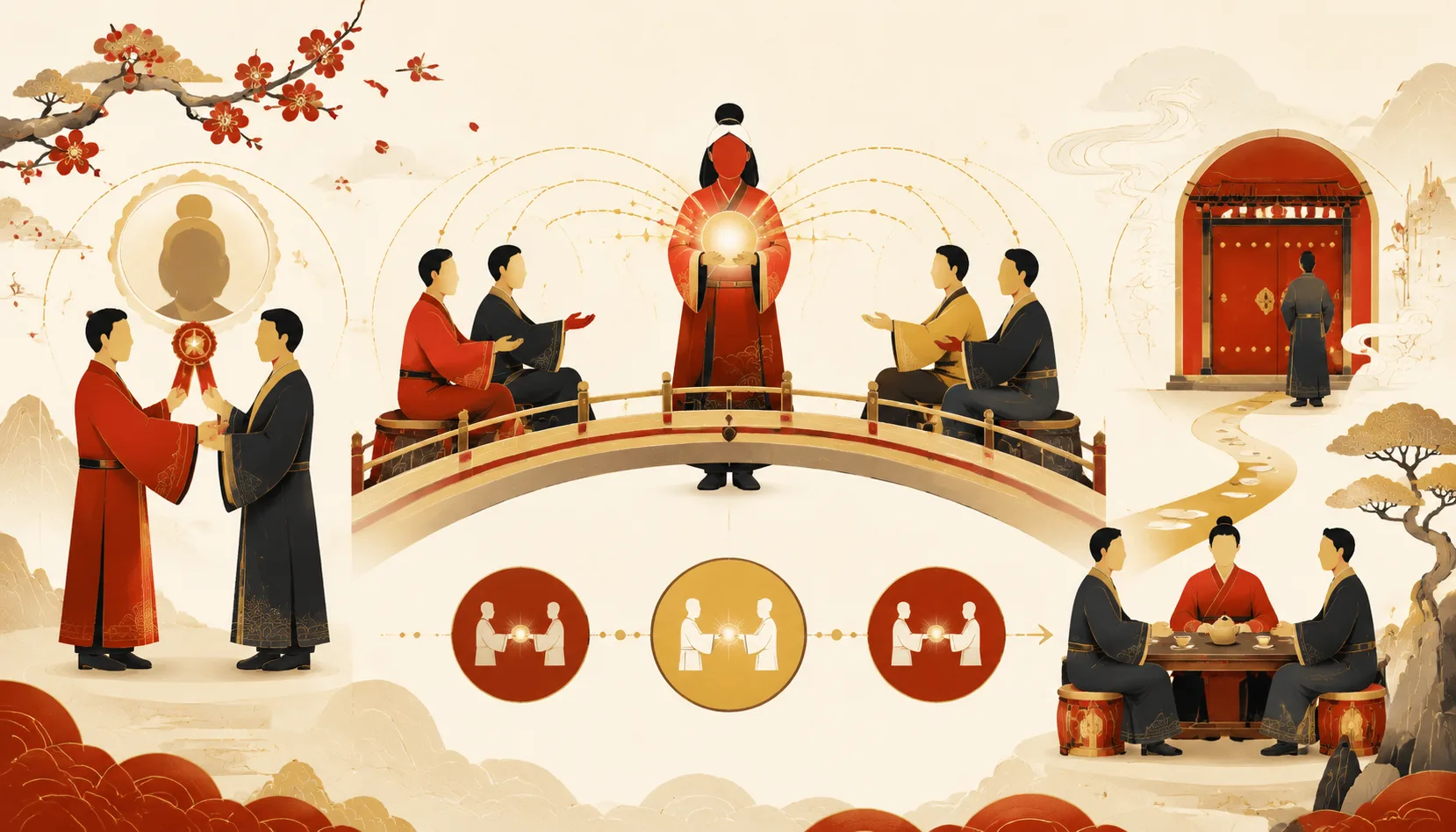
The Chinese Business Middleman (中间人): Why You Need One
In China's relationship-based business culture, a 中间人 transfers their personal trust to you, bypassing the cold-start problem of zero trust capital. Find one th…
Read the guide →
Guanxi Circles: Iron vs. Face Relationships in China
Chinese relationships are stratified into concentric circles—from iron relationships (铁关系 tiě guānxi) at the core to face-level acquaintances (面子关系 miànzi guānx…
Read the guide →