What are the customs and gift etiquette for Teacher's Day (教师节) in China?
Quick answer
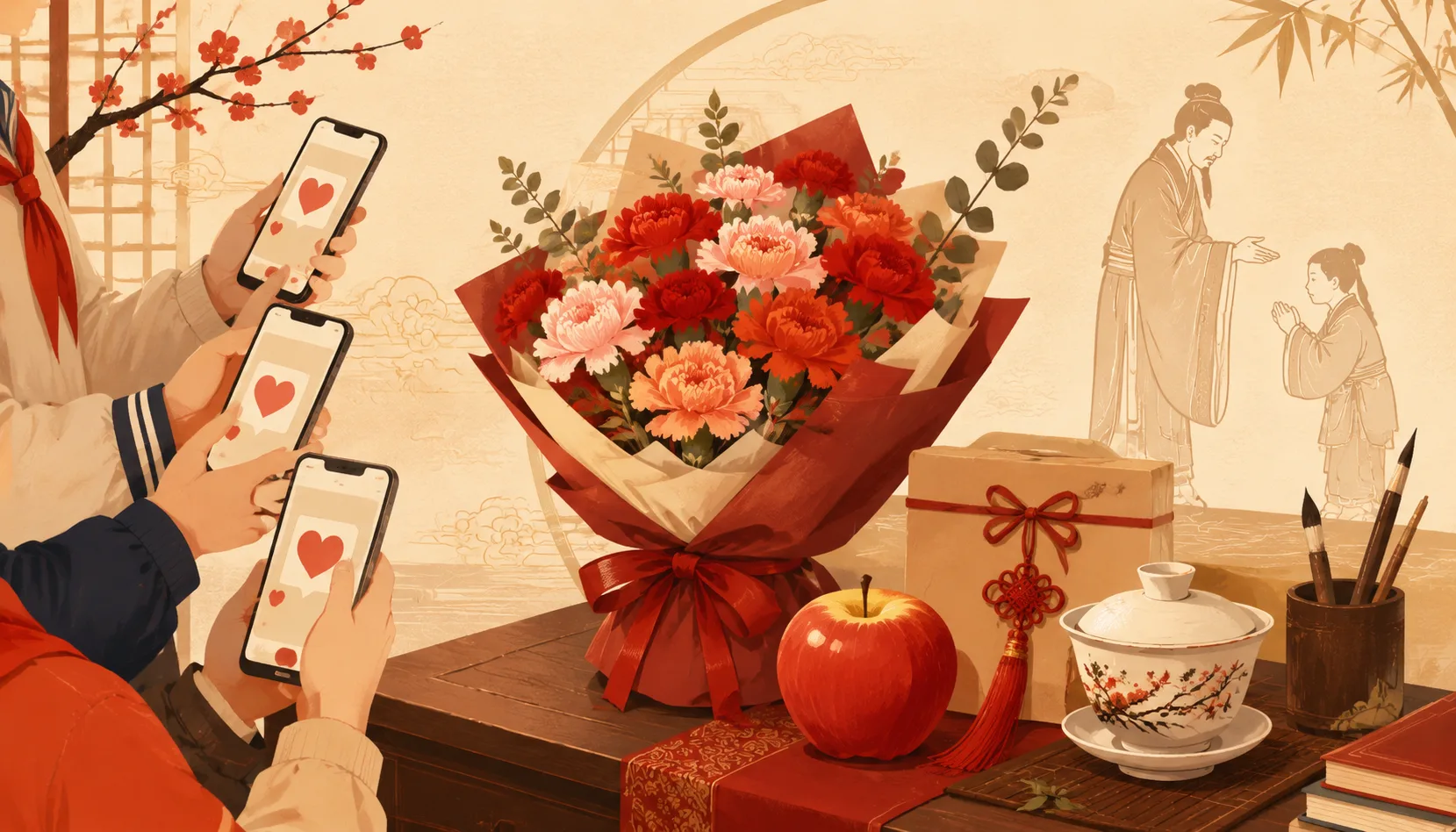
On September 10, students and parents show gratitude to teachers with flowers, small gifts, and heartfelt messages. Avoid cash gifts (controversial due to anti-corruption rules); instead, give modest items under ¥200 or join a class-organized group gift. If you teach, graciously accept tokens of appreciation and reply to '教师节快乐' messages.
Why Teacher's Day Matters in China
In China, Teacher's Day (教师节 Jiàoshī Jié) is not just a date on the calendar—it's a profound cultural expression rooted in Confucian values. For over two millennia, teachers (师 shī) have held a place just below parents in the social hierarchy, a concept captured in the saying “一日为师,终身为父” (Yī rì wéi shī, zhōng shēn wéi fù) — “Once a teacher, always a father figure.” This reverence shapes how Chinese society treats educators, making Teacher's Day a genuinely heartfelt occasion.
Since 1985, September 10 has been the official day, chosen to coincide with the start of the school year, symbolizing a fresh beginning and the importance of education. On this day, students across the country—from kindergarten to university—express gratitude to their teachers. But it’s not just about gifts; it’s about acknowledging the “辛苦付出” (xīnkǔ fùchū)—the dedicated hard work—that teachers invest in shaping young minds.
For foreigners, understanding this day offers a window into Chinese values. It’s a time when the entire society pauses to honor educators, and even adults who have long graduated will reach out to their former teachers. This lifelong bond is a unique aspect of Chinese culture that you’ll encounter if you teach or have taught anyone in China.
What Students Do: Traditions and Modern Practices
On Teacher's Day, students typically engage in a mix of traditional and modern gestures. The most common activities include:
- Visiting former teachers — Many students return to their old schools or arrange visits to their teachers' homes, bringing small gifts and spending time chatting.
- Sending WeChat messages — A flood of “教师节快乐” (Jiàoshī Jié kuàilè) messages fills teachers' phones. These are often accompanied by heartfelt notes or digital cards.
- Giving gifts — Flowers, especially carnations (康乃馨 kāngnǎixīn), are the classic choice. They symbolize love and respect, and their affordability makes them accessible to all.
In recent years, modern trends have expanded the gift repertoire. Quality tea (好茶 hǎo chá), books, and even gift cards are popular. However, the gift-giving landscape has shifted due to anti-corruption campaigns, making cash gifts highly controversial. Public school teachers are often explicitly told not to accept cash, and doing so can put both the giver and receiver in an awkward position.
If you’re a student in China, the safest and most appreciated gesture is a handwritten card or a small, thoughtful gift. The effort matters more than the price tag. As one Chinese saying goes, “礼轻情意重” (Lǐ qīng qíng yì zhòng) — “A small gift carries deep meaning.”
What Parents Should Know: Group Gifts and Social Expectations
If you’re a parent with a child in a Chinese school, Teacher's Day is a social minefield. The key practice to understand is the class-organized group gift. Typically, a parent representative (often called 家委会 jiāwěihuì — the parent committee) will collect money from all families to buy a single, more substantial gift for the teacher. This could be a bouquet, a high-quality thermos, or a gift basket.
Participate in the group gift. Even if you feel uncomfortable with the idea, not participating marks you as unsociable and can strain relationships with both teachers and other parents. The amount is usually modest—often ¥20–¥50 per family—so it’s not a financial burden.
Here’s a quick guide to group gift etiquette:
| Situation | Do | Don't |
|---|---|---|
| Parent committee collects money | Contribute promptly and cheerfully | Question the amount or purpose publicly |
| Teacher receives group gift | Send a WeChat thank-you to the committee | Expect a personal thank-you to your child |
| Your child wants to give a personal gift | Encourage a small, handmade item or card | Give cash or expensive items (over ¥200) |
Remember, the goal is to show collective appreciation, not to stand out. By participating, you’re reinforcing your child’s social standing and demonstrating respect for Chinese customs.
If You're Teaching in China: How to Receive Gifts Gracefully
As a foreign teacher in China, you’ll likely be on the receiving end of Teacher's Day generosity. Expect flowers, cards, and small gifts from students—and sometimes even from their parents. The golden rule is to receive them graciously. Refusing a gift can be seen as rejecting the student’s sincerity, which is a social faux pas.
Here’s what to do:
- Accept with a smile and express genuine thanks: “谢谢你的礼物” (Xièxiè nǐ de lǐwù) — “Thank you for your gift.”
- Open gifts in front of the student if it’s a small item like a card or flower. This shows appreciation.
- For larger gifts, such as a box of fruit or a gift basket, acknowledge it warmly and mention you’ll enjoy it at home.
- Never ask about the price or make comparisons with other gifts.
You’ll also receive a flood of WeChat messages from current and former students. Take the time to reply to each one, even if it’s just a simple “谢谢,同乐!” (Xièxiè, tóng lè!) — “Thanks, happy Teacher's Day to you too!” This small effort builds strong relationships.
Be mindful of school policies: some schools have strict rules about gift acceptance. If you’re unsure, ask your school’s administration. But in general, small tokens of appreciation are fine and expected.
The Lifelong Teacher-Student Bond
One of the most beautiful aspects of Chinese culture is the lifelong bond between teachers and students. Unlike in many Western countries where the relationship often ends at graduation, Chinese students frequently maintain contact with their teachers for years—even decades—after leaving school. This is rooted in the Confucian ideal of “尊师重道” (zūn shī zhòng dào) — “respect the teacher and honor the way.”
On Teacher's Day, this bond manifests in visits, phone calls, and gifts from former students. It’s not uncommon for a retired teacher to receive dozens of visitors on September 10, each bringing a small gift and warm memories. For significant teachers—those who had a profound impact—students may give more substantial gifts, such as a nice pen, a silk scarf, or a high-quality tea set.
If you’ve taught in China and left, don’t be surprised to receive WeChat messages from former students on Teacher's Day. This is a sign of respect, and you should reply warmly. If you’re a student, consider reaching out to a teacher who changed your life. A simple message like “感谢老师的辛苦付出” (Gǎnxiè lǎoshī de xīnkǔ fùchū) — “Thank you for your dedicated hard work, teacher” — can mean the world.
This enduring connection is a unique privilege of teaching in China, and embracing it enriches your experience both personally and professionally.
Gift Etiquette: What to Give (and What to Avoid)
Choosing the right gift for a Chinese teacher can be tricky, especially with the ethical concerns around cash. Here’s a practical guide:
| Gift Type | Appropriate? | Notes |
|---|---|---|
| Cash (现金 xiànjīn) | ❌ Avoid | Controversial; may raise compliance concerns, especially for public school teachers. |
| Gift cards (购物卡 gòuwùkǎ) | ⚠️ Use caution | Some schools prohibit them; if given, keep the amount low (under ¥100). |
| Flowers (花 huā) | ✅ Yes | Carnations are classic; sunflowers are also popular. |
| Quality tea (好茶 hǎo chá) | ✅ Yes | Green tea or oolong is a safe, elegant choice. |
| Books (书 shū) | ✅ Yes | Choose something related to the teacher’s subject or a classic. |
| Handmade cards (手工卡 shǒugōng kǎ) | ✅ Yes | Most heartfelt; children often make these. |
| Group gift (集体礼物 jítǐ lǐwù) | ✅ Yes | Organized by parent committee; usually a nicer item. |
Key rule: Keep any personal gift under ¥200 per family. This aligns with anti-corruption guidelines and avoids putting the teacher in an awkward position. If you’re unsure, a handwritten card is always safe and appreciated.
Also, avoid overly personal or expensive items like jewelry, watches, or luxury goods. These can be misconstrued and may embarrass the teacher. Remember, the sentiment is what counts.
Key Phrases for Teacher's Day
Whether you’re a student, parent, or teacher, knowing a few key phrases will help you navigate Teacher's Day with confidence. Here are the most useful ones:
| Chinese | Pinyin | English |
|---|---|---|
| 教师节快乐 | Jiàoshī Jié kuàilè | Happy Teacher's Day |
| 感谢老师的辛苦付出 | Gǎnxiè lǎoshī de xīnkǔ fùchū | Thank you for your dedicated hard work, teacher |
| 老师,您辛苦了 | Lǎoshī, nín xīnkǔ le | Teacher, you’ve worked hard |
| 谢谢您的教导 | Xièxiè nín de jiàodǎo | Thank you for your guidance |
| 祝您身体健康 | Zhù nín shēntǐ jiànkāng | Wishing you good health |
| 这是给您的礼物 | Zhè shì gěi nín de lǐwù | This is a gift for you |
Use these in person or in WeChat messages. For written messages, you can add a personal touch by mentioning something specific the teacher did for you. For example: “老师,谢谢您去年帮我提高英语成绩。教师节快乐!” (Lǎoshī, xièxiè nín qùnián bāng wǒ tígāo Yīngyǔ chéngjì. Jiàoshī Jié kuàilè!) — “Teacher, thank you for helping me improve my English last year. Happy Teacher's Day!”
This personalization shows genuine appreciation and strengthens your relationship. Even a simple phrase goes a long way in Chinese culture.
What Chinese People Actually Say
What Chinese People Actually Say: On September 10, students and parents show gratitude to teachers with flowers, small gifts, and heartfelt messages. Avoid cash gifts (controversial due to anti‑corruption rules); instead, give modest items.
- 老师,您辛苦了! (lǎo shī, nín xīn kǔ le) – "Teacher, you have worked hard!" – a classic thank‑you phrase.
- 祝老师桃李满天下! (zhù lǎo shī táo lǐ mǎn tiān xià) – "May your peach and plum trees fill the world" – wishes the teacher many successful students.
- 教师节快乐! (jiào shī jié kuài lè) – "Happy Teacher's Day!" – the standard holiday greeting.
- 谢谢老师的辛勤教导 (xiè xie lǎo shī de xīn qín jiào dǎo) – "Thank you for your diligent teaching" – used when writing a card.
2026 Reality Check
2026 Reality Check: As China’s Teacher’s Day evolves, generational and city‑tier gaps are widening. Gen Z, now entering the workforce, prefers digital gifts—e‑cards, WeChat red packets, and personalized video messages—over traditional items, reflecting a desire for convenience and sustainability. Older generations, especially parents and grandparents, still favor tangible tokens like flowers, tea sets, or modest cash envelopes, viewing them as respectful gestures. In tier‑1 cities such as Beijing and Shanghai, teachers often receive higher‑value gifts or experience‑based presents (e.g., concert tickets, online courses) due to higher disposable income and tech‑savvy parents. In tier‑2/3 cities, modest physical gifts remain common, but mobile‑payment red packets are rapidly gaining ground, blending tradition with digital convenience. By 2026, expect a hybrid model: a mix of digital tokens in urban centers and still‑valued physical items in smaller towns, with social media shaping expectations across all tiers.
Frequently asked questions
Can I give my child's teacher a gift card or cash for Teacher's Day in China?
No. Cash and gift cards are widely considered inappropriate due to China's strict anti-corruption rules for educators. Teachers may face penalties for accepting them, and schools often warn parents against it. Even a small cash amount can create awkwardness. Stick to symbolic gifts like flowers, fruit, or a handwritten card instead.
What is a safe budget for a Teacher's Day gift in China?
Keep any individual gift under ¥200 (about 8 USD). This amount stays within generally acceptable boundaries and avoids triggering suspicion of bribery. Many schools even encourage gifts under ¥50. If you want to give something more substantial, join a class-organized group gift where multiple families pool money for a single, nicer present.
Is it okay to give a teacher a gift after Teacher's Day has passed?
Yes, but it's less common. Teacher's Day is September 10, and gifts are typically given that day or during the week before. A late gift is fine if you explain a scheduling conflict or travel. However, avoid giving gifts weeks later, as it may look like an attempt to gain special treatment rather than a genuine holiday gesture.
Are there regional differences in Teacher's Day gift customs across China?
Yes, though the overall etiquette is similar. In big cities like Beijing and Shanghai, gifts lean toward high-quality flowers, tea, or books, and parents are more aware of anti-corruption limits. In smaller towns or rural areas, homemade food, eggs, or local produce are still appreciated. Always observe what other parents do in your specific school community.
Can teachers accept gifts from students in China?
Yes, within limits. Teachers may accept small, symbolic gifts like flowers, cards, or fruit, especially if given openly in front of a class. They should politely decline cash, luxury items, or anything clearly exceeding a modest value. Many teachers will accept a gift and then give a small return item, like a bookmark or candy, to balance the exchange.
What should I say or write in a Teacher's Day card in Chinese?
Keep it warm and simple. Write '老师,教师节快乐!感谢您的辛勤教导' (Teacher, Happy Teacher's Day! Thank you for your hard work). For a more personal touch, add a specific memory, like 'I still remember how you helped me with math.' Avoid overly formal or exaggerated praise; sincerity matters more than flowery language.
Try our tools
Related guides
Chinese New Year Survival Guide for Foreigners: What to Do, What Not to Do (2026)
Spring Festival is China’s biggest holiday, a family reunion that dwarfs Western celebrations. If invited to New Year’s Eve dinner, arrive early, bring fruit or…
Read the guide →
Mid-Autumn Festival Guide for Foreigners in China 2026: Moon, Mooncakes, and Gift Etiquette
Mid-Autumn Festival is China’s second-biggest gift-giving event, blending Thanksgiving’s warmth with Christmas’s pressure around a full moon. Expect three days …
Read the guide →
Dragon Boat Festival China: Zongzi, Dragon Boats & What Foreigners Must Know (2026)
Dragon Boat Festival (端午节, Duānwǔ Jié) falls on the 5th day of the 5th lunar month. Eat zongzi (sticky rice dumplings wrapped in bamboo leaves), watch or join d…
Read the guide →