How do I register and navigate a Chinese public hospital visit as a foreigner?
Quick answer
Register via the hospital's WeChat mini-program (挂号, Guàhào) to book a department, doctor, and time slot. Bring your passport, a phone with WeChat Pay or Alipay, and a written list of symptoms in Chinese. Expect a fast-paced visit: registration, triage, a 3-5 minute doctor consultation, tests, payment, and pharmacy pickup — all paid via mobile apps.
Understanding 挂号 (Guàhào) – It’s More Than Just Signing In
When you first walk into a Chinese public hospital, you’ll see the word 挂号 (Guàhào) everywhere. It literally means “hang a number,” but in practice it’s a full appointment system. You’re not just checking in — you’re selecting a specific department (科室, Kēshì), a doctor (医生, Yīshēng), a time slot, and a level of service: general (普通, Pǔtōng) or specialist (专家, Zhuānjiā).
Top specialists at famous hospitals (like Peking Union Medical College Hospital in Beijing) can have their slots sell out in seconds. Slots are typically released at 8:00 AM daily or weekly, depending on the hospital. Set an alarm and be ready to book the moment they open.
Today, online booking via the hospital’s WeChat mini-program is the standard. You can search for the hospital’s official account, find the “挂号” menu, and pick your department and doctor. You’ll need to link your passport (护照, Hùzhào) to the system. If you’re not tech-savvy, you can also use the self-service kiosks in the hospital lobby, but they may require a Chinese ID or a local phone number — so bring your passport and be prepared to ask for help.
| Chinese | Pinyin | English |
|---|---|---|
| 挂号 | Guàhào | Registration / Appointment |
| 科室 | Kēshì | Department |
| 专家 | Zhuānjiā | Specialist |
| 普通 | Pǔtōng | General |
Actionable tip: Before you go, download the hospital’s WeChat mini-program and practice navigating it. If you can’t book online, arrive at the hospital at 7:00 AM to queue at the registration counter — but be prepared for a long wait.
What to Bring: Your Hospital Survival Kit
Walking into a Chinese hospital unprepared is like going to a battlefield without armor. Here’s your essential kit:
- Passport (护照, Hùzhào) – This is your ID for registration, payment, and any paperwork. Keep it handy.
- Phone with WeChat Pay or Alipay – Almost all payments are mobile. You’ll pay for registration, tests, and medicine via QR code scans. Make sure your apps are funded and linked to an international card.
- International insurance card with emergency number – If you have travel or expat health insurance, bring the card and the 24-hour emergency assistance number. You may need to pay upfront and claim later.
- A written list of symptoms and current medications in Chinese – This is a lifesaver. Write down your symptoms, when they started, and any medications you take (with generic names). You can ask a Chinese-speaking friend or use a translation app to prepare this.
Actionable tip: Keep a photo of your passport and insurance card on your phone as backup, but always carry the physical passport — hospitals require it for registration.
The Visit Flow: What Happens Step by Step
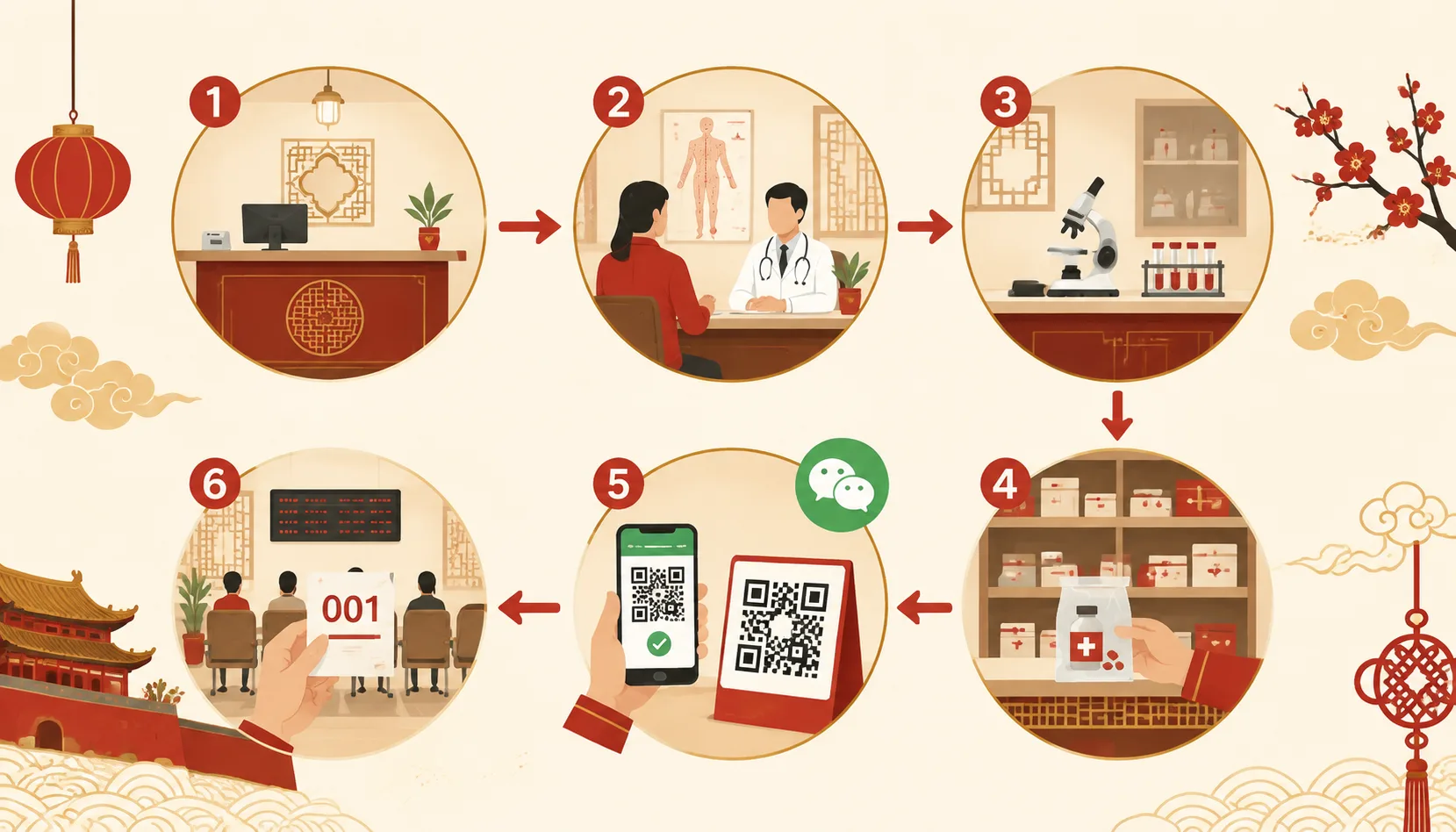
Once you have your 挂号 (Guàhào), the flow is systematic but fast. Here’s the typical sequence:
- Registration (挂号, Guàhào) – You’ve already done this online or at a kiosk. You’ll get a receipt or QR code.
- Triage/Nurse check (分诊, Fēnzhěn) – At the department’s nursing station, a nurse will take your basic vitals (blood pressure, temperature) and confirm your appointment.
- Doctor consultation (看医生, Kàn yīshēng) – This is the core visit. In busy public hospitals, you get 3-5 minutes with the doctor. Be concise and prepared.
- Tests ordered (开检查, Kāi jiǎnchá) – The doctor may order blood tests, imaging, or other diagnostics. You’ll receive a list of tests.
- Pay for tests (缴费, Jiǎofèi) – Pay via WeChat/Alipay at the payment counter or on your phone. You’ll get a payment notification.
- Get tests done (做检查, Zuò jiǎnchá) – Go to the lab or imaging department. Blood results often come back in 30 minutes; CT scans in about an hour.
- Wait for results (等结果, Děng jiéguǒ) – You’ll receive a notification or check the hospital’s app for results.
- Return to doctor (回诊, Huízhěn) – Take your results back to the doctor for interpretation and treatment plan.
- Get prescription (开药, Kāi yào) – The doctor writes a prescription.
- Pay for medicine (缴费, Jiǎofèi) – Pay at the pharmacy payment window or via your phone.
- Collect medicine (取药, Qǔ yào) – Go to the pharmacy window (药房, Yàofáng) with your receipt or QR code.
Actionable tip: Take a screenshot of each payment QR code and receipt. You’ll need them at every step, and the hospital Wi-Fi can be spotty.
The 3-5 Minute Doctor Reality: How to Make the Most of It
Don’t be shocked when your doctor consultation feels like a sprint. In public hospitals, doctors see dozens of patients per hour, so they’re trained to be efficient. Come prepared to give a concise, structured summary of your problem.
Here’s what to state, in order:
- When the symptom started (e.g., “三天前” – three days ago)
- Where it hurts (be specific: “肚子右边” – right side of abdomen)
- Severity on a scale of 1-10 (e.g., “疼,7分” – pain, 7/10)
- What makes it better or worse (e.g., “吃饭后更疼” – worse after eating)
- Current medications and any allergies (e.g., “对青霉素过敏” – allergic to penicillin)
No chitchat. The doctor will ask targeted questions, then likely order tests. If you have a written list in Chinese, hand it to the doctor — it saves time and reduces miscommunication.
Actionable tip: Practice saying your key symptoms in Chinese using a translation app. Even if your pronunciation is imperfect, the written list will be a lifesaver.
Why Doctors Order Lots of Tests (And Why That’s Okay)
You might be surprised when a doctor orders a full blood panel for a simple headache. This is normal. China’s medical-legal environment and high patient volume mean doctors rely on objective data (tests) rather than just your description. It’s not a scam — it’s standard practice to avoid misdiagnosis and protect themselves legally.
Tests are also fast. Blood results come back in about 30 minutes, and a CT scan in about an hour. You’ll wait in designated areas, and your phone will buzz when results are ready (often via the hospital’s app or SMS).
Actionable tip: Budget extra time for tests. Even though individual tests are quick, the queues can be long. Bring a book or download a movie — you might wait 1-2 hours total.
Payment and Pharmacy: It’s All on Your Phone
Gone are the days of cash or cards. Everything is paid via WeChat Pay or Alipay. After each step (registration, tests, medicine), you’ll get a payment notification on your phone. Simply scan the QR code at the payment counter or approve the payment in-app.
For medicine collection, after paying for your prescription, go to the pharmacy window (药房, Yàofáng). You’ll need your receipt or the QR code from your payment confirmation. The pharmacist will hand you your medicine, often with brief instructions. If you need more detailed instructions, ask for a printed label or use a translation app.
Actionable tip: Keep your phone charged — you’ll be scanning QR codes constantly. Also, check if your insurance requires itemized receipts; you can get these at the hospital’s billing office.
Pro Tips: Timing and Realistic Scenarios
Avoid Monday mornings at top hospitals. That’s when crowds peak — everyone wants to see a doctor early in the week. Tuesday to Thursday afternoons are significantly quieter. If you can, schedule your appointment for 2:00 PM on a Wednesday.
Realistic scenario: You wake up with a fever and sore throat. You book a general practitioner (普通号, Pǔtōng hào) via the hospital’s WeChat mini-program for 10:30 AM. You arrive at 10:15, show your passport at the registration counter, go to the internal medicine department (内科, Nèikē), and check in with the nurse. At 10:35, you see the doctor, who asks about your symptoms. You hand over your written list. The doctor orders a blood test. You pay 150 RMB via Alipay, get your blood drawn, and wait 30 minutes. Results show a bacterial infection. The doctor prescribes antibiotics. You pay 80 RMB, collect your medicine, and leave by 11:45 AM. Total time: 1.5 hours. Total cost: 230 RMB (about $32).
Actionable tip: If you have a chronic condition, ask the doctor for a 复诊 (Fùzhěn) appointment — a follow-up visit that can be booked in advance, saving you from the morning rush.
What Chinese People Actually Say
- 挂号 | guà hào | to register for a hospital visit | Say this first at the reception desk to get a queue number
- 医保卡 | yī bǎo kǎ | medical insurance card | Present this to reduce costs; most hospitals accept it
- 门诊 | mén zhěn | outpatient department | Use this for non-emergency doctor consultations
2026 Reality Check
Registration Methods (2026): Online booking via apps (WeChat, Alipay) dominates in major cities—QR codes have largely replaced paper cards. Older generations still struggle with digital registration, but hospital staff usually assists. Smaller cities lag; many still require walk-in registration with ID.
Queuing Etiquette: Still followed but relaxing. Beijing/Shanghai hospitals use ticket machines that call numbers—physical line-jumping is rare now. Smaller cities see more informal queuing; older patients sometimes push ahead, causing friction with younger people.
Gen Z vs. Older Generations: Gen Z books appointments days in advance, uses hospital apps for everything, and avoids small talk. Older generations prefer arriving early, asking staff directly, and building personal connections with doctors—though they're learning to use phones.
Regional Differences: Tier-1 cities are nearly fully digitized. Tier-2/3 cities mix old and new. Rural areas still rely heavily on cash, paper, and in-person arrangements.
Frequently asked questions
Can I register at a Chinese hospital without a Chinese ID card?
Yes. Foreigners use their passport as identification. In the WeChat mini-program, select 'passport' as your ID type and enter your passport number. At the hospital, bring the same passport to the registration counter or self-service kiosk to collect your physical queue number and medical card.
What if I don't have WeChat Pay or Alipay set up?
Most large public hospitals now require mobile payment for registration, tests, and medication. If you lack WeChat Pay or Alipay, bring a Visa or Mastercard — but acceptance is inconsistent. Some hospitals have a cash/foreign-card window, but expect longer queues. Download and link Alipay to a foreign card before your visit to avoid delays.
How do I pick the right department (科室) when I'm unsure of my symptoms?
If uncertain, choose 全科 (General Practice) or 内科 (Internal Medicine) for non-emergency issues. You can also ask at the hospital's 导诊台 (guidance desk) — staff there speak minimal English but understand common symptom keywords. For emergencies, go directly to 急诊 (Emergency Department); no prior online registration is needed there.
Is it possible to see a doctor without registering online first?
Yes, but expect long waits. Walk-in registration (现场挂号) is available at most hospitals, but popular departments and time slots often sell out by mid-morning. Online booking via the mini-program is strongly recommended, especially for specialists. For same-day walk-ins, arrive before 7:30 AM to secure a slot.
Can I use my travel insurance at a Chinese public hospital?
Most international travel insurance policies require you to pay upfront and claim reimbursement later. The hospital will not bill your insurer directly. Keep all receipts, test results, and the doctor's prescription in Chinese. After paying, request an official invoice (发票) and a medical certificate (诊断证明) for your claim.
What should I do if the doctor speaks no English and my symptoms list is insufficient?
Use a translation app like Google Translate or Pleco for real-time conversation. Write key phrases in Chinese beforehand, such as 'I have a fever' (我发烧) and 'it hurts here' (这里疼). If possible, ask a Chinese-speaking friend or hotel staff to accompany you via phone. Doctors are used to this and will often write instructions in simple Chinese.
Try our tools
Related guides

Can You Give a Clock to a Chinese Person?
Traditionally, no. “Giving a clock” (送钟, sòng zhōng) sounds exactly like 送终 (sòng zhōng), an expression for attending to the dying — so clocks and watches are t…
Read the guide →
Buying Medicine in China: Pharmacy Guide for Foreigners
Look for pharmacies with a green cross sign (药). Most common OTC meds are available without a prescription, but antibiotics and many other drugs require a presc…
Read the guide →
Visiting a Sick Friend in China: Hospital Etiquette Guide
Visit in the afternoon or early evening, keep it to 20–30 minutes, and bring a fruit basket (avoid pears), quality tea, or a red envelope if you're close. Never…
Read the guide →