What gifts should I avoid giving in China?
Quick answer
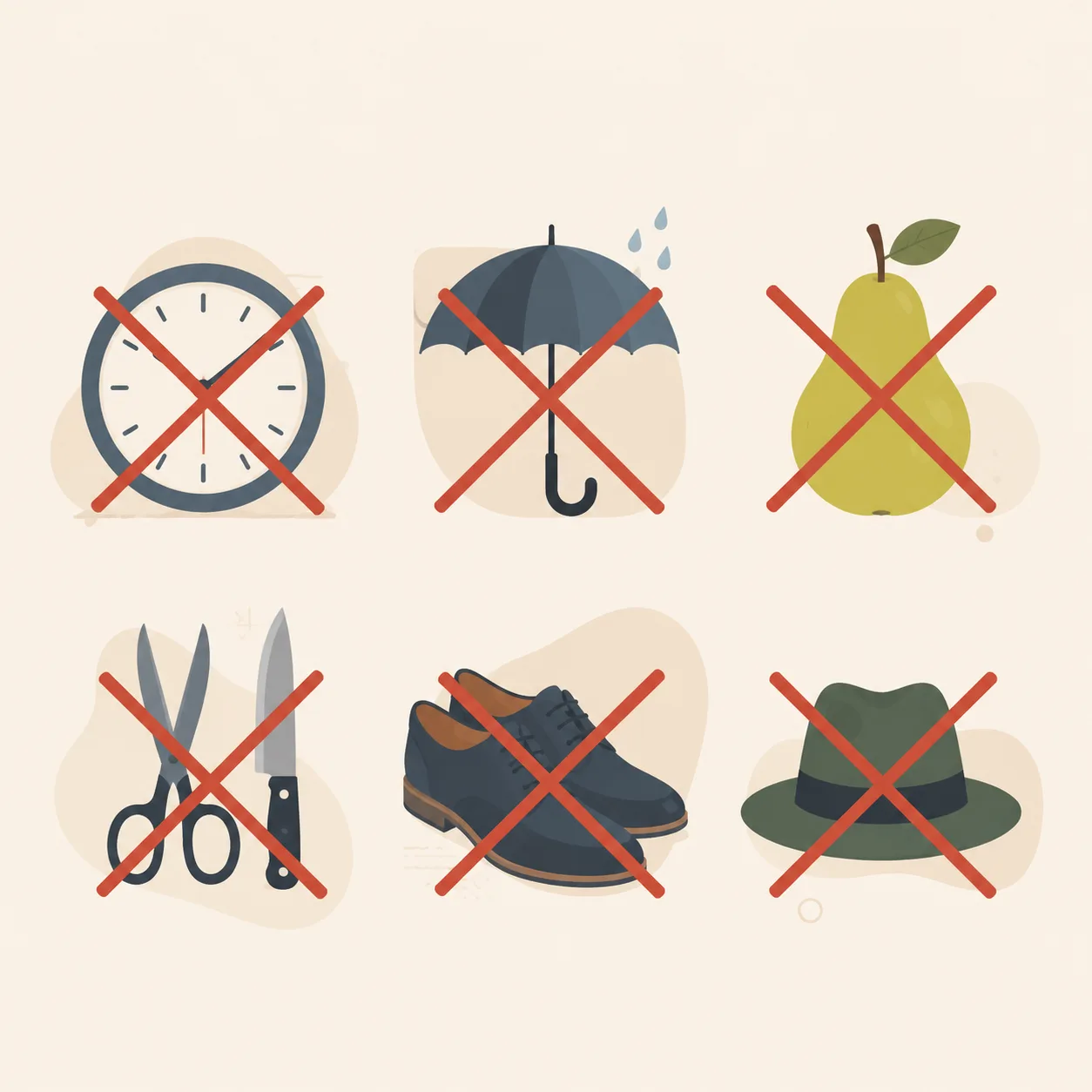
The classic gifts to avoid are clocks and watches, pears, umbrellas, shoes (especially around holidays), wallets, and cigarettes for elders’ birthdays — most of these are homophone taboos about separation, death, or drifting apart. Safe, well-received gifts include quality tea, seasonal fruit, specialty foods, and wine or baijiu for elders — ideally in even numbers and bright wrapping.
Gifts With Unlucky Meanings: Pear, Umbrella, Shoes, Wallet, Cigarettes

Several everyday gifts carry unlucky homophones: pears (梨 lí sounds like 离, “to part”), umbrellas (伞 sǎn sounds like 散, “to scatter”), shoes (鞋 xié sounds like 邪, “evil”, and suggest walking away), wallets (you would be giving away your “wealth luck”), and cigarettes for elders’ birthdays (烟 yān evokes 咽, “to gasp one’s last breath”). Sensitivity varies, but these are the classics to avoid.
Do
- Choose gifts whose names or numbers sound auspicious — wine for elders (久, “long-lasting”), tea, fruit.
- Give in even numbers where quantity applies.
- Use bright, red-toned wrapping rather than black or white.
Don't
- Don’t give pears — above all during festivals and reunions, when “separation” is the last word anyone wants.
- Don’t give umbrellas as farewell or celebration gifts.
- Be careful with shoes around holidays and for elders.
- Don’t give cigarettes as birthday or longevity gifts for elders (“寿不送烟”).
- Avoid gifting your own wallet with money in it as a “lucky” gesture — tradition says the wallet carries the giver’s wealth luck away.
Why it matters
Chinese gift etiquette is dominated by homophones (谐音): the sound of a gift’s name matters as much as the gift itself. A pear says “parting”, an umbrella says “scattering”, shoes say “evil” and “walking away”, cigarettes to an elder say “last breath”, and a wallet carries your own fortune out the door. None of this is logical — it is symbolic language, and knowing it lets you speak it fluently.
What to do instead
- Quality tea — a safe, well-received gift nearly everywhere
- Seasonal fruit in even numbers (skip pears)
- Regional specialty foods
- Wine or baijiu for elders
Real-life examples
- A guest brings a box of pears to a Spring Festival family dinner. The host accepts them graciously but won’t serve them — 梨 sounds like 离 (“separation”), the exact opposite of a reunion festival.
- A manager gives an umbrella to a departing intern with a speech about “shelter on the road ahead”. A local colleague translates the goodwill — and quietly explains why the gift itself made everyone smile awkwardly.
Traditional vs. modern
Traditional view
The pears/umbrellas/shoes taboos are standard entries in traditional gift-giving etiquette, summarized in sayings like “喜不送伞,寿不送烟” (“no umbrellas at celebrations, no cigarettes at birthdays”).
Modern reality
Young urban Chinese often ignore these taboos among themselves, but for elders, in-laws, and formal occasions — weddings, festivals, business gifts — they still shape what people actually buy.
How much it matters varies
By region and family: Recognition is national through Mandarin homophones; southern dialects have their own variations, but the “avoid” list overlaps heavily.
By generation: The gap is generational more than regional: grandparents take these seriously, grandchildren mostly know the list for exams — and for choosing gifts for the grandparents.
Chinese terms
Don’t Give a Clock (or a Watch) as a Gift
Traditionally, no. In Mandarin, “giving a clock” (送钟, sòng zhōng) sounds exactly like 送终 (sòng zhōng), an expression for attending to the dying and arranging funeral rites — so clocks and watches are the classic unlucky gift, especially for elders’ birthdays. How strongly someone feels varies by age, family, and region, but it remains the most famous gift taboo in China.
Do
- Choose gifts with positive associations instead — quality tea, seasonal fruit, specialty foods, or wine/baijiu for elders.
- Give in even numbers where quantity applies — “good things come in pairs”.
- Wrap gifts in red or other bright colors rather than black or white.
Don't
- Avoid gifting clocks, wall clocks, alarm clocks, and watches — above all as birthday or longevity gifts for elders.
- Don’t give timepieces at openings or business celebrations either.
Why it matters
The taboo is a perfect homophone: 送钟 (sòng zhōng, “give a clock”) is indistinguishable in speech from 送终 (sòng zhōng, “to see someone off at the end of life”). A gift that says “I’ll attend your deathbed” is the last thing anyone wants at a birthday celebration — which is why clocks top every traditional list of gifts to avoid, particularly for older recipients.
What to do instead
- Quality tea or a nice tea set
- Seasonal whole fruit (arranged in even numbers)
- Specialty food or wine from your home region
- Wine or baijiu for elders — 酒 (jiǔ, “alcohol”) puns on 久 (jiǔ, “long-lasting”)
Real-life examples
- A foreign guest brings an elegant imported wall clock to a colleague’s housewarming. The colleague accepts graciously — then quietly asks a coworker later what it “meant”. The guest had unknowingly chosen the single most famous taboo gift.
- A grandfather receives an antique clock for his 80th birthday. Even family members who dismiss the superstition wince: on a longevity celebration, it is the worst-choice gift by tradition.
Traditional vs. modern
Traditional view
Homophone-based gift taboos are centuries old in Chinese culture; 送钟/送终 is the most cited example in etiquette teaching.
Modern reality
Many younger Chinese consider the taboo outdated for themselves — yet still avoid clock gifts out of respect for parents and grandparents. The practical rule: don’t choose one yourself; accept the variation when others do.
How much it matters varies
By region and family: Recognized wherever Mandarin homophones carry weight (mainland China, Taiwan, Singapore, Malaysia); Cantonese-speaking regions have a parallel version of the same taboo.
By generation: Elders and traditional families take it most seriously; among close young friends it may be laughed off — but why risk it when tea and fruit always work?
Chinese terms
Never Visit a Chinese Home Empty-Handed

Yes — bringing a modest gift when visiting someone’s home is standard courtesy in China, rooted in 礼尚往来 (“courtesy demands reciprocity”). The gift doesn’t need to be expensive: fruit, tea, snacks, a specialty from your hometown, or wine for elders all work. Arriving empty-handed — especially on a first visit or a festival — can read as thoughtless.
Do
- Bring a modest gift: seasonal fruit, quality tea, snacks, or a regional specialty.
- Offer the gift with both hands when you arrive.
- Keep the value moderate — the gesture matters more than the price.
- For elders, wine or baijiu is a traditional hit (酒 puns on 久, “long-lasting”).
Don't
- Don’t show up empty-handed, especially for first visits, festivals, or formal occasions.
- Don’t overspend — an extravagant gift can embarrass the host and create obligation.
- Avoid the classic taboo gifts (clocks, pears, umbrellas) and black/white wrapping.
Why it matters
The Book of Rites states the principle outright: 礼尚往来 — courtesy flows both ways. Your host feeds you and opens their home; a gift restores the balance and signals that you value the relationship. That is why the tradition says the gift’s worth is in the 意 (thought), not the price tag.
What to do instead
- A fruit basket (even numbers of items, no pears)
- Nice tea leaves
- Specialty food from your home country or city
- Flowers are increasingly accepted in cities, though less traditional
Real-life examples
- An American student visits his tutor’s family for the first time carrying a box of California almonds. The parents later tell relatives: “he 懂规矩 — he knows the rules.” The gift cost little; the gesture did everything.
Traditional vs. modern
Traditional view
Host-guest reciprocity is one of the oldest continuously observed Chinese social rules, documented from the Book of Rites through countless later etiquette texts.
Modern reality
Fully alive today: urban Chinese still bring fruit, tea, or cake when visiting. Among very close young friends the formality may drop — but a first visit or a holiday visit without a gift still gets noticed.
How much it matters varies
By region and family: Practiced nationwide; what counts as a “good” gift varies (tea in Fujian, liquor in the north), but bringing something is universal.
By generation: Every generation expects it; only the close-friend exception is generational.
Chinese terms
Wrapping and numbers matter too
Two more traditional guidelines from the same rulebook: give in <a href="/gifts/gift-send-doubles-not-singles/">even numbers</a> where quantity applies — 好事成双, “good things come in pairs” — and choose red or other bright wrapping rather than black or white, which are associated with funerals.\n\nNeither rule is enforced among close young friends, but both smooth the way with elders, in-laws, and formal hosts, which is exactly when you want every advantage.
Real-life examples
- A guest brings a box of pears to a Spring Festival dinner. The host accepts them graciously but never serves them — 梨 sounds like 离 (“to part”), the opposite of a reunion festival.
- A manager gives an umbrella to a departing intern with a nice speech about “shelter on the road ahead”. The goodwill lands; the gift itself makes everyone smile awkwardly — 伞 sounds like 散 (“to scatter”).
- For a father-in-law’s 60th birthday, a bottle of good baijiu is a hit: 酒 (“alcohol”) sounds like 久 (“long-lasting”) — exactly the wish for the occasion.
Regional differences and generational shifts
Taboos aren’t uniform across China. In Beijing and Shanghai, younger urban professionals in their 20s and 30s often roll their eyes at homophone rules — a friend might even joke about a clock gift. But in Fujian, Guangdong, and rural areas, especially among those over 50, the same gift can cause genuine offense. Also, some regions have their own twists: in parts of Zhejiang, giving a mirror (jing) is avoided because it sounds like 'death' in some dialects, while in Hunan, giving a fan (shan) implies 'scattering' the relationship. If you’re unsure, ask a local colleague about their hometown customs — they’ll appreciate the effort.
Real-Life Scenarios: Gifts to Avoid in China
- During a business dinner in Shanghai, a German executive handed his Chinese client a black umbrella as a thank-you gift. The client accepted it politely but later mentioned to a colleague that the gift felt like a subtle hint of separation—black and white objects are linked to funerals, and the word for umbrella sounds like 'to separate.' The deal proceeded, but the relationship never warmed.
- In Chengdu, a Canadian tourist bought a beautiful green hat for her host family's grandfather as a token of appreciation. The grandfather chuckled awkwardly, and the family explained that 'wearing a green hat' (dài lǜ mào) implies a spouse's infidelity in Chinese culture. The tourist was mortified, but the family forgave her cultural slip.
- A French entrepreneur in Shenzhen brought a pair of sharp scissors to a startup partner as a symbolic gift for 'cutting through obstacles.' The partner's face fell—giving scissors signals severing ties or ending a relationship. The entrepreneur quickly clarified his intent, but the partner remained guarded for weeks.
- At a wedding banquet in Xi'an, an Australian guest presented the couple with a white envelope containing cash, thinking it was a neutral choice. The bride's mother quietly pulled her aside and explained that white is reserved for funerals; red packets (hóngbāo) are the only acceptable cash gift. The guest apologized and quickly found a red envelope, but the moment lingered awkwardly.
What the host thinks but won't say
When you give a taboo gift, the Chinese host rarely says anything negative to your face — that would be rude. Instead, they’ll accept it politely, then quietly put it aside, regift it to someone else, or even throw it away later. Internally, they might think: 'Does this foreigner not care about our family's wellbeing?' or 'Are they trying to send a message?' In business settings, a bad gift can subtly lower trust, making negotiations colder. The host won’t explain the issue — they’ll just remember. That’s why it’s better to ask a local friend before any gift-giving occasion, especially for weddings, funerals, or elder birthdays.
Quick tip for last-minute gifts
If you’re caught off guard and need a gift fast, head to a supermarket or fruit shop and buy: a bag of oranges (ji, meaning luck), apples (ping, meaning peace), or a box of quality tea. These are safe almost anywhere in China, regardless of region or generation. Avoid anything sharp, white flowers, or single items — and if you’re in doubt, bring two of something. This saves you from awkward moments and shows you’ve done your homework.
What Chinese People Actually Say
- 送钟 | sòng zhōng | giving a clock | Avoid—sounds like "attending a funeral" (送终)
- 送梨 | sòng lí | giving pears | Avoid—sounds like "separating" (离)
- 送绿色帽子 | sòng lǜsè màozi | giving a green hat | Avoid—symbolizes cuckold in Chinese culture
2026 Reality Check
2026 Reality Check: Traditional gift taboos still exist but are fading fast, especially in major cities.
Gen Z vs. Older Generations: Boomers and Gen X still avoid clocks, white flowers, number 4, pears, and umbrellas—especially for business or elder occasions. Gen Z knows these rules but often ignores them for casual gifting. They'll gift a watch or flowers without thinking twice.
Beijing/Shanghai vs. Smaller Cities: Tier-1 cities are cosmopolitan. Young professionals exchange gifts online (flowers, gift cards) without checking symbolism. Smaller cities and rural areas still observe traditional taboos more strictly—refusing a clock or white envelope remains a real offense.
The Shift: Practical gifts (red envelopes, tea, fruit) remain safe. But the old superstitions? More like gentle suggestions in 2026.
Frequently asked questions
Is it OK to give shoes to my partner?
Among young couples it is common enough, but shoes carry the traditional associations of 鞋/邪 (“evil”) and “walking away”, so they are risky gifts for elders or around holidays. Between partners who don’t mind, it’s between you.
Why are even numbers better for gifts?
Tradition ties pairs to blessings — 好事成双. It matters most for gifts counted in units (cups, bottles) and for wedding cash gifts, which should be even amounts.
Can I just give money instead?
Yes — for weddings and many formal occasions, cash in a red envelope is the standard, expected gift. Give even amounts for weddings, odd for funerals, and match the local going rate.
Sources
- 《老祖宗留下的规矩》 — Rules Passed Down by Our Ancestors (site owner’s source material)
We mark items based on traditional material and ongoing verification — cultural rules vary by region, family, and generation.
Try our tools
Related guides

Chinese Gift-Giving Guide 2026: Rules, Taboos, and What Actually Works
In China, gift-giving is not about the gift. It's about the relationship. The right gift, delivered at the right time with the right words and two hands, commun…
Read the guide →
14 Chinese Gift Taboos: The Complete Forbidden List (With Salvage Tips)
Most Chinese gift taboos come from homophones — words that sound identical to something unlucky. "送钟" (giving a clock) sounds exactly like "送终" (attending a fun…
Read the guide →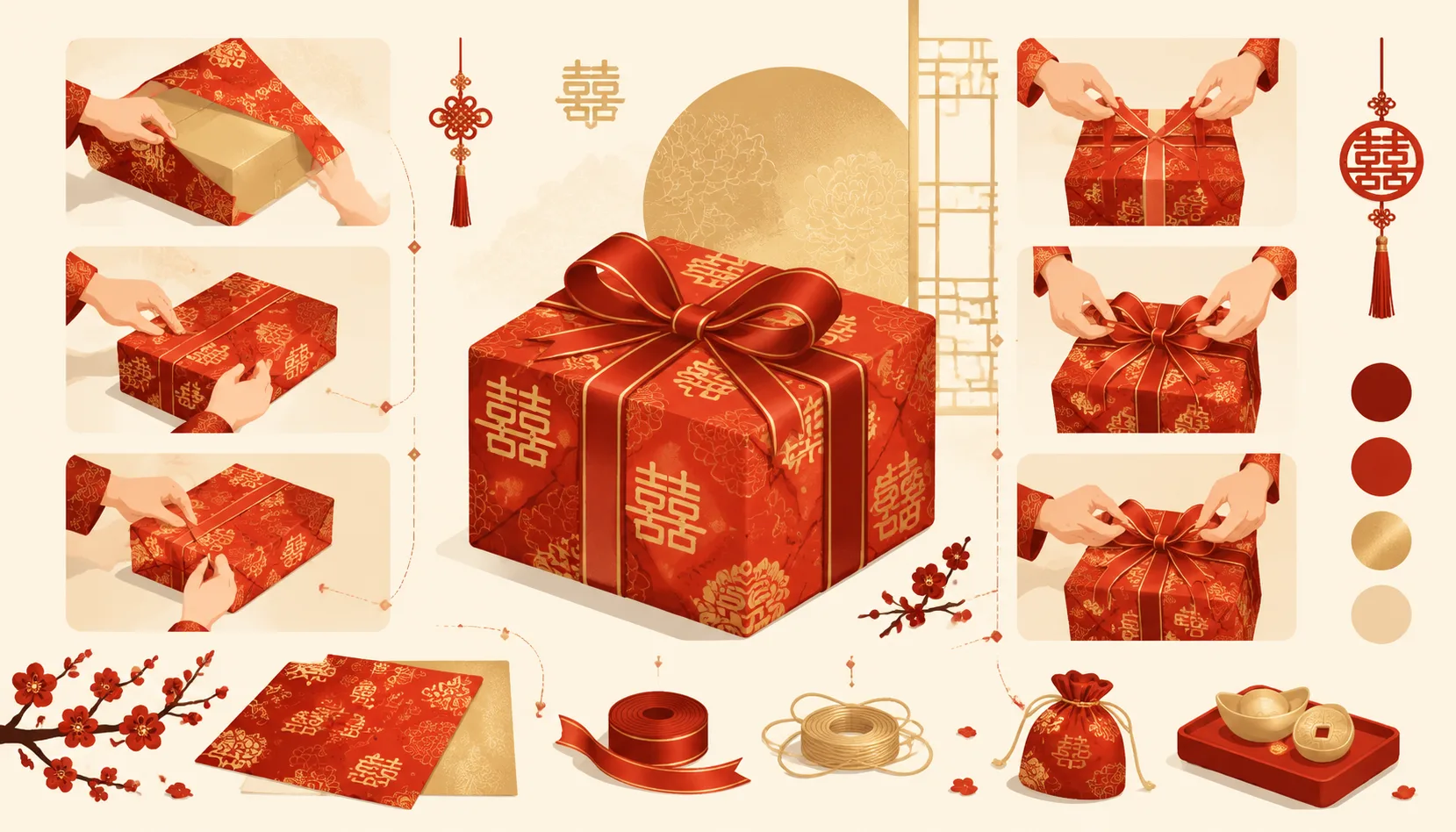
Chinese Gift Wrapping Rules: Colors, Lucky Numbers, and the Packaging Taboos You Need to Know
In China, the packaging communicates before the gift is opened. Red and gold are always safe — they signal joy and prosperity. White and black are funeral color…
Read the guide →