How do Chinese names work and how should foreigners address Chinese people without causing offense?
Quick answer
Chinese names put the family name first (e.g., Wang Wei – Wang is the family name). Always address someone by their full name or title + family name (e.g., Manager Wang) unless they invite you to use their given name. Many colleagues adopt English names for business convenience, but use them only if offered.
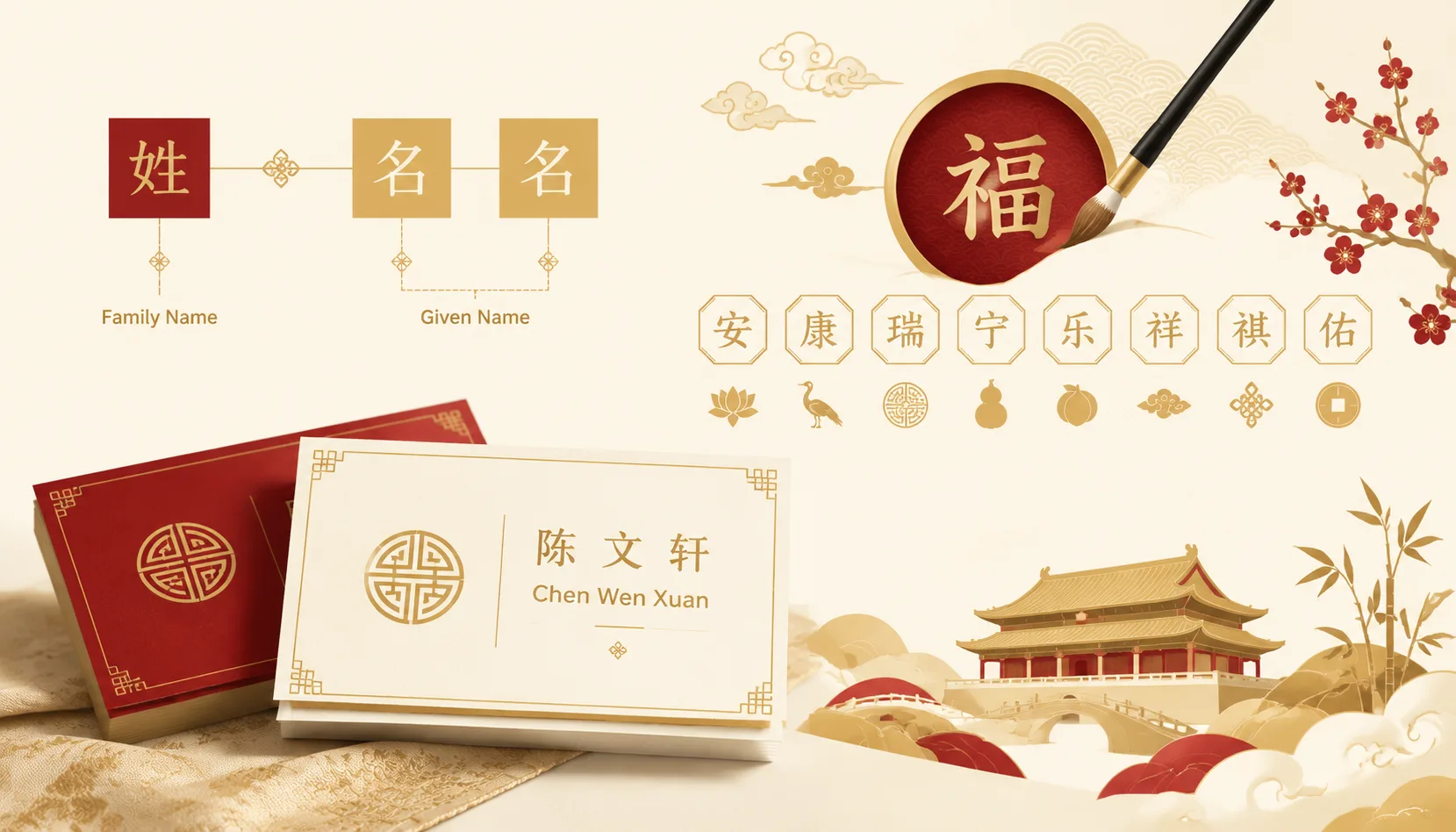
How Chinese Names Are Structured
In Chinese culture, the family name (surname) comes first, followed by the given name. For example, in Wang Wei, Wang is the surname and Wei is the given name. This order reflects the importance of family and ancestry over the individual.
Most Chinese surnames are one syllable (e.g., Li, Zhang, Chen), while given names are usually one or two syllables. Two-syllable given names often combine two characters with complementary meanings, like Jianhua (build China) or Xiu Ying (elegant and clever).
When writing names in English, the family name is often placed last to follow Western conventions, but this can cause confusion. For example, Wang Wei might be written as Wei Wang in English, but in Chinese contexts, always assume the first name you see is the surname unless told otherwise.
To avoid mistakes, always ask: “What is your family name?” or “How should I address you?” Most Chinese people are understanding of foreigners’ confusion, but showing effort to get it right earns respect.
The Meaning Behind Given Names
Chinese given names are not arbitrary—they are carefully chosen to convey positive meanings, aspirations, or virtues. Parents may select characters based on:
- Virtues: e.g., De (virtue), Ren (benevolence), Zhi (wisdom).
- Nature: e.g., Yu (jade), Hua (flower), Long (dragon).
- Auspiciousness: characters like Fu (good fortune), Shou (longevity), Xi (joy).
- Generational markers: some families share a middle character across siblings or cousins to indicate their generation.
Names can also reflect the time of birth, family hopes, or even historical events. For example, many born during the 1980s have names like Jianjun (army building) or Guoqiang (country strong).
When you meet a Chinese person, you can show interest by asking about the meaning of their name. This is often appreciated and can break the ice. However, avoid making jokes about their name or comparing it to something silly—names carry deep personal and family significance.
Auspicious Character Selection and Taboos
Choosing a name in China is a serious task, often involving auspicious characters and avoiding taboos. Parents may consult fortune tellers, use the Chinese zodiac, or analyze the five elements (metal, wood, water, fire, earth) to ensure balance.
Common auspicious characters include Xiang (auspicious), Rui (lucky), Kang (health), and An (peace). These are believed to bring good fortune to the child.
Taboos to be aware of:
- Avoid naming after ancestors: It is considered disrespectful to use the exact name of a living elder or a recently deceased relative.
- Avoid negative meanings: Characters with negative connotations (e.g., Si meaning death) are strictly avoided.
- Homophone check: Names that sound like negative words are avoided. For example, Li Si sounds like “death” in some contexts.
- Elder generation taboo: In some families, younger members must avoid using characters from the names of elders, especially in writing.
If you are helping a Chinese friend name a child, never suggest characters that sound like unfortunate words in Chinese. Always double-check with a native speaker.
Why Many Chinese Colleagues Use English Names
In international business settings, you will frequently encounter Chinese colleagues using English names like “David,” “Lucy,” or “Kevin.” This is not a rejection of their Chinese identity but a practical adaptation.
Reasons for English names:
- Pronunciation ease: Chinese sounds can be difficult for foreigners, and English names simplify communication.
- Professional identity: In multinational companies, an English name helps avoid mispronunciations that might cause embarrassment.
- Cultural neutrality: Using an English name can reduce the formality of addressing a senior or unfamiliar person.
- Personal preference: Some feel their Chinese name is too personal or sacred to be used casually by strangers.
If a colleague introduces themselves as “David,” use that name. Do not insist on using their Chinese name unless they offer it. Conversely, if they give you their Chinese name, make an effort to pronounce it correctly—ask them to say it slowly and repeat it.
Remember that English names are for convenience; they do not replace the Chinese name in official documents or formal settings. When in doubt, ask which name they prefer.
How to Address Chinese People Correctly
Addressing someone correctly is crucial in Chinese culture—using the wrong name can be seen as rude or disrespectful. Here are practical rules:
- Use title + family name: For example, Wang Jingli (Manager Wang), Li Laoshi (Teacher Li), Zhang Yisheng (Doctor Zhang). This is the safest and most respectful form.
- Use full name in formal settings: In business meetings or official introductions, use the full name (e.g., “Wang Wei”) to show professionalism.
- Do not use given name alone: Unless you are close friends or have been explicitly invited, never address someone by their given name alone. This is reserved for family, romantic partners, and very close friends.
- Use “xiansheng” (Mr.) and “nvshi” (Ms.) with surname: E.g., Wang Xiansheng (Mr. Wang), Li Nvshi (Ms. Li). This is polite but more formal.
- When in doubt, ask: “How should I address you?” is perfectly acceptable and shows respect.
Also note that in Chinese, the surname is always said first, so “Wang Jingli” means Manager Wang, not Wang the manager.
Name Taboos Around Elders and Superiors
In traditional Chinese culture, avoiding the names of elders and superiors is a sign of respect. This practice, known as bi hui (avoidance of names), has historical roots but still influences modern behavior.
Key taboos:
- Never call an elder by their given name: Even if they are friendly, always use a title like “Uncle,” “Auntie,” or their surname + title.
- Avoid using the same characters as elders’ names: When naming children, families often avoid characters that appear in the names of living grandparents or great-grandparents.
- In the workplace: Never address a boss or senior colleague by their given name unless they explicitly permit it. Use their title (e.g., “Director Zhang”) or “Boss” (laoban) in informal settings.
- When writing or speaking: If an elder’s name is similar to a common word, be careful not to use that word in a negative context.
If you accidentally use a name inappropriately, apologize sincerely. Most Chinese people will forgive a foreigner’s mistake, but showing awareness of the custom earns you respect.
Introducing Yourself Without Awkwardness
When introducing yourself to Chinese people, follow these tips to avoid confusion and awkwardness:
- State your full name clearly: Say “My name is [Full Name]” and then, if helpful, “You can call me [Nickname].”
- If you have a Chinese name, use it: Many foreigners adopt a Chinese name for easier communication. If you have one, introduce yourself with it first, then your original name.
- Explain your name structure: For example, “In English, my first name is John, and my last name is Smith. But you can call me John.” This helps Chinese people understand how to address you.
- Ask for their preferred name: After introducing yourself, ask “What should I call you?” This shows respect and avoids guessing.
- Be patient with pronunciation: If they struggle with your name, smile and offer a simpler version. Don’t show frustration.
- Use business cards: In formal settings, exchange business cards with both hands. This is a common practice and helps avoid name mispronunciations.
Remember that in China, the family name comes first. So if you introduce yourself as “John Smith,” Chinese people may assume “John” is your family name. Clarify this to avoid confusion.
What Chinese People Actually Say
- 贵姓 | guì xìng | "Your honorable surname" | Use when formally asking someone's name
- 敝姓 | bì xìng | "My humble surname" | Use when introducing yourself formally
- 久仰大名 | jiǔ yǎng dà míng | "I've long heard your great name" | Use as a polite compliment when meeting someone respected
2026 Reality Check
Reality Check 2026: Traditional Chinese naming etiquette is fading but not dead. The rule of addressing people by surname + title (王老师, 李经理) remains common in formal business and with elders, but casual settings increasingly use Western-style first names.
Gen Z vs Older Generations: Young people (under 25) largely ignore honorifics among peers, preferring nicknames or English names. They view traditional forms as "too formal" or "old-fashioned." Boomers and Gen X still expect and respect proper titles, especially in professional settings.
Beijing/Shanghai vs Smaller Cities: Tier-1 cities are more casual—first-name basis is common even in workplaces. Smaller cities and rural areas retain stronger adherence to hierarchical naming customs, particularly in government and education sectors.
Verdict: The rule survives in formal/business contexts and with elders. It's dying in casual urban youth culture. Expectation gap exists—elders may find younger people rude; youth see elders as overly formal.
Frequently asked questions
Why do Chinese names put the family name first and how does that affect how I address someone?
Chinese names follow family name first, then given name (e.g., Wang Wei). This reflects the cultural priority of family over the individual. In practice, always use the full name (Wang Wei) or title plus family name (Manager Wang). Never call someone by their given name alone unless they explicitly invite you to, as it implies a closeness you may not have earned.
What should I do if a Chinese colleague has an English name like 'David'?
Use the English name only if your colleague introduces themselves with it or asks you to call them that. It's a common bridge for foreigners, but switching to it uninvited can feel presumptuous. When in doubt, stick with their full Chinese name or title plus family name. If they say 'Call me David,' then it's fine to use it in casual conversation.
Can I use just the given name of a Chinese person if we are friends?
Yes, but only after they signal it's acceptable. Chinese friendships often move to given names naturally, but the invitation usually comes from the Chinese person, not you. If they start calling you by your first name and suggest you do the same, that's your cue. Until then, using the full name shows respect and avoids awkwardness.
Is it offensive to ask a Chinese person what their name means?
Not at all—in fact, most Chinese people enjoy explaining the meaning behind their given name, as parents choose characters with hopes for personality, success, or virtue. However, avoid asking about the family name's meaning, as it's tied to ancestry and lineage. Keep the question light and curious, and it can be a great icebreaker.
How do I address a Chinese person with a professional title like doctor or professor?
Use the title plus the family name, just like in English. For example, call a professor 'Professor Zhang' or a doctor 'Dr. Li.' If you don't know the exact title, use 'Mr.' or 'Ms.' with the family name (e.g., Mr. Wang). Avoid using given names in formal settings, as this can come across as disrespectful or overly familiar.
What if I can't remember whether the name is the family name or given name?
When in doubt, use the full name as it appears—this is almost always safe. If you must single out one part, remember that the first character(s) are the family name (usually one syllable, sometimes two). For example, in 'Ouyang Xiu,' Ouyang is the family name. If you mix it up, apologize briefly and ask for correction; Chinese people are generally understanding with foreigners.
Try our tools
Related guides
Chinese Business Titles and Forms of Address: How to Address Chinese Colleagues Correctly
In Chinese business settings, you address people by job title + surname, not by first name. "Director Li" (李总监), "Manager Wang" (王经理), "President Zhang" (张总). U…
Read the guide →
Chinese Business Card Etiquette: How to Exchange Cards in China (2026 Guide)
In China, the business card is not a contact-sharing tool. It is a formal introduction of your identity and position. Present it with both hands, Chinese side f…
Read the guide →
Chinese Phrases for Visiting Someone's Home: Essential Scripts with Pinyin
Key phrases: 打扰了 (dǎ rǎo le) = "Thank you for having me," 一点心意 (yī diǎn xīn yì) = "Just a small token," 请留步 (qǐng liú bù) = "Please don't walk me further out." …
Read the guide →