How Chinese People Apologize: Why 'I'm Sorry' Is Sometimes Not Enough
Quick answer
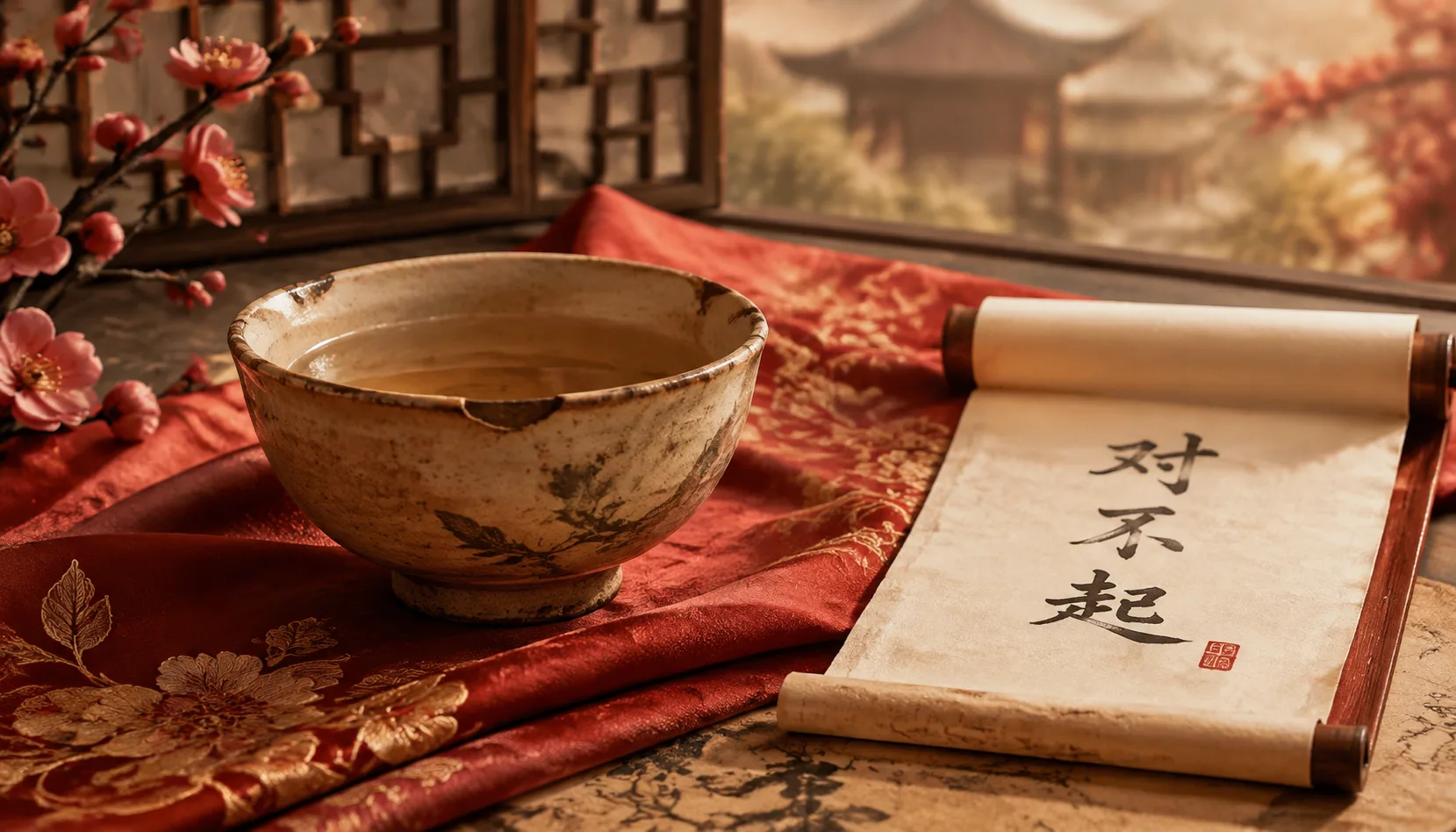
In China, “I’m sorry” often isn’t enough—context and action matter more than the phrase itself. 不好意思 (bù hǎo yìsi) covers everything from “excuse me” to deep regret, while 对不起 (duì bù qǐ) is reserved for serious faults. Expect apologies to be followed by corrective behavior, like offering tea or fixing the mistake. Accept gracefully with “没关系” (méi guānxi) to smooth things over.
The Many Faces of 不好意思 (Bù Hǎo Yìsi)
If you spend any time in China, you'll quickly notice that 不好意思 (bù hǎo yìsi) is everywhere. It's the Swiss Army knife of Chinese apologies—a phrase that can mean 'excuse me,' 'sorry to bother you,' 'I'm embarrassed,' or 'I genuinely regret what I did.' For Westerners, this can be confusing: how can one expression cover everything from bumping into someone on the subway to admitting a serious mistake?
The key is understanding that Chinese apology culture is context-driven, not word-driven. The same phrase can carry vastly different weight depending on the situation, your relationship with the other person, and what you do after saying it. In Chinese social logic, the goal of an apology is not just to acknowledge a mistake—it's to restore harmony and preserve the relationship. That's why the words matter less than the overall social repair work you do around them.
As an expat, learning to decode 不好意思 and its cousins (like 对不起, duìbùqǐ, and 抱歉, bàoqiàn) will save you from both over-apologizing and under-apologizing. Let's break down the full spectrum of Chinese apologies—from casual 'oops' to serious 'I owe you one.'
The Apology Spectrum: From 不好意思 to 对不起
Chinese has multiple words for 'sorry,' each with a different level of seriousness. Here's a practical guide:
- 不好意思 (bù hǎo yìsi): The lightest form. Use it for minor social frictions—bumping into someone, interrupting, asking for a favor, or when you feel a bit embarrassed. It literally means 'not good meaning' and conveys a sense of awkwardness or mild regret.
- 抱歉 (bàoqiàn): A step up. It means 'I apologize' and is appropriate when you've caused real inconvenience—being late to a meeting, missing a deadline, or canceling plans at the last minute.
- 对不起 (duìbùqǐ): The heavy-duty apology. It means 'I'm sorry' in the fullest sense and is reserved for genuine mistakes that have harmed someone—breaking trust, causing financial loss, or hurting someone's feelings. In serious situations, saying only 不好意思 would be seen as dismissive.
Here's the trap for Westerners: in English, we often use 'sorry' for everything, from 'sorry, what did you say?' to 'sorry I ruined your life.' In Chinese, using the wrong level can make you seem either flippant (using 不好意思 for a serious mistake) or melodramatic (using 对不起 for stepping on someone's toe).
Practical tip: When in doubt, start with 不好意思 for small things, and escalate to 抱歉 or 对不起 when the situation clearly calls for it. If you're unsure, you can always ask a Chinese friend or colleague: 'Is this a 不好意思 situation or a 对不起 situation?'
When Verbal Apology Alone Is Not Enough: The Power of Action
One of the biggest cultural shocks for Westerners in China is discovering that words alone often aren't enough to apologize for serious wrongs. In Western cultures, a sincere 'I'm sorry' can often close the matter, especially if you explain what went wrong and promise not to repeat it. In China, that's often just the beginning.
Chinese apology culture is deeply influenced by the concept of 人情 (rénqíng), or human feeling/obligation. When you hurt someone, you create an imbalance in the relationship. A verbal apology acknowledges the imbalance, but it doesn't restore the balance. To truly make amends, you need to demonstrate your regret through action.
What does this look like in practice?
- Pay for a meal: Inviting the person you wronged to dinner is a classic way to show you're sorry. The act of sharing food and spending time together symbolizes a desire to repair the relationship.
- Give a thoughtful gift: A small gift—something you know they like—shows you've been thinking about them and their feelings.
- Do them a favor: If you've caused someone inconvenience, offering to help them with a task or project can be a powerful way to make up for it.
- Public acknowledgment: If you embarrassed someone publicly, apologizing publicly (in front of the same group) can help restore their face.
For example, if you're late to a business meeting and your Chinese counterpart has been waiting for 30 minutes, a simple '抱歉' might not suffice. You might also say, 'Let me buy you lunch to make up for it.' This shows you understand the inconvenience you caused and are willing to invest in repairing the relationship.
The Face Dimension: Apologizing Without Losing Face
In Chinese culture, 面子 (miànzi)—face—is everything. Face is your social reputation, your standing in the eyes of others. Apologizing involves a delicate dance: you must acknowledge your mistake without causing the other person to lose face, and you must accept the apology without making the apologizer feel humiliated.
Here's where it gets tricky for Westerners. In English, we often value directness: 'I was wrong, and I'm sorry.' In Chinese, a direct, blunt apology can actually be counterproductive because it makes the situation too explicit and draws attention to the mistake itself. Instead, Chinese apologies often employ indirect language and face-saving strategies.
Examples of face-saving apologies:
- Blaming external factors: 'I'm so sorry—the traffic was terrible, and the meeting ran late.' This gives both parties a way to save face by attributing the mistake to circumstances rather than personal failure.
- Using 不好意思 instead of 对不起: In some situations, saying 对不起 is too strong because it implies serious fault. A lighter 不好意思 can convey regret without making the situation too heavy.
- Apologizing through a third party: For very serious offenses, you might ask a mutual friend or colleague to convey your apology, which allows the wronged party to save face by not hearing the apology directly.
When you apologize in China, the goal is not to 'own' your mistake in a dramatic, self-deprecating way that makes everyone uncomfortable. Instead, you want to acknowledge the problem, express regret, and offer a path forward—all while keeping the atmosphere harmonious.
One more tip: if you're the one who has been wronged, don't corner the other person into a public apology. That forces them to lose face, which will make them resent you. Instead, give them a face-saving way to apologize privately.
Why Chinese People Often Apologize Through Actions, Not Words
You might have noticed that Chinese people sometimes don't say 'sorry' at all, even when they've clearly made a mistake. Instead, they might do something nice for you—bring you a coffee, help you with a task, or invite you to lunch. This isn't because they're avoiding responsibility; it's because in Chinese culture, actions are often trusted more than words.
This stems from the Confucian emphasis on 行为 (xíngwéi)—behavior—as the ultimate expression of one's character. Words are cheap; anyone can say 'sorry.' But actions require effort, and effort demonstrates sincerity.
Consider this scenario: your Chinese colleague accidentally deletes a file you needed. Instead of saying 'I'm so sorry,' they might:
- Spend their lunch break trying to recover it.
- Find a workaround to get you the data you need.
- Buy you a coffee the next morning as a silent apology.
If you're from a culture where verbal apologies are the norm, you might feel that your colleague is not taking responsibility. But in Chinese terms, they are taking more responsibility—they're putting in real effort to fix the situation.
Conversely, if you are the one who makes a mistake in China, don't just say sorry—show you're sorry. Offer to fix the problem, help out, or make amends in a tangible way. This will earn you far more respect than a hundred 'I'm sorrys.'
The 'Dinner as Apology' Mechanism
One of the most distinctive features of Chinese apology culture is the dinner-as-apology mechanism. When someone has wronged you, they might invite you to a meal as a way of saying 'I'm sorry'—even if they never use the word 'sorry' during the meal.
Why dinner? Because in Chinese culture, food is a powerful symbol of connection, generosity, and community. Sharing a meal brings people together, dissolves tension, and creates a space for reconciliation. The host who pays for the meal is making a financial sacrifice, which is a tangible demonstration of their regret and desire to make things right.
Here's how it works in practice:
- The invitation: The person who made a mistake suggests getting together for a meal. This is often done casually—'Let's have dinner sometime'—but both parties understand the subtext: this is an apology meal.
- The meal itself: The conversation is usually light and social. There may be a brief acknowledgment of the issue, but it's not dwelled upon. The focus is on enjoying the food and each other's company.
- The resolution: By the end of the meal, the apology has been communicated and accepted. The relationship is considered repaired, and the incident is often never mentioned again.
For Westerners, this can be disorienting. You might be expecting a heartfelt verbal apology, but instead you're being served dumplings and tea. The key is to recognize the dinner itself as the apology. If you accept the invitation and share the meal, you are accepting the apology. If you refuse, you are signaling that the relationship is not yet repaired.
If you are the one who needs to apologize, consider offering to take the other person to dinner. It's a safe, culturally appropriate way to show remorse—especially if you're not sure what else to do.
How to Accept a Chinese Apology Gracefully
Accepting an apology in China is just as nuanced as giving one. If you respond too warmly, you might seem insincere; if you respond too coldly, you might cause the other person to lose face. Here are some guidelines:
- Don't dwell on the mistake: Once an apology has been offered (verbally or through action), it's usually best to move on. Continuing to bring up the issue can make the other person feel defensive and embarrassed.
- Respond with a face-saving phrase: Instead of saying 'I forgive you,' which can sound condescending, try something like '没关系 (méi guānxi)'—'it's nothing'—or '没事 (méi shì)'—'it's fine.' These phrases downplay the severity of the issue and signal that the relationship is more important than the mistake.
- Accept the dinner invitation: If someone invites you to a meal as an apology, go. Even if you're still a bit upset, showing up demonstrates that you value the relationship enough to work on it.
- Offer a reciprocal gesture: To fully restore balance, you might later invite them back for a meal or do them a small favor. This creates a cycle of mutual goodwill.
One common mistake Westerners make is to say 'It's okay' in response to an apology when it's not okay. In Chinese culture, saying '没关系' doesn't mean 'I'm not hurt'; it means 'I'm choosing to let this go for the sake of the relationship.' You can accept an apology while still privately feeling upset. But publicly, you should signal that you're willing to move forward.
Practical Do's and Don'ts for Expats
To help you navigate Chinese apology culture with confidence, here's a quick cheat sheet:
- Do use 不好意思 for minor social frictions—it's the default for 'excuse me' and 'sorry to bother you.'
- Don't use 对不起 for every little thing—save it for real mistakes, or you'll sound overly dramatic.
- Do offer to buy a meal or coffee when you've caused real inconvenience. It shows you understand the weight of the situation.
- Don't expect a verbal apology for every mistake. Watch for actions—someone going out of their way to help you is often their way of saying sorry.
- Do accept apologies gracefully with '没关系' or '没事'—and don't bring up the mistake later.
- Don't force a public apology in a group setting. If you humiliate someone, you'll damage the relationship beyond repair.
- Do remember that in Chinese culture, the goal of an apology is to restore harmony, not to assign blame. Focus on the future, not the past.
By understanding these nuances, you'll not only avoid cultural faux pas but also build stronger, more trusting relationships with your Chinese colleagues, friends, and business partners. Remember: in China, an apology isn't just about saying the right words—it's about showing you care enough to make things right.
What Chinese People Actually Say
When apologizing, Chinese speakers often go beyond “I’m sorry.” Here are common phrases you’ll hear:
- 不好意思 (bù hǎo yìsi) – literally “not comfortable feeling.” Used for mild apologies, like bumping into someone, asking for a small favor, or even a light “excuse me.” It can also express deeper regret when combined with context.
- 对不起 (duì bù qǐ) – literally “cannot face (you).” Reserved for more serious mistakes, such as breaking something, causing a noticeable inconvenience, or when a genuine apology is needed.
- 抱歉 (bào qiàn) – literally “regret.” A step more formal than “对不起,” used when you miss a meeting, forget a promise, or need to show sincere remorse.
- 请原谅 (qǐng yuán liàng) – literally “please forgive.” The most formal expression, used when you need explicit forgiveness after a major blunder or repeated mistake.
2026 Reality Check
2026 Reality Check: In 2026, Chinese apologies are evolving. Gen Z now often drops a quick “sorry” in English or Mandarin on social media, valuing speed and authenticity, while older generations still favor a face‑saving approach—often a gift, a meal, or a handwritten note. Tier‑1 cities like Shanghai and Beijing see a hybrid style: a casual “I’m sorry” followed by a Chinese “duìbùqǐ” in professional emails, reflecting global influence. In tier‑2 and tier‑3 towns, the classic “wǒ juéde duìbùqǐ” (I think I’m sorry) remains common, and people expect a more formal, relational apology. Recent shifts include heightened mental‑health awareness, prompting more sincere verbal apologies, yet a rise in “performative” public apologies on platforms like Weibo shows the tension between authenticity and social media performance.
Frequently asked questions
What does 不好意思 (bù hǎo yì si) actually mean and when should I use it?
不好意思 literally translates to 'not good meaning,' but it's a versatile phrase covering 'excuse me,' 'sorry to bother you,' and mild apologies. Use it for small mistakes, bumping into someone, or asking a favor. It's less serious than 对不起 (duì bu qǐ), which is reserved for genuine wrongdoing. Overusing 不好意思 in serious situations can seem insincere.
Is saying 'I'm sorry' (对不起) enough to resolve a conflict in China?
Often no, especially for serious offenses. In Chinese culture, apologies are judged by actions, not words. You must show remorse through behavior—like offering compensation, fixing the problem, or giving a gift. Simply saying 对不起 without corrective action may be seen as empty words and can damage trust further.
How do I apologize to a Chinese boss or elder without losing face?
Avoid public apologies that embarrass them. Instead, apologize privately, using humble language like 非常抱歉 (fēi cháng bào qiàn, 'very sorry'). Acknowledge your mistake, express regret, and propose a solution. Offering a small gift or treating them to a meal can help restore harmony. Never blame others or make excuses, as this shifts face.
Can I use 对不起 to say 'excuse me' when passing through a crowd?
Technically yes, but it sounds overly formal and heavy. For squeezing past people, use 借过 (jiè guò, 'let me pass') or 不好意思. Saying 对不起 for minor physical contact can make you seem excessively apologetic, which Chinese people might find awkward. Save 对不起 for real mistakes.
What if I offend someone but don't understand what I did wrong?
In China, indirect communication means you might miss subtle cues. If someone becomes distant or cold, ask a mutual friend to mediate. You can also say 如果我有做得不好的地方,请告诉我 (rú guǒ wǒ yǒu zuò dé bù hǎo de dì fāng, qǐng gào sù wǒ, 'if I did something wrong, please tell me'). This shows humility without demanding an explanation.
How should I respond when a Chinese person apologizes to me?
Don't just say 'it's okay' (没关系, méi guān xi). For minor issues, respond with 没事 (méi shì, 'no problem') or 别客气 (bié kè qi, 'don't be polite'). For serious apologies, acknowledge their effort: 我接受你的道歉 (wǒ jiē shòu nǐ de dào qiàn, 'I accept your apology') and perhaps share a meal to show reconciliation. Downplaying their apology can be seen as rejecting their sincerity.
Try our tools
Related guides

Chinese Face-Saving Language: Compliments, Refusals, and Farewells
Face-saving language in Chinese runs through compliments (always deflect, never accept directly), refusals (always indirect), and farewells (longer and more rit…
Read the guide →
Understanding Mianzi (Face) in China: The Rule Beneath All the Rules
Mianzi (面子) is social reputation and dignity — the invisible currency that governs Chinese social life. It can be given, lost, saved, or attacked. Almost every …
Read the guide →
Chinese Modesty: Why '哪里哪里' Doesn't Mean 'Where, Where?' (Compliment Guide)
When a Chinese person says “哪里哪里” (nǎlǐ nǎlǐ), they’re not asking for directions—it’s a humble way of saying “I don’t deserve your praise.” Similarly, “还行吧” (há…
Read the guide →