What are the most common and damaging mistakes foreigners make when building guanxi in China, and how can they be avoided?
Quick answer
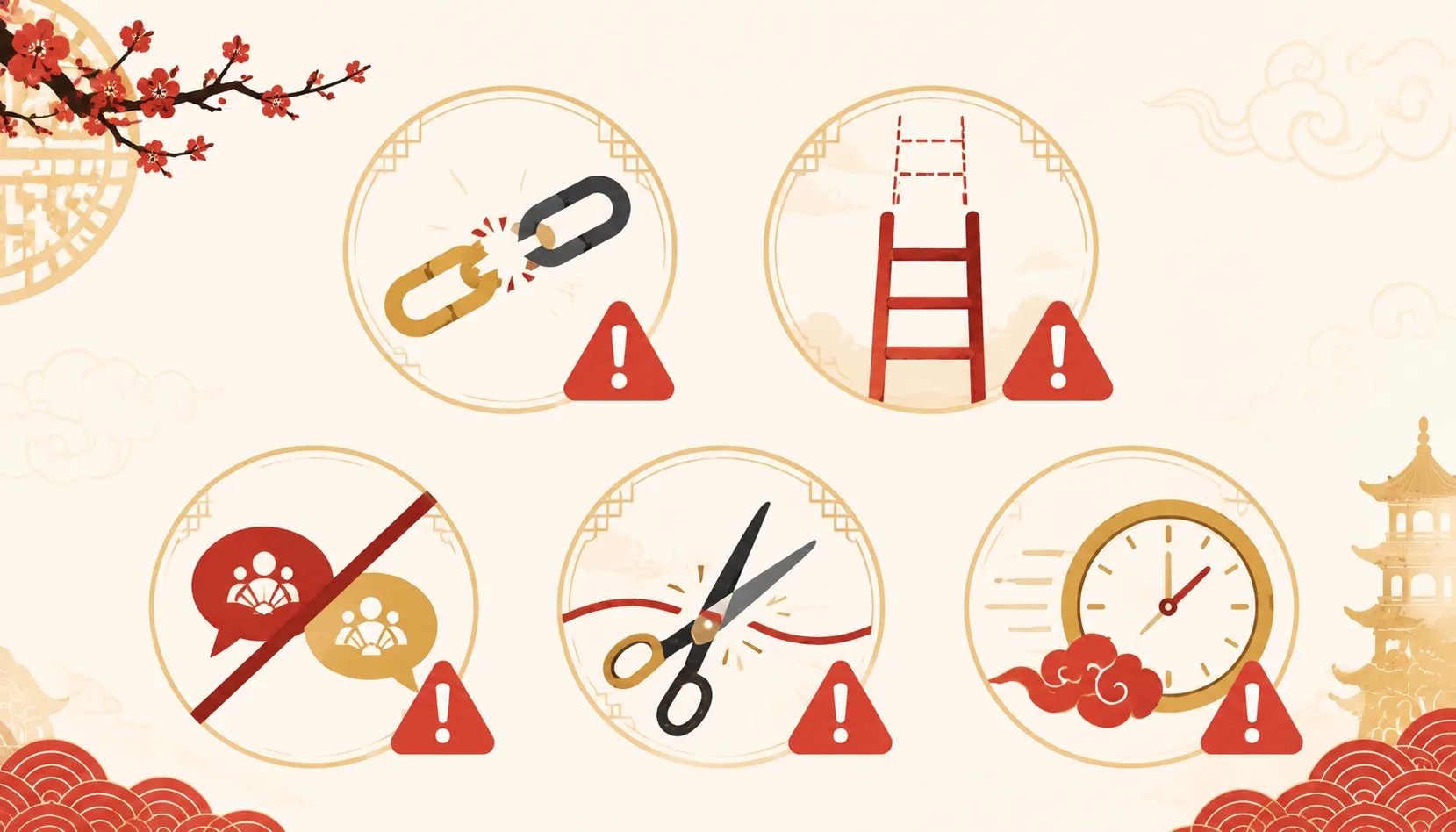
The five biggest guanxi killers are treating contacts as tools, skipping relationship levels, bragging about other connections, ghosting 'useless' contacts, and pushing for business too fast. Fix them by maintaining regular contact, diagnosing relationship levels, showing loyalty, keeping all doors open, and letting the relationship set the pace.
Why Guanxi Is a Minefield for Foreigners
You've heard it a hundred times: in China, business runs on guanxi (关系)—relationships built on trust, reciprocity, and long-term commitment. But knowing that doesn't stop you from making mistakes that quietly destroy your network. The problem? Most Westerners treat guanxi like a business card exchange: collect as many as possible, use them when needed, and move on. That approach is a one-way ticket to being labeled 不可靠 (bù kěkào)—unreliable.
Over a decade of working with foreign executives in Shanghai, I've seen brilliant professionals sabotage themselves with five recurring errors. These aren't ethical violations; they're cultural blind spots. The good news: each mistake is avoidable once you see it clearly. In this guide, I'll walk you through the five most damaging guanxi mistakes, with real-world examples and practical fixes. By the end, you'll have a self-diagnosis tool to audit your own relationships before it's too late.
Key takeaway: Guanxi is not a transaction; it's a garden. You water it even when you're not hungry.
Mistake #1: Treating Contacts as 'Tool People' (工具人)
Imagine this: You meet a Chinese supplier at a trade fair in Shenzhen. You exchange WeChat, have a promising dinner, and promise to stay in touch. Then you vanish for two years. Suddenly, you're back with a big order and a request for a 30% discount. Your contact smiles, says yes, but internally labels you a 工具人 (gōngjù rén)—a tool person, someone who only appears when they need something.
This is the most common and most lethal mistake. Chinese professionals have long memories. They notice patterns. If you only reach out when you need a favor, you're not a partner; you're a parasite. The fix is simple: maintain regular contact even when you need nothing. Send a WeChat for Chinese New Year, share an interesting article, ask about their family. It takes five minutes a month but builds a bridge that lasts decades.
Here's a real case: A German procurement manager, Markus, lost a key contact after ignoring her for 18 months. When he finally asked for a factory tour, she politely declined, citing 'scheduling conflicts.' He later learned she had labeled him 'opportunistic' in her network. Markus had to rebuild from scratch with a junior assistant—a costly lesson. Don't be Markus.
Mistake #2: Skipping Relationship Levels
In China, relationships have unspoken levels: from 认识 (rènshi) (acquaintance) to 朋友 (péngyou) (friend) to 兄弟 (xiōngdì) (brother). Each level has its own rules of exchange. Asking for a major favor when you're still at the acquaintance stage is like proposing marriage on a first date—it signals you don't respect the hierarchy.
I've seen foreigners ask a new contact to introduce them to a government official within a week of meeting. The Chinese side feels used and withdraws. The fix: diagnose which level you're at with each contact and only make level-appropriate asks. At the acquaintance level, ask for advice or a restaurant recommendation. At the friend level, ask for a warm introduction. At the brother level, you can ask for a favor that involves significant time or resources.
Here's a practical tool: Rate each key contact on a scale of 1–5 (1 = just met, 5 = trusted ally). Then match your requests to that level. If you're at a 2, don't ask for a 4-level favor. This simple discipline prevents most relationship damage.
Mistake #3: Bragging About Other Connections
You're at a dinner with a potential partner, and to impress them, you mention that you're also close friends with their competitor, Chen, and the head of the local chamber of commerce. You think you're showing your network's strength. Your Chinese host hears: 'This person is a social butterfly who won't be loyal to anyone.'
In Chinese business culture, loyalty and exclusivity are paramount. Showing off your other connections signals that you're spreading your bets, which makes you untrustworthy. The fix: never name-drop other people in your Chinese contact's circle. Be present and focused on the person in front of you. If they ask about your network, be vague: 'I know a few people, but I value our relationship most.'
Consider this case: An American entrepreneur, Sarah, was courting a major distributor. At a lunch, she casually mentioned her 'close relationship' with the distributor's rival. The distributor's enthusiasm cooled visibly. He later told a mutual friend, 'She's not serious about us.' Sarah lost the deal. Lesson: In guanxi, exclusivity is a form of respect.
Mistake #4: Cutting Off 'Useless' Contacts
You meet a junior assistant at a government office. They seem to have no power, so you stop responding to their messages. Three years later, they're the deputy director—and they remember your silence. In China, the business landscape shifts fast, and relationships have nonlinear long-tail value. The saying goes: 凡事留一线,日后好相见 (fán shì liú yī xiàn, rìhòu hǎo xiāng jiàn)—always leave a thread; we may meet again.
Cutting off a contact because they seem 'useless' today is a short-term mistake. The fix: maintain basic warmth with all contacts, regardless of current utility. Send holiday greetings, like their WeChat posts, occasionally ask how they're doing. This costs nothing but keeps the door open.
A classic example: A British expat, James, ignored a young engineer he met at a conference. Two years later, that engineer became the CTO of a major tech firm—exactly the person James needed. But the engineer wouldn't take his calls. James had to go through three intermediaries to rebuild the bridge. Don't burn bridges you can't see.
Mistake #5: Expecting Immediacy
You've had two meetings, the vibe is good, so you push for a signed contract by Friday. Your Chinese counterpart stalls, and you interpret it as disinterest. In reality, they're testing your patience. Chinese decision-making is relationship-gated: business moves only when trust is sufficient. Pushing for speed signals you're unreliable and self-centered.
The fix: read the relationship level accurately and let the Chinese side initiate the business conversation. If you've built genuine rapport, they'll bring up business when they're ready. Your job is to be patient and consistent. This doesn't mean being passive; it means being attuned to subtle cues. If they suggest a third meeting over tea, that's progress. If they introduce you to their team, that's a green light.
Remember: In China, 'yes' often means 'maybe,' and silence is a form of communication. Pushing too hard can kill a deal that was already 90% there. Patience is a strategy, not a weakness.
Self-Diagnosis: Which Mistake Are You Making?
Use this table to identify your own patterns. Be honest—everyone has at least one.
| Mistake | Symptoms | Fix |
|---|---|---|
| Tool people | Only contact when you need something; long gaps in communication | Set a monthly reminder to check in with key contacts |
| Skipping levels | Asking for big favors early; feeling rejected when they hesitate | Rate each contact (1–5) and match requests to level |
| Bragging about connections | Name-dropping in conversations; trying to impress with network size | Focus on the person in front of you; never mention rivals |
| Cutting off 'useless' contacts | Ghosting people who aren't immediately valuable | Keep a 'low-value' list and send occasional greetings |
| Expecting immediacy | Pushing for business outcomes before trust is built | Let the Chinese side initiate business; practice patience |
Print this table and keep it in your notebook. Review it before every interaction with Chinese contacts.
Recovery: It's Never Too Late to Fix Guanxi
The good news: guanxi mistakes are recoverable if caught early. The key is consistent, patient, relationship-first behavior. If you've made one of these errors, don't panic. Start by sending a sincere apology—not for the specific mistake, but for 'not being in touch enough' or 'being too focused on business.' Then, demonstrate change over time: regular check-ins, small gestures of goodwill, and zero asks for at least three months.
I've seen foreigners repair relationships that seemed dead. One executive, after realizing he'd been a 'tool person,' spent six months rebuilding trust with a client. He sent handwritten notes, remembered birthdays, and never mentioned business. When he finally did ask for a meeting, the client said yes—and they've been partners for five years. Guanxi is resilient, but only if you water it.
Start today: pick one contact you've neglected and send a simple WeChat: '最近怎么样? (Zuìjìn zěnme yàng?)'—How have you been? No agenda. That's the first step.
What Chinese People Actually Say
- 送礼 | sòng lǐ | giving gifts | Always present with both hands; never give clocks or white items as gifts.
- 走后门 | zǒu hòu mén | using connections/backdoor | Use sparingly—implies bypassing official channels.
- 给面子 | gěi miànzi | to give face/respect | Publicly acknowledge someone's status to strengthen the bond.
2026 Reality Check
2026 Reality Check: Guanxi still matters in China, but the rules have softened. Formal hierarchy matters less in tech hubs, yet relationships remain currency for business deals.
Gen Z vs Older Generations: Younger Chinese (under 30) prioritize speed and efficiency—WeChat deals over long banquets. They still respect elders but reject excessive face-saving rituals. Boomers and Gen X still expect traditional protocol: gift-giving, reciprocal favors, and public respect.
Beijing/Shanghai vs Smaller Cities: Tier-1 cities operate more globally—direct communication accepted, less rigid hierarchy. Second and third-tier cities still value traditional guanxi heavily. Local government connections remain essential outside major metros.
Bottom Line: The 5 mistakes still apply but with less severity in urban, youth circles. Ignore guanxi entirely at your peril—adapt the approach instead.
Frequently asked questions
What is the most common guanxi mistake foreigners make in China?
Treating contacts as tools instead of building genuine relationships. Avoid this by showing personal interest, remembering details about their lives, and offering help without expecting immediate returns.
How can I tell what level my guanxi relationship is at?
Diagnose the level by observing trust and reciprocity: if you're still exchanging pleasantries, it's basic; if you're sharing personal favors or introductions, it's deeper. Match your requests to the current level to avoid overstepping.
Why is bragging about other connections harmful in China?
It signals disloyalty and makes contacts feel like stepping stones. Instead, keep your network private and only mention others when it directly benefits the person you're speaking with.
Should I keep in touch with contacts who don't seem useful right now?
Yes, ghosting 'useless' contacts burns bridges—guanxi is long-term. Send occasional greetings, share relevant news, or invite them to casual meetups to keep the door open for future opportunities.
How fast should I push for business deals in a guanxi relationship?
Never rush—let the relationship set the pace. Start with small talk and social gatherings, then gradually introduce business topics only after trust is established, which can take months or even years.
What's a practical way to maintain regular contact without being annoying?
Use WeChat to send holiday greetings, share articles related to their interests, or comment on their posts. Aim for a touchpoint every few weeks, and always respond promptly when they reach out.
Try our tools
Related guides

Why Chinese People Don't Say No: Reading Indirect Refusals
In Chinese communication, direct 'no' is avoided to preserve face for both parties. Instead, you'll hear vague phrases like 'we'll look into it' (我们研究研究) or 'th…
Read the guide →
Face, Renqing & Guanxi at Work: Chinese Office Culture Decoded
In Chinese offices, mianzi governs public interactions, renqing tracks unspoken debts and credits, and guanxi maps actual influence beyond titles. To thrive, de…
Read the guide →
The Chinese Business Middleman (中间人): Why You Need One
In China's relationship-based business culture, a 中间人 transfers their personal trust to you, bypassing the cold-start problem of zero trust capital. Find one th…
Read the guide →