How do I know if I understand Chinese social etiquette well enough, and how do I level up?
Quick answer
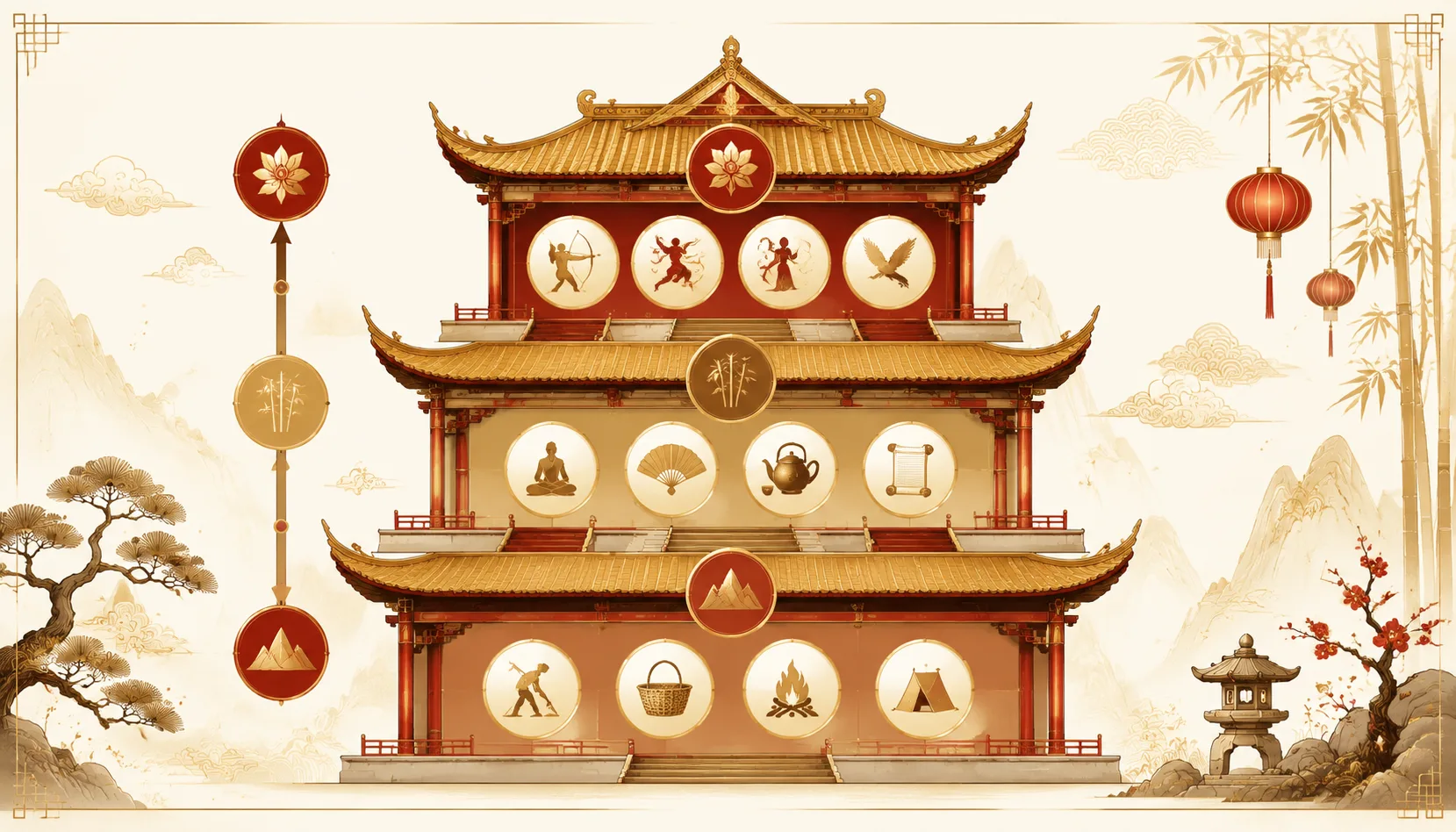
Chinese social fluency develops in stages: survival level (avoiding obvious offenses), intermediate (reading indirect signals and participating in rituals), and advanced (understanding face dynamics, relationship reciprocity, and when rules bend). This self-assessment helps you identify where you are and what to work on next.
Level 1 — Survival: Not Offending Anyone
You are at Level 1 if you can confidently answer yes to all of these:
- I remove my shoes at the entrance to Chinese homes without being reminded.
- I never stick chopsticks vertically into a bowl of rice.
- I accept a business card with both hands and read it before putting it away.
- I bring a gift when visiting a Chinese home for the first time.
- I pour for others at the table before refilling my own glass.
- I do not open gifts or red envelopes immediately in front of the giver.
- I know that "have you eaten?" is a greeting, not a dinner invitation.
- I avoid wearing white or black to Chinese weddings.
If you missed any of these: that is your starting point. These are the non-negotiables — the behaviors that, if violated, create an immediate negative impression regardless of context.
Level 2 — Intermediate: Reading the Room
Level 2 is about reading situations rather than following a fixed rulebook. You are at Level 2 if:
- You can distinguish a real dinner invitation from a ritual one based on context.
- You notice when a Chinese counterpart is giving a soft no and respond accordingly without pushing.
- You know when to speak and when to wait in a group with a senior person present.
- You can tell whether a "no problem" is genuine or a face-saving response.
- You understand that complimenting a host's food loudly is a social contribution, not flattery.
- You can give and receive compliments in the appropriate register (deflect, then graciously accept when pushed).
- You know how to excuse yourself from drinking without creating awkwardness.
The gap between Level 1 and Level 2 is not more rules — it is context-sensitivity. Level 1 practitioners follow rules mechanically. Level 2 practitioners understand why the rules exist and can adapt when the situation is unusual.
Level 3 — Advanced: Face, Reciprocity, and Relationship Capital
Advanced Chinese social fluency is about understanding the invisible architecture underneath the behaviors. You are approaching Level 3 if:
- You instinctively protect the face of people you disagree with, managing corrections privately and carefully.
- You understand that relationship reciprocity operates on a long time horizon — a favor done today may be returned months or years later.
- You know when a rule can be relaxed (close friends, younger generation, casual contexts) versus when it is non-negotiable.
- You navigate guanxi appropriately — investing in relationships genuinely, not as a transactional mechanism.
- You can read emotional subtext: when quiet means content, when quiet means upset, and when a cheerful surface is managing something uncomfortable.
- You understand that group harmony is a legitimate social value, not conformism — and you can participate in group settings without sacrificing your own integrity.
Your Learning Path: What to Work On Next
If you are at Level 1: Focus entirely on the concrete behaviors — the physical rituals, the gift-giving rules, the dining customs. These can be learned in a few weeks of intentional reading and practice. The ChineseRules101 beginner guides cover all of them.
If you are at Level 2: Your development is now about exposure, not study. Spend time in Chinese social settings, pay attention to what is happening under the surface, and reflect on interactions afterward. Ask your Chinese friends what they noticed. This stage takes months.
If you are at Level 3: You already know that the real learning here is ongoing and humbling. Every new region, generation, and social context reveals new layers. The best Level 3 practitioners stay curious and avoid assuming they have it figured out.
One tip that accelerates every stage: Learn Mandarin, even at a basic level. Language learning forces cultural immersion in a way that no amount of reading can replicate — and every phrase you learn opens a window into how Chinese people see the world.
What Chinese People Actually Say
- 礼尚往来 | lǐ shàng wǎng lái | "courtesy demands reciprocity" | Use when discussing gift-giving or returning hospitality
- 谦虚 | qiān xū | "humble/modest" | Use when downplaying achievements or deflecting praise gracefully
- 敬酒 | jìng jiǔ | "to propose a toast" | Use during formal dinners to show respect to elders or hosts
2026 Reality Check
2026 Reality Check: Many traditional Chinese etiquette rules survive, but compliance varies wildly by generation and location.
Gen Z vs. Older Generations: Millennials and Gen Z increasingly reject rigid formalities like serving tea with both hands or elaborate greeting ceremonies. They prefer casual, direct interactions. However, respect for elders and gift-giving customs remain strong—especially during Lunar New Year. Older generations still expect face-saving behaviors, but younger Chinese increasingly call out outdated rules.
Beijing/Shanghai vs. Smaller Cities: Tier-1 cities embrace Western-influenced casualness—less bowing, more handshakes. Smaller cities and rural areas maintain stricter adherence to hierarchy, formality, and traditional customs. Business etiquette in Beijing remains highly formal; social etiquette in Shanghai is more relaxed.
Verdict: Etiquette persists as situational performance. Younger urban Chinese "code-switch" between traditional formality and modern casualness depending on context—family gatherings vs. peer interactions.
Frequently asked questions
What are the most common etiquette mistakes foreigners make at the survival level in China?
At the survival level, foreigners typically commit errors like handing money or objects with one hand, pointing with a finger, or placing chopsticks upright in rice. These actions are seen as disrespectful or reminiscent of funeral rituals. Also, refusing food or drink too forcefully at a meal can offend your host. Learning these basics prevents immediate social friction.
How can I tell if I've moved from intermediate to advanced understanding of Chinese etiquette?
You've reached an advanced level when you can accurately read indirect signals, such as a host saying 'no need' while still expecting you to insist, or you understand when a rule like not toasting your superior is intentionally broken to show closeness. Advanced fluency means you can navigate 'face' dynamics and know when to bend rules for harmony.
Why is understanding 'face' (mianzi) so critical for advancing my etiquette level?
Mianzi governs nearly all social interactions in China. At intermediate levels, you avoid embarrassing others; at advanced levels, you actively give face through public praise, subtle deference, or by offering a graceful exit in awkward moments. Misunderstanding face can undermine relationships even if you follow every literal rule, making it the core differentiator between basic and true fluency.
Is it okay to ask my Chinese friends directly if I've made an etiquette mistake?
Yes, but only with close friends, and frame it humbly. Directly asking 'Did I offend anyone?' can put them in an awkward position and make them lose face. Instead, say something like 'I want to improve my manners; what would you have done differently here?' This invites guidance without demanding criticism, and shows you respect their expertise.
Can I rely on online etiquette guides for regional variations within China?
No, online guides cover general national norms but miss crucial regional differences. For example, drinking customs are far more intense in northern provinces like Shandong, while Cantonese speakers in the south place higher importance on tea-pouring gestures. When traveling, observe locals, or ask a trusted contact from that region. Adapting to regional nuances is a hallmark of advanced understanding.
What should I do if I realize I've unknowingly committed a serious etiquette breach during a business dinner?
Do not panic or over-apologize, as this draws attention and causes the host to lose face. Instead, quickly correct the action if possible, then subtly show respect, such as by toasting the host or complimenting the food. If you're unsure, follow the lead of the most senior person. A smooth recovery often impresses more than never making a mistake.
Try our tools
Related guides

Understanding Mianzi (Face) in China: The Rule Beneath All the Rules
Mianzi (面子) is social reputation and dignity — the invisible currency that governs Chinese social life. It can be given, lost, saved, or attacked. Almost every …
Read the guide →
Chinese Business Communication Style: High-Context Culture, Indirect Speech, and Reading Between the Lines
Chinese business communication is high-context: what matters is often what's not said — the tone, the timing, who said it, and what was conspicuously omitted. W…
Read the guide →
Chinese Business Etiquette Guide 2026: What Western Professionals Must Know
Chinese business culture runs on three invisible engines: Guanxi (relationships), Mianzi (face), and Hierarchy (rank order). Get these right and deals follow. G…
Read the guide →