WeChat Red Envelope Etiquette: Amounts, Timing, Refusing

Quick answer
WeChat red envelopes (hongbao 红包) are a traditional way to send money as a gift or blessing. When someone sends you one, you should usually accept it, but the amount and timing matter—refusing can be seen as rude unless done with a specific polite phrase.
Quick Answer
WeChat red envelopes (hongbao 红包 / hóng bāo) are digital versions of the traditional Chinese cash gift, sent via the WeChat app. They carry symbolic meaning—money represents luck and good wishes. When someone sends you a red envelope, accepting shows respect for their generosity; refusing improperly can damage relationships.
DO
- Say thank you (xièxie 谢谢) when receiving
- Accept with both hands if in person, or with a polite voice message
- Return the gesture on appropriate occasions (birthdays, weddings)
- Use even amounts for celebrations, odd amounts for funerals
- Open red envelopes promptly—it shows you value the sender
DON'T
- Refuse without a valid reason—it's considered rude
- Open immediately if you're the sender and testing
- Comment on the amount negatively (太少le tài shǎo / that's too little)
- Send red envelopes to your boss without understanding the context
- Ignore red envelopes from elders—it signals disrespect
Why This Matters
In China, money in a red envelope is never just money. It carries blessings, respect, and social meaning. When a colleague sends you a hongbao after you help them, refusing it suggests you don't value the relationship. When a family member sends one during Chinese New Year, accepting shows you accept their good wishes.
For foreigners, understanding this etiquette prevents awkward situations. A well-meaning refusal can actually offend the sender—they may think you look down on their gesture or don't want to maintain the relationship. In business contexts, mishandling red envelopes can damage professional relationships or even create legal issues (bribery concerns).
The amounts matter too. Sending 8 yuan (八元 / bā yuán) is good because 八 (ba) sounds like 发 (fa), meaning "prosper." Sending 4 yuan is bad because 四 (sì) sounds like 死 (sǐ), meaning "death." These number associations affect how your gesture is received.
Regional and Generational Differences
Beijing and Shanghai have different red envelope cultures compared to smaller cities and rural areas. In major cities, red envelope amounts tend to be higher and more standardized—expect 200-500 yuan ($28-70) for casual occasions among friends. In smaller cities and rural areas, amounts are often smaller but the social obligation feels stronger. If you're invited to a wedding in a tier-3 city, 100-200 yuan is appropriate; in Beijing, 500-1000 yuan might be expected from close friends.
Generational differences are significant. Older generations (50+) treat red envelopes with deep cultural seriousness—they follow traditional rules strictly and may feel genuinely offended by improper refusals. Middle-aged people (35-50) often use red envelopes strategically in business relationships and understand modern digital etiquette.
Gen Z (born after 1995) has transformed red envelope culture. They send smaller amounts more frequently, often as jokes or to show appreciation in casual chats. A 1.68 yuan "one love you" (一路发 / yī lù fā) red envelope is common among close friends. They might refuse more casually, saying "下次你请客" (xià cì nǐ qǐng kè / you treat next time). This is acceptable among peers but would be rude when receiving from elders or in formal situations.
In 2026, QR code red envelopes are becoming popular in markets—you scan a merchant's QR to receive a small "luck money" amount, typically 0.1-1 yuan. This is purely fun and carries no social obligation.
What Chinese People Actually Say
- 收下吧 (shōu xià ba) — "Please accept it" (sender to receiver)
- 恭喜发财 (gōng xǐ fá cái) — "Congratulations and prosperity" (traditional New Year greeting)
- 不用客气 (bù yòng kè qì) — "You're welcome / Don't be polite" (when refusing)
- 心意到了就行 (xīn yì dào le jiù xíng) — "The thought counts" (when amount is small)
- 下次我请 (xià cì wǒ qǐng) — "I'll treat next time" (polite refusal among friends)
- 太客气了 (tài kè qì le) — "You're too kind / too generous" (receiving)
- 我先帮你存着 (wǒ xiān bài nǐ cún zhe) — "I'll keep it for you" (to children/elders)
- 谢谢叔叔阿姨 (xièxie shūshu āyí) — "Thank you uncle auntie" (children's standard response)
2026 Reality Check
Red envelope etiquette continues evolving in 2026. Key changes:
- Digital group envelopes (群红包 / qún hóng bāo) are now standard in WeChat groups—amounts are often small (1-10 yuan) and distributed randomly among members. It's considered poor form to grab and not thank the sender.
- "Anti-corruption" limits mean government workers and state-owned enterprise employees face strict limits (typically 300 yuan maximum). Don't be confused if a government contact refuses or sends a minimal amount.
- Foreigners are given more slack—Chinese people generally understand that foreigners may not know all the rules. A polite "对不起,我不太了解这个传统" (duìbùqǐ, wǒ bù tài liǎojiě zhège chuántǒng / Sorry, I don't know much about this tradition) usually gets a understanding response.
- Voice messages matter—sending a quick voice message saying thank you in Chinese is now expected in polite exchanges. Text-only thanks can feel cold.
- Timing expectations have shifted: in 2026, it's considered polite to open red envelopes within 24 hours. Ignoring them longer signals disinterest.
Bottom line for foreigners: When in doubt, accept. Say thank you. Return the gesture when appropriate. Chinese people appreciate the effort to follow their customs, and most will help you navigate the nuances.
Related guides

WeChat Pay and Red Envelopes: A Foreigner's Guide to China
WeChat Pay may allow some users to link international cards, but eligibility, supported cards, verification, limits, and merchant acceptance vary by account, is…
Read the guide →
Never Interrupt When Two People Are Mid-Conversation
Yes. Cutting into a conversation someone else is having — even with something short — is considered a serious breach of manners. Wait until they finish before s…
Read the guide →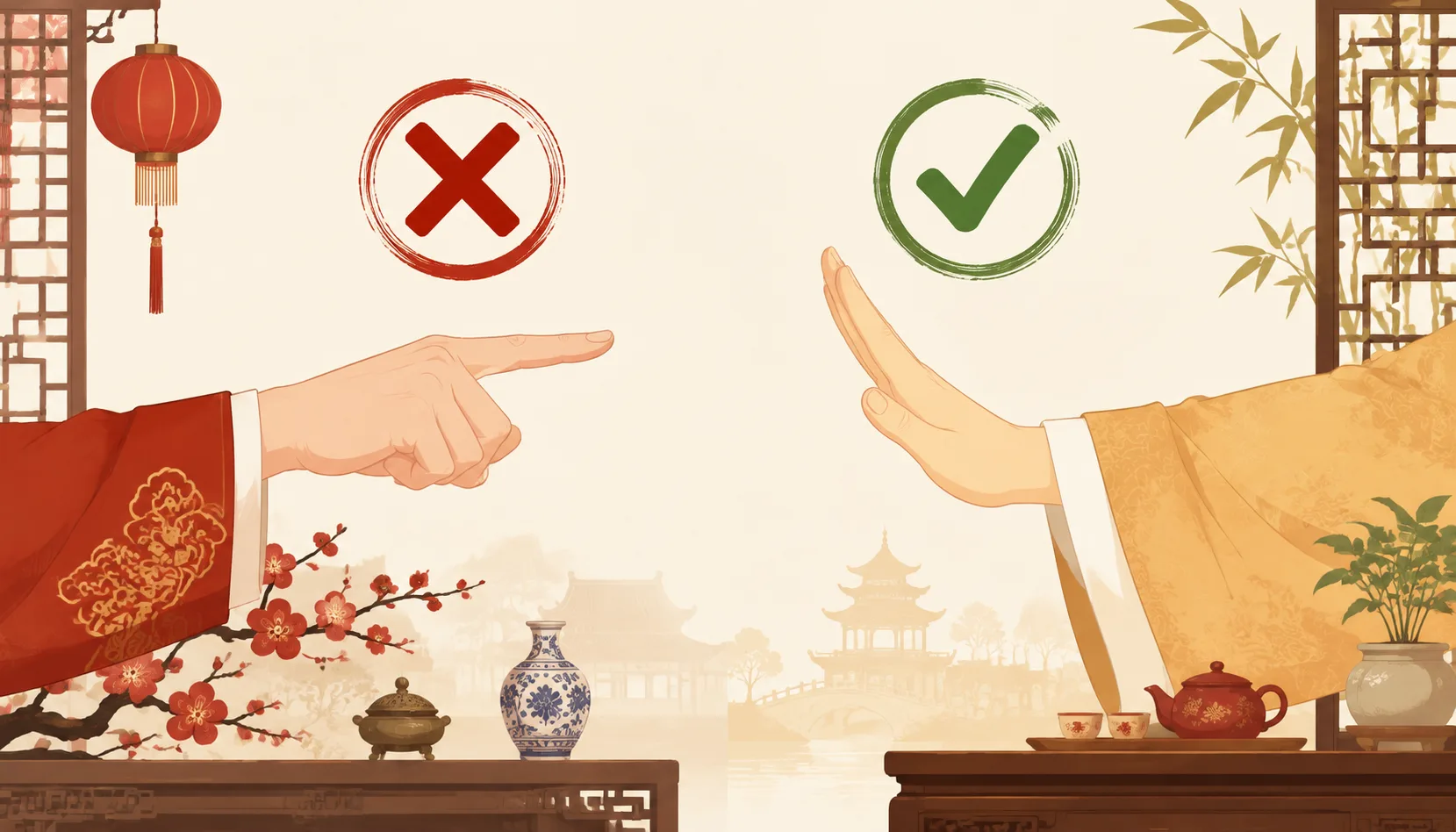
Don't Point at People With Your Index Finger
Yes. Pointing at a person with your index finger is seen as aggressive and disrespectful, regardless of your status or the context. Use an open hand gesture ins…
Read the guide →