Is it acceptable to let children misbehave in public by saying they're too young to know better?
Quick answer
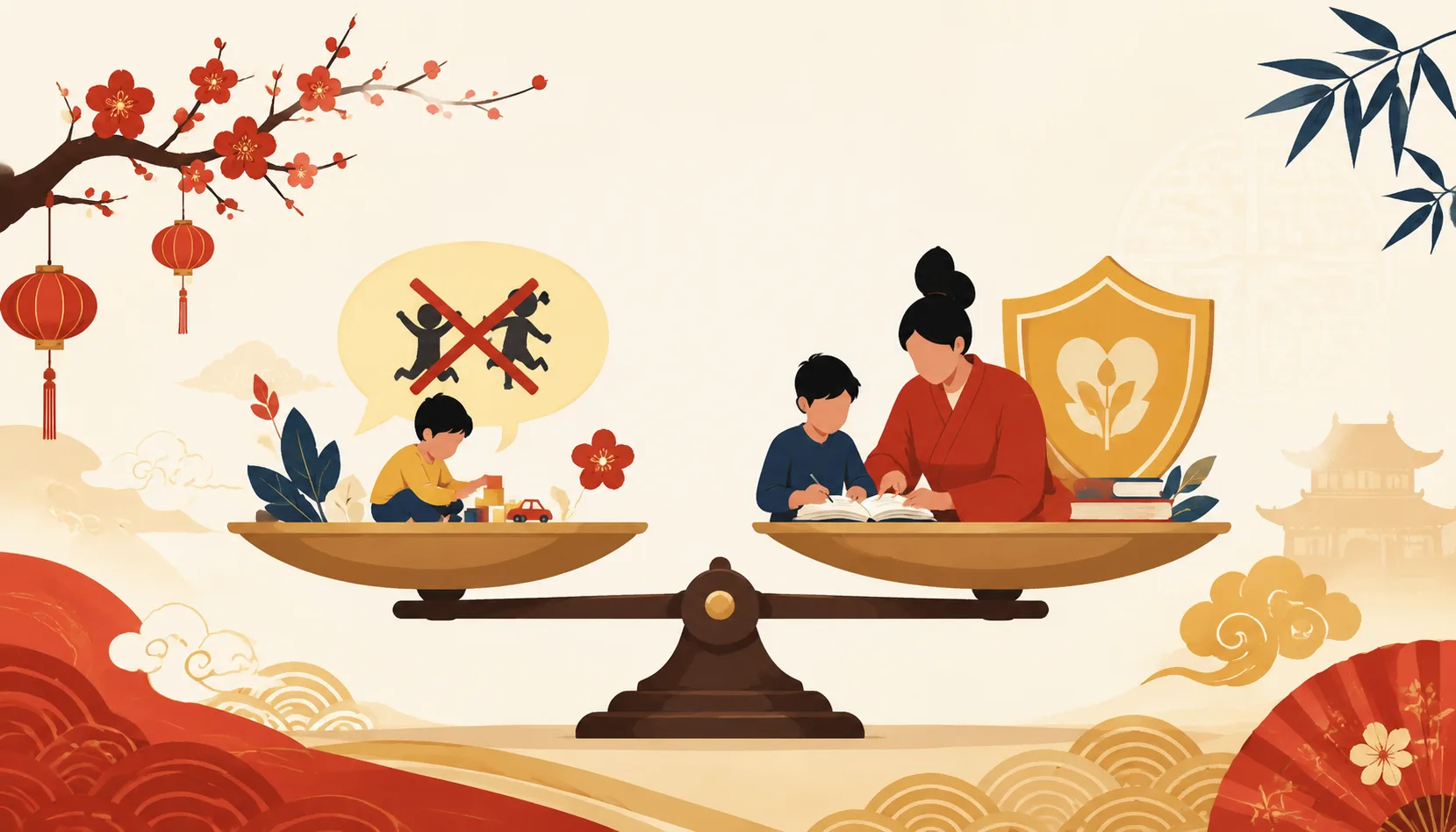
No. Using 'they're just a kid' as a blanket excuse for disruptive, rude, or inconsiderate behavior is widely condemned. Parents are expected to correct behavior regardless of age.
Why This Rule Matters
The Chinese saying 'wù yǐ shàn xiǎo ér bù wéi, wù yǐ è xiǎo ér wéi zhī' (勿以善小而不为,勿以恶小而为之, don't neglect small good deeds; don't allow small bad behaviors) emphasizes early correction. In Chinese culture, a 'bad child' reflects directly on the parents — and parents who excuse bad behavior are seen as '熊家长' (bear parents), as irresponsible as their 'bear child.'
What You Should Do
- Correct children's public behavior calmly and immediately
- Apologize to others if your child has caused disruption or inconvenience
- Teach expectations before going to public places: restaurants, ceremonies, etc.
What You Shouldn't Do
- Dismiss complaints about a child's behavior with 'what do you expect, they're a child'
- Allow a child to disturb other diners, guests, or members of the public without intervention
- Argue with adults who politely address a child's misbehavior
Practical Tips for Foreigners
This expectation is strongest in formal settings, family gatherings, and smaller cities or rural areas, while tier-1 urban parents are often more relaxed. When in doubt, watch what your Chinese host or senior colleague does and follow their lead. Breaking this rule once is forgivable — breaking it repeatedly signals a lack of cultural awareness.
Why Chinese Parents Hold Kids to Higher Standards
In China, a child's behavior is a direct reflection of the family's upbringing (jiā jiào). When a kid acts up in public, the silent judgment falls on the parents, not the child. Grandparents in particular — especially in northern cities like Beijing or Tianjin — are quick to scold a misbehaving grandchild precisely because they don't want neighbors to whisper about their 'failed' parenting. This isn't about being harsh; it's about collective face. The unspoken expectation is that even a three-year-old can learn basic social rules, and the adult's job is to enforce them, not excuse them.
Real Scenarios: When 'Just a Kid' Backfires
- An American expat in Shanghai let her 6-year-old run around a hotpot restaurant, nearly knocking over a waiter's tray. The manager didn't say anything to the child — he looked directly at the mother and said, 'Please control your child, or we'll need you to leave.' She later learned that other diners had already complained to the staff.
- In Beijing, a British father laughed off his son's loud screaming on the subway with 'He's just excited.' An elderly woman next to him muttered loudly about 'lacking family education' (méi jiào yǎng). His Chinese colleague later explained: in that context, the old lady wasn't criticizing the kid — she was publicly shaming the father.
- A German expat in Shenzhen brought his daughter to a formal dinner with his wife's family. When she interrupted the conversation repeatedly, his father-in-law from Fujian quietly put down his chopsticks and said, 'In our family, children learn to listen first.' The daughter was 5 — but that excuse held no weight in that room.
- At a Guangzhou kindergarten, an Australian mother tried to explain her son's hitting by saying 'He's still learning to share.' The Chinese teacher replied, 'Yes, and you're still learning to teach him. Let's fix both.'
Regional Nuance: Not All of China Is the Same
While the core rule holds nationwide, the intensity varies. In first-tier cities like Shanghai and Shenzhen, younger, more Westernized parents are often more relaxed — you'll see them let kids 'figure it out' at playgrounds. But in smaller cities, rural areas, or with older generations (especially from northern provinces like Shandong or Henan), the expectation is strict: children should be seen and not disruptive, period. Also note: in southern regions like Guangdong, there's a slightly more pragmatic 'kids will be kids' attitude in casual settings, but never in formal or family-gathering contexts. When in doubt, watch how the local parents around you react — match their standard, not your home country's.
The 'Face' Trap Foreigners Fall Into
Foreigners often think correcting a child in public is 'losing face' for the kid or themselves. In China, the opposite is true: a brief, firm correction — even a stern look — actually saves face because it shows you're taking responsibility. What Chinese hosts think but won't say: 'If you don't correct your child now, I assume you don't care about our relationship, because you're letting your kid disrespect my space.' Silence reads as permission, and permission reads as an insult.
What Chinese People Actually Say
- 孩子还小 | háizi hái xiǎo | "The child is still young" | Use when dismissing misbehavior as age-appropriate; common parent excuse.
- 不懂事 | bù dǒng shì | "Doesn't understand / doesn't know better" | Used to claim child lacks judgment; implies they'll learn later.
- 小孩都这样 | xiǎohái dōu zhèyàng | "All kids are like this" | Normalizes bad behavior by claiming it's universal to childhood.
2026 Reality Check
In 2026, the "don't excuse bad behavior with 'they're just a kid'" rule is increasingly ignored, especially in public spaces. Parents still use the excuse, but younger onlookers are more vocal about calling it out.
Gen Z vs Older Generations: Gen Z parents themselves are more likely to correct children in public. However, their own parents (the grandparents) still frequently use "they're just a kid" to dismiss bad behavior. The conflict between generations is visible at family dinners.
Beijing/Shanghai vs Smaller Cities: Tier-1 cities see more enforcement—parents apologize for tantrums, strangers intervene politely. In smaller cities and rural areas, the excuse remains widely accepted. "They're just a kid" still works as a social shield in many contexts.
The rule survives in principle but weakens in practice, especially outside major urban centers.
Frequently asked questions
What should I do if my child misbehaves in a restaurant in China?
Quietly but firmly correct them on the spot, apologize briefly to nearby diners, and remove them from the situation if needed. Chinese parents are expected to actively manage their children's behavior in public.
Is it okay to let a toddler cry loudly on a Chinese bus or subway?
No, you should try to soothe or distract the child, and if crying persists, step off at the next stop to calm them. Continuous loud crying is seen as a lack of parental control and may draw disapproving looks.
How do I handle my child touching items in a Chinese shop without buying?
Teach them to look with eyes only, and if they touch, guide their hand away and say 'no' firmly. Shopkeepers expect parents to prevent children from handling merchandise, so apologize and move on.
What is the Chinese view on children interrupting adult conversations?
Interrupting is considered rude; teach your child to wait or say 'excuse me' first. In China, respect for elders and social harmony means children should learn to wait their turn early.
Can I use 'they're just a kid' to excuse my child pushing others on a playground?
No, you should immediately apologize to the other child's parents and correct your child's action. Chinese parents are expected to teach respect and boundaries from a young age, not excuse aggression.
What should I do if my child throws a tantrum in a Chinese shopping mall?
Stay calm, move to a quieter corner, and talk to them at eye level until they calm down. Avoid giving in to the tantrum, as Chinese parenting emphasizes discipline and self-control in public.
Try our tools
Related guides
10 Chinese Social Myths — Debunked
Many widely circulated 'rules' about Chinese culture are oversimplified, outdated, or simply wrong. Chewing loudly is not a compliment everywhere. Baijiu does n…
Read the guide →
Ancient Chinese Etiquette Rules: What Foreigners Must Know
China has thousands of years of accumulated social rules — many of them "unwritten" but universally understood. These rules cover everything from how you sit, h…
Read the guide →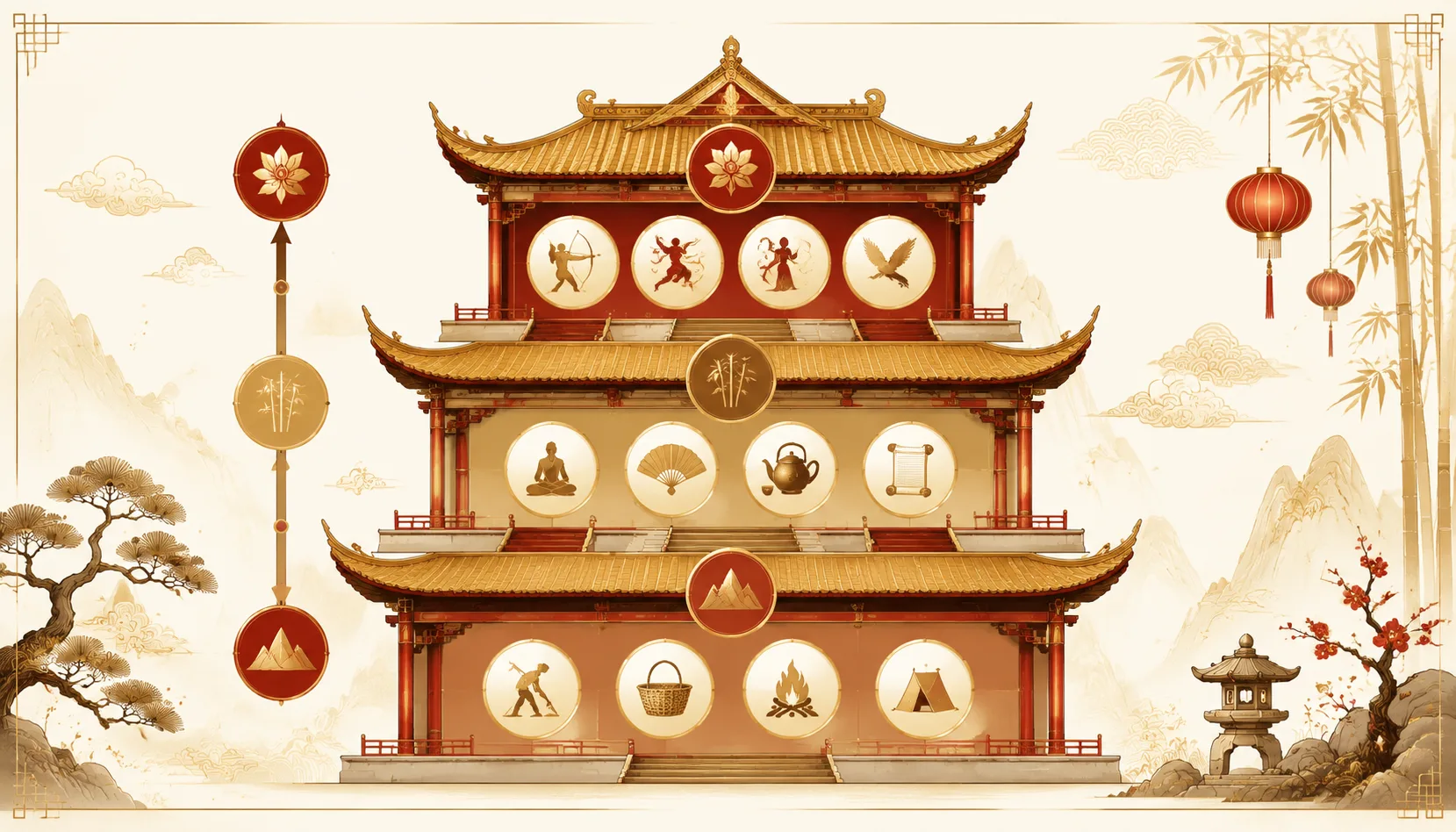
Chinese Etiquette Self-Assessment: What Level Are You At?
Chinese social fluency develops in stages: survival level (avoiding obvious offenses), intermediate (reading indirect signals and participating in rituals), and…
Read the guide →