Is there a correct way to knock on doors in China?
Quick answer
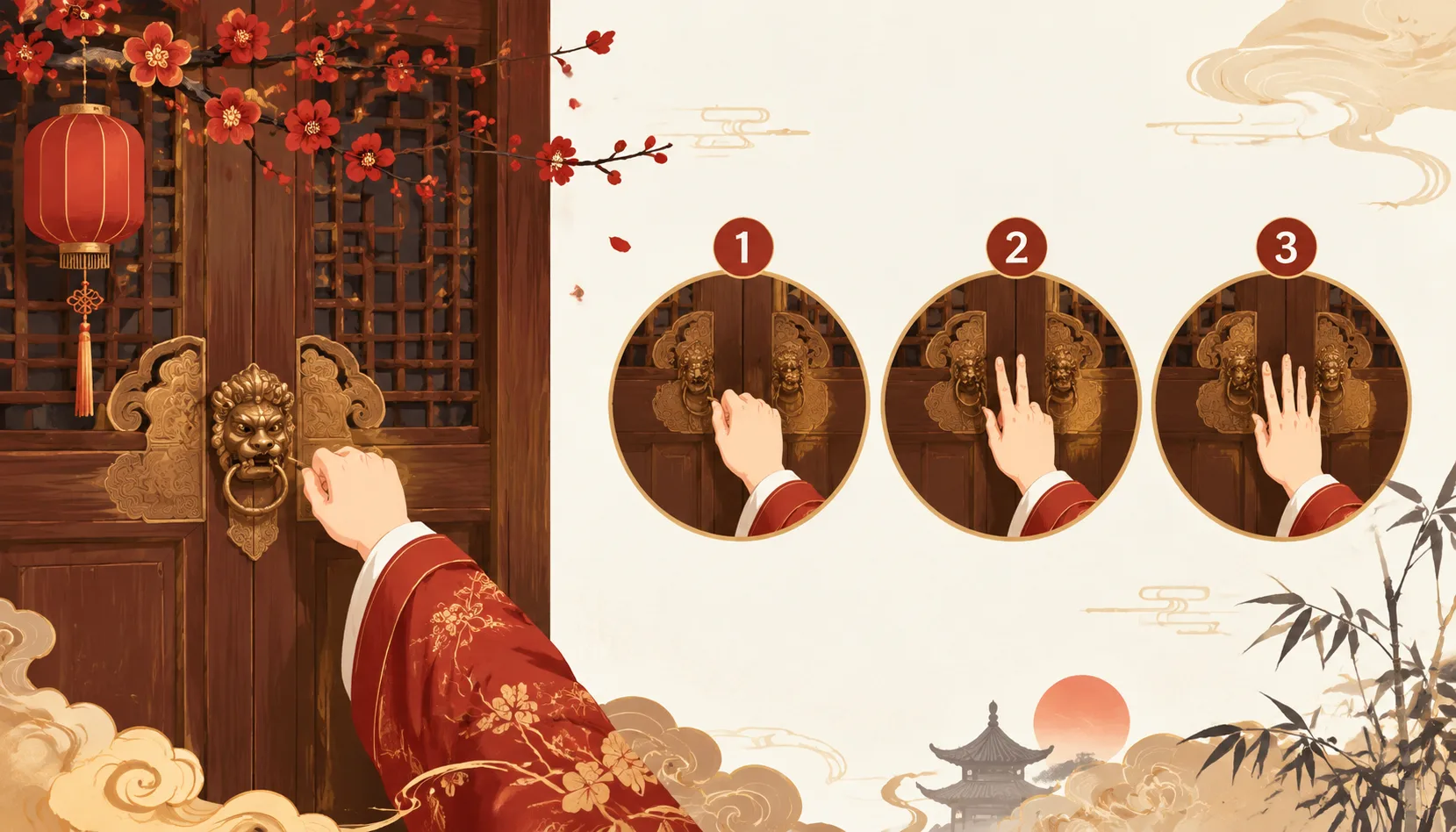
Knock three times: the first tap light, the second and third slightly firmer. Wait after knocking. Don't pound the door or ring a doorbell repeatedly.
Why This Rule Matters
A light first knock followed by two firmer ones mimics the cadence of asking '有人吗?' (yǒu rén ma, is anyone there?). Knocking too hard suggests aggression or emergency; too softly suggests timidity. Hammering a doorbell multiple times is universally regarded as impatient and rude.
What You Should Do
- Knock three times in a light-heavy-heavy rhythm
- Wait several seconds after knocking before knocking again
- If there's a doorbell, press it once slowly, wait, then press once more if needed
What You Shouldn't Do
- Pound the door loudly — it startles and alarms the person inside
- Knock too softly so no one can hear
- Ring a doorbell multiple times in rapid succession
- Walk in without waiting for acknowledgment
Practical Tips for Foreigners
This rule applies in most social and formal settings across China. When in doubt, watch what your Chinese host or senior colleague does and follow their lead. Breaking this rule once is forgivable — breaking it repeatedly signals a lack of cultural awareness.
Why the Rhythm Matters More Than Volume
In China, the knock isn't just a signal — it's a social cue carrying respect. The light-first, firmer-follow pattern mirrors the verbal politeness of 'excuse me' before entering. A flat, uniform knock sounds mechanical and impatient, like you're demanding entry rather than requesting it. Chinese hosts often subconsciously judge your temperament by your knock: too soft suggests timidity, too hard suggests aggression or anger. The three-tap rhythm gives the person inside a beat to respond — typically they'll say '进来' (come in) or open the door themselves. Pausing after knocking is equally important; it signals you're giving them time to compose themselves, whether they're tidying a desk or finishing a phone call.
Real Scenarios From the Field
- A British expat in Shanghai attended a colleague's housewarming and, out of habit, gave two quick hard knocks like back home. The host opened the door looking startled, then joked 'who's the police?' — but the tension lingered for the first hour.
- An American manager in Shenzhen knocked on a subordinate's office door with a single firm pound. The employee later told a coworker, 'I thought I was in trouble.' The manager never realized the knock had set a negative tone for the whole meeting.
- At a Beijing government office, a German consultant knocked softly and hesitantly. The receptionist didn't hear it, and he stood outside for two minutes before a passerby helped. Too soft reads as lack of confidence — even in formal settings, you must commit to the rhythm.
- In Guangdong factories, workers often knock on dorm doors with two quick taps and a shout. But at the management level, the three-tap rule still applies — younger staff in Shenzhen may laugh it off, but older supervisors from Fujian or Zhejiang still notice the difference.
Regional and Generational Variations
The three-tap rule is strongest in northern cities like Beijing and Tianjin, where formal courtesy is tied to 'face' culture. In Shanghai's business districts, the rule is observed but with a slightly faster tempo — efficiency matters. In southern Guangdong and Hong Kong, especially among younger professionals, a quick double-knock is common in casual settings, but elders from Fujian or rural areas still expect the traditional pattern. The generational split is real: under-30s often don't care, while over-50s in state-owned enterprises or government roles will notice. When in doubt, match the person's seniority — older or higher-ranking means stricter adherence to the light-heavy-heavy rhythm.
What They Won't Tell You
Chinese colleagues rarely correct foreigners on knocking etiquette — pointing it out would cause you embarrassment, which violates hospitality norms. So if your knock was too hard, they'll just open the door with a tight smile and say nothing. If it was too soft, they might ignore it entirely, pretending they didn't hear, rather than risk an awkward interaction. The silence is the feedback. If you notice doors opening a beat slower after your knock, or hosts looking slightly guarded, adjust your force next time. Also, never knock and immediately open — that's reserved for family or very close friends. For everyone else, wait for the verbal invitation.
What Chinese People Actually Say
- 敲门 | qiāo mén | to knock on the door | knock three times with moderate force
- 轻敲门 | qīng qiāo mén | to knock gently | use gentle force, not too hard or soft
- 适度敲门 | shì dù qiāo mén | to knock with appropriate force | maintain steady rhythm and moderate strength
2026 Reality Check
Reality Check 2026: The "three taps, moderate force" rule is fading but not dead. Urban millennials still observe it; many simply text "I'm here" instead.
Gen Z vs. Older Generations: Boomers and Gen X largely keep the tradition—nervous tapping signals respect. Gen Z treats door-knocking as optional, often opting for phone calls or WeChat messages. Many younger renters in cities don't even know the rule exists.
Beijing/Shanghai vs. Smaller Cities: Tier-1 cities see the weakest adherence—apartment living means buzzers replace knocking. Smaller cities and rural areas hold tighter to the custom, especially for formal visits or elders' homes. Class matters too: educated urbanites over 40 still teach it to kids; working-class families care less.
Bottom line: It's a dying etiquette in affluent urban China, survives in traditional or rural contexts. The force metaphor—"not too hard, not too soft"—now applies more to WeChat messages than actual doors.
Frequently asked questions
How many times should I knock on a door in China?
Knock three times: the first tap light, the second and third slightly firmer. This signals respect and patience.
What is the proper force for knocking on a door in China?
Use a moderate force—not too hard or soft. The first tap is light, and the next two are a bit firmer, but avoid pounding.
Should I wait after knocking on a door in China?
Yes, always wait a few seconds after knocking. This gives the person inside time to respond without feeling rushed.
Is it okay to ring a doorbell multiple times in China?
No, avoid ringing a doorbell repeatedly. One or two rings is enough; repeated ringing is seen as impatient and rude.
What should I do if no one answers after knocking in China?
Wait a few more seconds, then knock once more with the same three-tap pattern. If still no answer, leave a note or try later.
Are there any cultural reasons for the three-tap knock in China?
Yes, the three taps symbolize politeness and mindfulness, showing you are considerate of the person inside. It avoids startling them or seeming aggressive.
Try our tools
Related guides

Visiting a Chinese Home: Complete Etiquette Guide for Foreigners
Bring a small gift, arrive 5 minutes late (never early), remove shoes at the door, wait for the host to assign your seat, and let the eldest eat first. Follow t…
Read the guide →
Ancient Chinese Etiquette Rules: The Unwritten Code Every Foreigner Should Know
China has thousands of years of accumulated social rules — many of them "unwritten" but universally understood. These rules cover everything from how you sit, h…
Read the guide →
Chinese Office Etiquette: Dress Codes, Nap Culture, and Team Building
Chinese office etiquette has three surprises for most Westerners: dress codes are industry-specific and more formal than you'd expect, the lunch nap (午休) is a r…
Read the guide →