What are the three distinct layers of Chinese face (mianzi) and how do they shape business and social interactions?
Quick answer
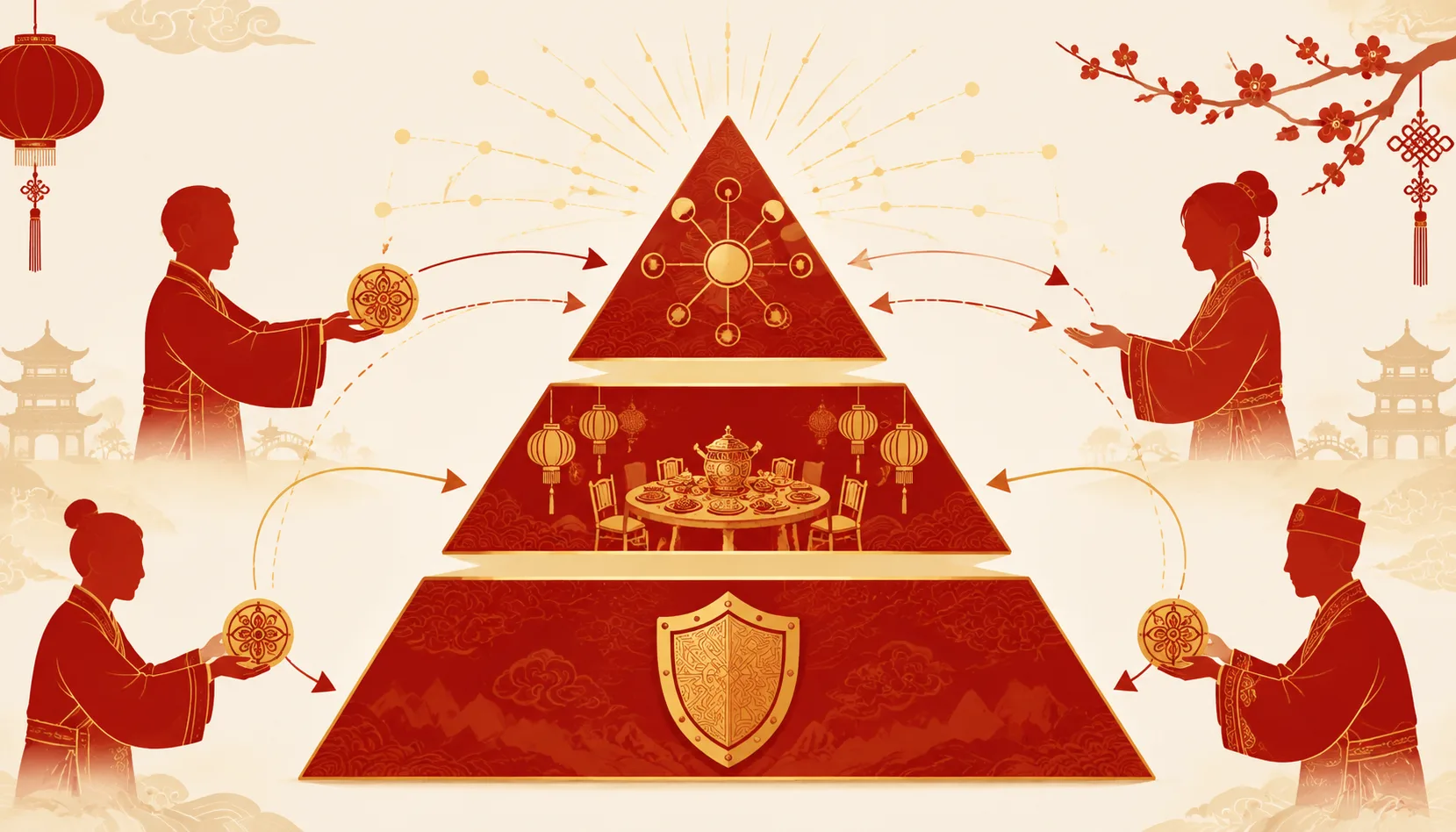
Chinese face operates on three levels: 尊严 (zūnyán, dignity) — the baseline right not to be humiliated; 排场 (páichǎng, social grandeur) — the display of respect through occasion and hospitality; and 影响力 (yǐngxiǎnglì, social influence) — the ability to mobilize people and resources. Understanding which layer is active in a given situation helps you avoid missteps and build deeper trust.
Introduction: Face Is Not One Thing — It's Three
Most Western professionals know that 面子 (miànzi, face) matters in China. They've heard the advice: don't embarrass people, give face in public, avoid direct confrontation. But that's like saying 'water is wet' — technically true, but useless for navigation.
In reality, Chinese face operates on three distinct layers, each with its own rules, triggers, and consequences. Confusing them leads to costly mistakes: a manager who thinks they're being 'direct' is actually committing social violence at Layer 1; a negotiator who skimps on hospitality is sending a message at Layer 2; a foreign executive who ignores someone's network power is blind at Layer 3.
This guide breaks down each layer with real-world scenarios, Chinese phrases, and actionable takeaways. By the end, you'll not only know what face is — you'll know which face is at stake in any given moment.
Layer 1: 尊严 (Zūnyán) — The Baseline Floor of Dignity
尊严 (zūnyán) is the foundational layer — the non-negotiable right not to be publicly humiliated. This isn't about pride or ego; it's about functional social existence. In a group-oriented culture, once you're publicly shamed, your ability to work effectively with that group collapses. People won't trust you, won't cooperate with you, and may even avoid you.
Scenario: An American manager, Mark, spots an error in a Chinese senior manager's data during a 20-person meeting. He interrupts: 'Actually, the Q3 numbers are wrong. Let me correct that.' The Chinese manager goes silent. The room freezes. Mark thinks he's being helpful; the Chinese team sees a public execution.
Why? Mark violated the first rule of 尊严: never correct someone in front of others. The damage isn't about the error — it's about the exposure. The manager loses face in front of his subordinates, and now no rational business discussion can continue until face is restored.
Actionable takeaway: If you must correct someone, do it privately, one-on-one, and frame it as a shared problem: 'I might be misreading this — can we check together?' This preserves 尊严 and keeps the relationship functional.
Layer 2: 排场 (Páichǎng) — The Active Display of Social Grandeur
排场 (páichǎng) is the layer of visible signals — the restaurant you choose, the room you book, the level of hospitality you offer. These aren't just pleasantries; they're a communication system. The message being sent is: 'How important are you to me?'
In China, the pairing of venue and occasion with the status of the relationship is what matters — not the absolute cost. A multinational CEO treated to a cheap cafeteria lunch by a potential partner is receiving clear information: 'You're not that important to us.' Conversely, a modest but well-chosen restaurant that shows thoughtfulness can convey respect.
Scenario: A foreign company's VP visits a Chinese supplier. The supplier books a private room at a top hotel, sends a car, and prepares a multi-course meal. The VP, unaware of the significance, says, 'Let's just grab a quick bite at the food court — I'm busy.' The supplier's face is damaged — they invested in 排场 and were rejected.
Actionable takeaway: When you're the guest, accept the 排场 gracefully. When you're the host, invest according to the other party's rank. If you're unsure, err on the side of more formality — it's easier to dial down than to recover from underinvestment.
Layer 3: 影响力 (Yǐngxiǎnglì) — The Highest Layer of Social Influence
影响力 (yǐngxiǎnglì) is the apex of face — the measure of your ability to convene resources and people. When someone says 他面子很大 (tā miànzi hěn dà, 'he has a lot of face'), they mean: when he makes a request, people respond. His social gravity bends outcomes.
This layer is earned over years through demonstrated reliability, reciprocity, and the size and quality of one's relationship network. It's not about title or wealth alone — it's about the trust you've built and the favors you've accumulated.
Scenario: A foreign manager, Sarah, needs a favor from a government official. She asks her Chinese colleague, David, to help. David says, 'I can make a call — but it would be better if you ask Mr. Li. He has more face with that office.' Sarah, unfamiliar with this, insists on going directly. The official is polite but non-committal. David's advice was about 影响力 — the right person with the right network can open doors that direct requests cannot.
Actionable takeaway: Before making a request, ask: 'Who has the 影响力 to make this happen?' Acknowledge that person's position publicly, and be prepared to reciprocate. Building your own 影响力 requires consistent reliability — follow through on promises, and never let a favor go unreturned.
The Key Insight: Face Is Relational, Not Internal
In Western culture, dignity is often seen as an inherent internal right: 'I have dignity regardless of what you think of me.' In Chinese culture, face is relational — it's constructed in the eyes of others and can be given, taken, or damaged by other people's behavior toward you.
This makes face a shared social responsibility. When you give face to someone, you're not just being polite — you're actively contributing to their social standing. When you take face away, you're not just hurting their feelings — you're undermining their ability to function in the group.
For Westerners, this is a paradigm shift. It means that your behavior in meetings, dinners, and negotiations has a direct impact on the social capital of your Chinese counterparts. A simple act of public acknowledgment — 'I want to thank Mr. Zhang for his excellent preparation' — can boost his 尊严 and strengthen your relationship.
Actionable takeaway: Treat face as a currency. Every interaction either deposits or withdraws. Make a habit of depositing — through public praise, appropriate 排场, and recognition of others' 影响力.
Practical Western Mistakes at Each Layer
Even experienced expats make mistakes because they apply Western logic to Chinese face. Here are the most common errors at each layer:
- Layer 1 (尊严): Public criticism. Correcting someone in a meeting, sending a critical email with a cc list, or bluntly refusing a toast. These are seen as attacks on the person's social existence.
- Layer 2 (排场): Underinvesting in occasion signals. Choosing a casual venue for a high-stakes meeting, not providing a car, or skipping the formal dinner. This communicates low regard.
- Layer 3 (影响力): Not acknowledging someone's social position when making requests. Going over their head, or failing to recognize the weight of their network. This is a subtle but damaging insult.
Scenario: At a dinner, a Western executive is offered a toast by a senior Chinese official. The executive says, 'I don't drink, but thanks,' and takes a sip of water. The official's face is damaged — the toast was a Layer 1 gesture of respect. A better response: raise your glass, touch it to theirs, and take at least a symbolic sip. You don't have to drink — but you must honor the gesture.
Actionable takeaway: Before any interaction, ask yourself: 'Which layer is active here?' If it's a formal meeting, 尊严 is at stake. If it's a dinner, 排场 is on display. If it's a request, 影响力 is in play. Tailor your behavior accordingly.
Summary Table: The Three Layers at a Glance
| Layer | Chinese / Pinyin | English | Gives Face | Damages Face |
|---|---|---|---|---|
| 1 | 尊严 (zūnyán) | Dignity | Private correction, public praise | Public criticism, exposure of errors |
| 2 | 排场 (páichǎng) | Social Grandeur | Appropriate venue, hospitality | Underinvestment, casual treatment |
| 3 | 影响力 (yǐngxiǎnglì) | Social Influence | Acknowledging network power, reciprocating favors | Ignoring status, going over someone's head |
Use this table as a quick reference. When in doubt, remember the golden rule: give face generously, and never take it away.
What Chinese People Actually Say
- 給面子 | gěi miànzi | "to give face" - showing respect by acknowledging someone's dignity | Use when accepting help or acknowledging someone's status publicly
- 丟面子 | diū miànzi | "to lose face" - to be embarrassed or humiliated in front of others | Avoid causing this in public; apologize immediately if it happens
- 挽回面子 | wǎnhuí miànzi | "to save face" - to restore dignity after a loss of prestige | Use when offering someone a way out of an embarrassing situation
2026 Reality Check
2026 Reality Check: Mianzi remains culturally significant but its practice has evolved significantly. The concept hasn't disappeared—it's transformed.
Gen Z vs. Older Generations: Younger Chinese (under 30) still value face, but increasingly view it through a pragmatic lens. They care about "face" in professional contexts (reputation, credentials) but reject traditional face-saving rituals they see as performative or虚伪 (fake). Older generations (50+) remain more traditional, viewing public acknowledgment and respect as essential to relationships.
Beijing/Shanghai vs. Smaller Cities: Tier-1 cities show a hybrid model—business face matters in corporate settings, but younger residents mock excessive face-consciousness on social media. Smaller cities and rural areas maintain stronger traditional face dynamics, where family honor and public standing carry more weight in daily interactions.
Bottom Line: Mianzi persists but with generational and urban fractures. It's not dead—it's being renegotiated.
Frequently asked questions
How can I tell which layer of mianzi is most important in a business meeting?
Watch the signals. If the meeting is formal with senior leaders, dignity (zūnyán) is at stake—avoid any public criticism. If there's lavish dining or gift-giving, social grandeur (páichǎng) is active, so reciprocate with comparable hospitality. If the discussion involves resource allocation or favors, influence (yǐngxiǎnglì) matters—show you respect their network and connections.
What's the biggest mistake Westerners make when trying to 'save face' in China?
Treating all three layers as one. Many foreigners focus only on not embarrassing someone (dignity) but forget that skipping a grand banquet or failing to recognize someone's influential connections can be equally damaging. Each layer requires different actions—politeness alone won't cover the grandeur or influence layers, which demand visible gestures of respect and reciprocity.
Is losing face permanent, or can you recover it across the three layers?
Recovery depends on the layer. Dignity loss is often permanent if it involves public humiliation—rebuilding takes years. Grandeur loss can be repaired by hosting an even bigger event later. Influence loss is recoverable if you can demonstrate value through new connections or resources. Assess which layer was damaged before attempting repair, as generic apologies rarely work.
When should I use a middleman to protect mianzi in negotiations?
Use a middleman when the negotiation involves the influence layer—when you need to mobilize resources or connections beyond your direct contact. A trusted intermediary can also protect dignity by delivering bad news indirectly. For pure grandeur matters, handle face-to-face with proper ceremony. If you're unsure which layer is active, a middleman is the safer default to avoid missteps.
Can mianzi layers vary by region in China, or are they universal?
The three layers exist everywhere, but their emphasis shifts. In northern cities like Beijing, grandeur (páichǎng) often dominates—expect elaborate banquets and formal displays. In southern business hubs like Shanghai, influence (yǐngxiǎnglì) is more prominent, with focus on networks and efficiency. In smaller cities, dignity is paramount, so avoid any public challenge to authority.
What if I accidentally damage someone's mianzi—what's the fastest way to fix it?
Act immediately and specifically. For dignity, offer a private, sincere apology without witnesses. For grandeur, publicly acknowledge your mistake and arrange a compensatory gesture, like a nicer dinner. For influence, leverage your own network to provide a tangible benefit. Never let it linger—Chinese business culture values quick, visible repair over prolonged awkwardness.
Try our tools
Related guides

Chinese Business Etiquette Guide 2026: What Western Professionals Must Know
Chinese business culture runs on three invisible engines: Guanxi (relationships), Mianzi (face), and Hierarchy (rank order). Get these right and deals follow. G…
Read the guide →
Face, Renqing & Guanxi at Work: Chinese Office Culture Decoded
In Chinese offices, mianzi governs public interactions, renqing tracks unspoken debts and credits, and guanxi maps actual influence beyond titles. To thrive, de…
Read the guide →
The Chinese Business Middleman (中间人): Why You Need One
In China's relationship-based business culture, a 中间人 transfers their personal trust to you, bypassing the cold-start problem of zero trust capital. Find one th…
Read the guide →