Where Do I Sit? The Chinese Business Banquet Playbook
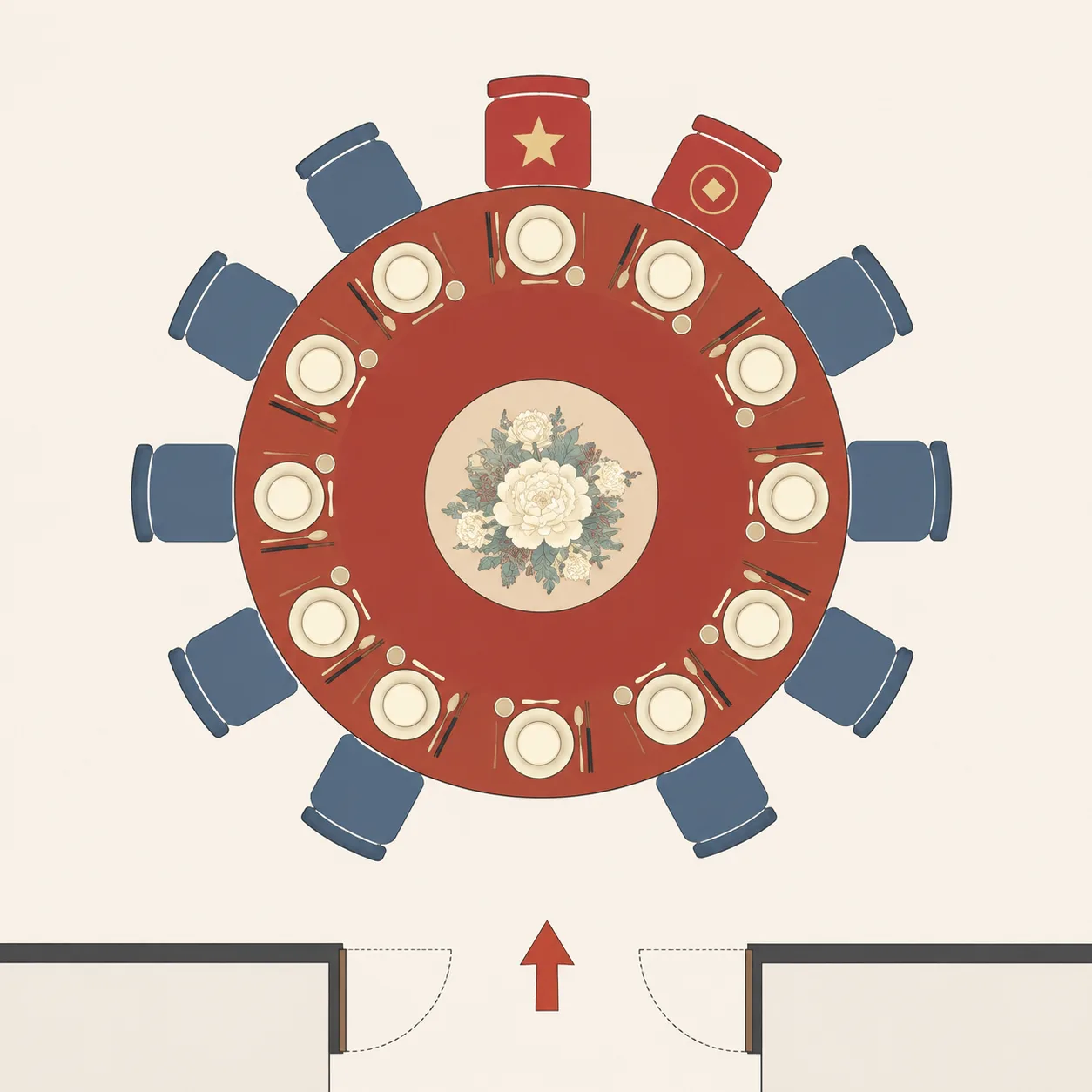
A Situation You May Recognize
A London consultant enters a Beijing banquet room and sees ten identical chairs around a round table. A colleague gestures vaguely and says, “Please, sit anywhere.” He chooses the chair facing the door so he can see the room. Seconds later, two senior guests arrive and everyone begins quietly changing places.
Was the invitation literal, a polite test, or simply incomplete guidance? The answer depends on clues most visitors never notice.
The practical guide to seating, ordering, serving tea, paying the bill, and leaving a formal Chinese dinner
Many foreigners worry about chopsticks before their first formal dinner in China.
Chopsticks are rarely the hardest part.
The difficult part is everything nobody explains.
You enter a private dining room.
Eight chairs look identical.
Someone tells you to sit down.
You wonder:
Is this the host’s seat?
Is this the guest-of-honor seat?
Am I supposed to refuse?
Who orders?
Should I pour tea?
Can I rotate the table?
Who pays?
When can I leave?
This guide deals with those invisible moments.
The First Rule of Chinese Banquet Seating
Here is the rule worth paying for:
Do not memorize a seating diagram before you understand the room.
Traditional Chinese banquet etiquette contains ideas about seats of honor, distance from the entrance, host positions, seniority, and left-versus-right precedence.
Those traditions are real.
But real restaurants are messy.
A private room may have a television on one wall, a serving station on another, windows behind one chair, two entrances, and a giant decorative painting where the theoretical “door” should be.
That makes rigid internet diagrams surprisingly dangerous.
Your most reliable signal is the host.
If someone clearly responsible for the dinner says:
“Mr. Smith, please sit here.”
Sit there.
Understanding the Main Seat
At many formal round-table dinners, there is a principal position associated with the guest of honor or senior host.
A seat with a commanding view of the entrance is traditionally significant in many layouts.
Seats closest to the principal guest may then carry greater importance.
But do not walk into a room, calculate the compass, and announce:
“According to Article 7 of Chinese Internet Etiquette, this chair belongs to me.”
Formal etiquette is supposed to acknowledge relationships.
It is not supposed to turn you into a furniture detective.
If You Are the Host
If you are organizing an important dinner, solve the seating issue before guests arrive.
Know who is the highest-ranking guest.
Know who should sit near them.
Know where your own senior representative will sit.
If there are interpreters, think about where they need to be.
If two people need to discuss a technical subject, do not place them at opposite ends of the table merely to satisfy an imaginary hierarchy chart.
Etiquette and practicality should cooperate.
If You Are the Guest
Follow direction.
If nobody directs you, pause.
Someone eventually will.
If the dinner is extremely casual and everyone simply grabs a seat, that itself is useful information.
It means the group probably does not expect a ceremonial seating plan.
Do not create formality where none exists.
If you are offered the obvious seat of honor, should you accept immediately, decline once, or wait for the host to insist?
Continue Reading — VIP Only
The rest of this article — real patterns, recognition signals, and step-by-step guidance for foreign executives — is available for a one-time unlock.
- ✓ Full article, including every example and action step
- ✓ Written for foreign professionals, managers & business owners
- ✓ Long-term access on this browser
Article preselected · One-time payment · Instant unlock
Try our tools
Related guides
The Complete Guide to Chinese Business Dinner Etiquette
At a formal Chinese business dinner, follow the host’s lead, wait for seating guidance, include everyone in conversation, and respect your own drinking limits. …
Read the guide →
Chinese Drinking and Toasting Etiquette
Chinese toasts can express respect and goodwill, but drinking alcohol is optional. Watch the host, offer a short sincere toast, and state your limits clearly. T…
Read the guide →
Chinese Business Etiquette Guide 2026: What You Must Know
Chinese business etiquette is easier to navigate when you watch three recurring patterns: relationship-building (guanxi), protecting dignity in public (mianzi),…
Read the guide →More in Dinner, Drinking & Gifts
Why Chinese Business Dinners Are About So Much More Than Food
The private dining room on the fourth floor of a Hefei hotel seats fourteen, and Daniel Brooks, a thirty-four-year-old procurement director …
Read Preview →🔒 VIPThe Complete Guide to Chinese Business Dinner Etiquette
At a formal Chinese business dinner, follow the host’s lead, wait for seating guidance, include everyone in conversation, and respect your o…
Read Preview →🔒 VIPChinese Drinking and Toasting Etiquette
Chinese toasts can express respect and goodwill, but drinking alcohol is optional. Watch the host, offer a short sincere toast, and state yo…
Read Preview →