How does the Chinese annual bonus (年终奖) work, and what do expats need to know to navigate it successfully?
Quick answer
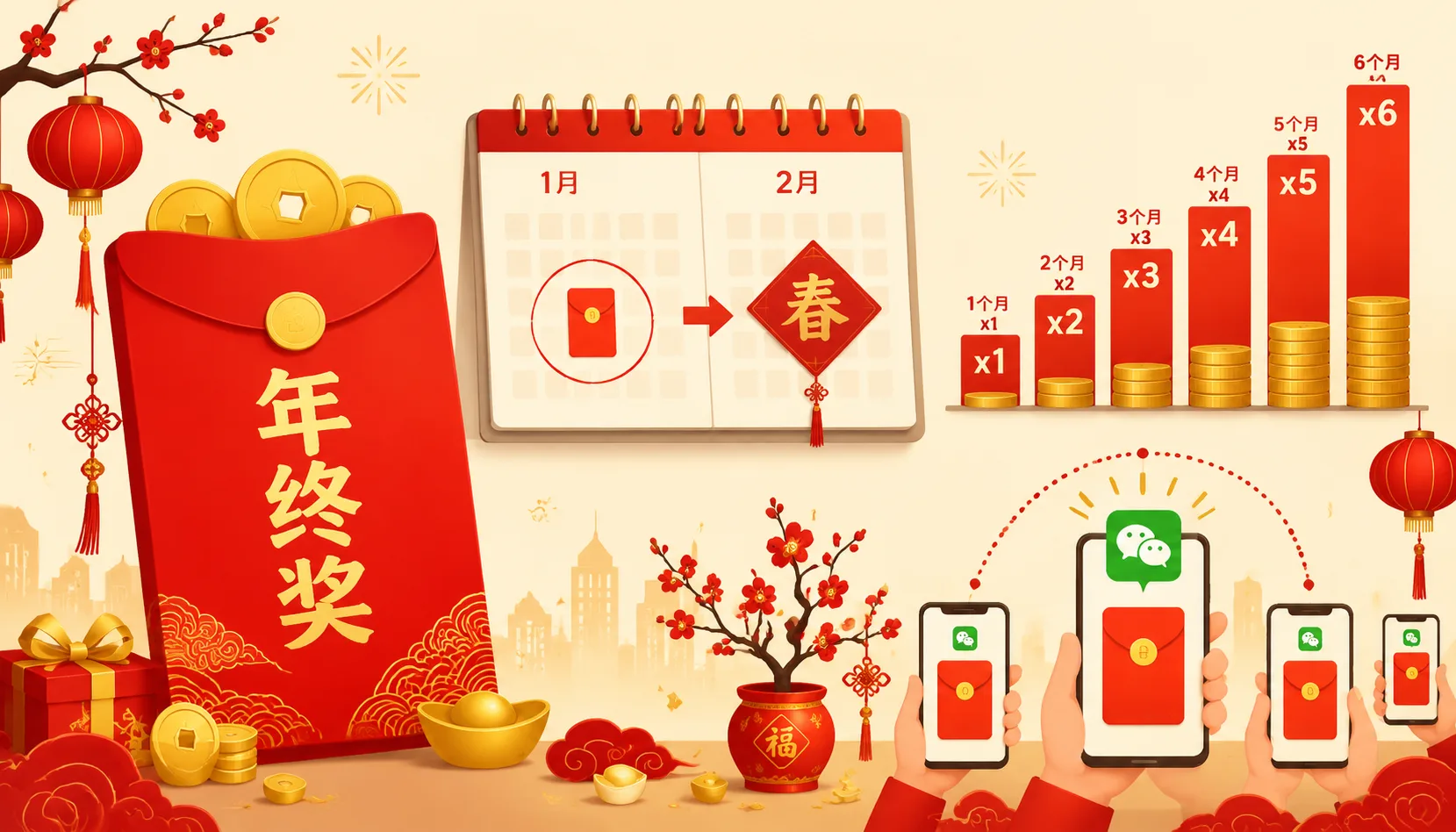
The 年终奖 (niánzhōng jiǎng) is a culturally significant year-end bonus paid before Chinese New Year, often worth 1-6 months' salary. For expats, negotiate it in your contract, communicate expectations early, and pay before the Spring Festival to avoid mass turnover.
What Is the 年终奖 (Niánzhōng Jiǎng)?
The 年终奖 (niánzhōng jiǎng) — literally 'year-end award' — is the most anticipated event in the Chinese workplace calendar. Unlike Western bonuses that are often tied to individual performance reviews, the Chinese year-end bonus carries deep cultural weight. It's not just money; it's a signal of how much the company values its employees, a measure of face (面子, miànzi), and a loyalty test.
For many Chinese employees, this bonus represents a significant chunk of their annual income. In strong-performing companies, it can range from one to six months' salary, with top performers in tech or finance seeing even more. In state-owned enterprises (SOEs) and traditional sectors, the bonus often includes physical goods like cooking oil (食用油, shíyòng yóu), rice (大米, dàmǐ), supermarket vouchers, or even small appliances — a practice that persists today, especially in government-affiliated units.
The timing is critical: the bonus is almost always paid in January or early February, just before Chinese New Year (春节, Chūnjié). This is deliberate — employees need the money for travel, gifts, and red envelopes (红包, hóngbāo) during the holiday. A late or missing bonus is more than a financial disappointment; it's a breach of trust that can trigger immediate resignation.
Why the Bonus Carries So Much Cultural Weight
In Western contexts, a disappointing bonus might lead to a quiet job search. In China, it often leads to mass departures — and quickly. Why? Because the 年终奖 is tied directly to face (面子, miànzi) and loyalty signals. When an employee receives a smaller bonus than a peer, it's a public loss of face, especially in team settings where amounts are sometimes informally compared.
The bonus also serves as a loyalty signal from the employer. A generous bonus says, 'We value you and want you to stay.' A stingy one says, 'We don't care if you leave.' This is why many employees wait all year for this moment — it's the annual verdict on their worth to the company.
Consider this scenario: a manager at a foreign company in Shanghai gives a mid-level engineer a bonus of 0.5 months' salary, citing average performance. The engineer, who expected at least 2 months based on industry norms, feels publicly humiliated. Within two weeks, he's accepted a job at a competitor offering a signing bonus that covers the gap. This is not an exception — it's a pattern.
Key insight for expat managers: The bonus is not just compensation; it's a cultural ritual. Handle it with the same care you'd give a major client negotiation.
The '13th Month' Salary vs. Performance Bonuses
Understanding the structure of Chinese bonuses is essential. Many companies pay a 13th month salary (十三薪, shísān xīn) as a baseline — essentially one extra month's pay, guaranteed and non-discretionary. This is often written into contracts and is not considered a 'bonus' in the discretionary sense.
Above this baseline, companies may offer a performance bonus (绩效奖金, jìxiào jiǎngjīn) that varies by individual and company performance. This is where the cultural complexity lies. The 13th month is expected; the performance bonus is where face and loyalty are tested.
| Component | Chinese | Pinyin | Typical Amount |
|---|---|---|---|
| 13th month salary | 十三薪 | shísān xīn | 1 month's base salary |
| Performance bonus | 绩效奖金 | jìxiào jiǎngjīn | 0-6 months' salary |
| Special awards | 特别奖 | tèbié jiǎng | Varies (e.g., project bonuses) |
In practice, a 'good' bonus in a thriving company is 2-4 months' total (including 13th month). In struggling sectors, it might be just the 13th month or less. Expat employees should clarify in their contracts whether the 13th month is guaranteed and how performance bonuses are calculated.
Timing: The Spring Festival Connection
The bonus is inextricably linked to Chinese New Year (春节, Chūnjié) and the world's largest annual human migration — the spring rush (春运, chūnyùn). This mass movement of workers begins in early February, with hundreds of millions traveling home. The bonus is the fuel for this journey: it covers train tickets, gifts, and red envelopes for family.
For expat managers, the rule is simple: announce and pay the bonus before the Spring Festival holiday. Ideally, pay it in mid-to-late January, giving employees time to plan travel and purchases. A bonus paid after the holiday loses its emotional impact and can feel like an afterthought.
Here's a practical timeline for bonus season:
- November: Set bonus criteria and communicate them clearly to all staff.
- December: Finalize performance reviews and bonus calculations.
- Mid-January: Announce bonuses individually and pay them.
- Late January: Distribute any additional red envelopes (红包, hóngbāo) via WeChat.
Remember, the Spring Festival date changes each year (late January or February), so check the lunar calendar and plan accordingly.
Red Envelope (红包) Culture at Bonus Time
Beyond the formal bonus, companies often distribute digital red envelopes (微信红包, Wēixìn hóngbāo) via WeChat during the bonus season. This is a modern twist on the traditional red envelope given during Chinese New Year. These digital gifts are smaller — typically 50 to 500 RMB — but they carry symbolic value.
For expat managers, participating in this practice is a powerful loyalty builder. Here's how to do it right:
- Distribute to the whole team on the same day — never single out individuals, as this can cause jealousy.
- Use WeChat's group red envelope feature, which randomly splits amounts — this adds fun and fairness.
- Send a brief message with the envelope, such as '感谢大家一年的努力' (gǎnxiè dàjiā yī nián de nǔlì — 'Thank you for your hard work this year').
- Don't make it a substitute for the formal bonus — it's an addition, not a replacement.
For expat employees, you'll likely receive these envelopes. Accept them graciously and consider sending a thank-you message in Chinese — it will be remembered.
For Expat Managers: Communication Is Key
The most common mistake expat managers make is poor communication about bonuses. In China, employees often harbor expectations all year based on industry norms, past payouts, or even rumors. If you stay silent until January, you risk a shock that leads to mass resignations.
Here's your action plan:
- Set expectations early: In your first team meeting of the fiscal year, explain the bonus structure — what's guaranteed (e.g., 13th month) and what's variable.
- Give mid-year feedback: Don't wait until December to tell someone their performance is lacking. Regular feedback prevents bonus-season surprises.
- Be transparent about company performance: If the company had a tough year, communicate this early so employees aren't blindsided.
- Announce individually, not publicly: Schedule one-on-one meetings to deliver bonus news, allowing for private reactions.
A well-handled bonus season can build loyalty that lasts all year. A badly communicated one can trigger a wave of resignations in February — a phenomenon so common it has a name: 年后离职潮 (nián hòu lízhí cháo, 'post-holiday resignation wave').
For Expat Employees: Negotiate and Know Your Rights
If you're an expat employee in China, the bonus is a critical part of your compensation — and it's negotiable during hiring. Unlike in some Western countries where bonuses are discretionary, in China it's standard to have the bonus structure written into your contract.
Here's what to do:
- Negotiate at the offer stage: Ask for a guaranteed 13th month and a clear formula for performance bonuses (e.g., 'up to 2 months based on individual and company performance').
- Ask HR about historical payouts: During interviews, ask 'What was the average bonus payout last year?' This gives you a benchmark.
- Read your contract carefully: Look for terms like 十三薪 (shísān xīn) and 绩效奖金 (jìxiào jiǎngjīn). Ensure they're defined.
- Understand tax implications: Bonuses are taxed differently in China — the tax rate can be higher for lump sums. Ask HR for a net estimate.
Remember, in Chinese workplace culture, asking about bonuses is not rude — it's expected. If you don't negotiate, you'll likely get the minimum. Be direct but polite, and frame it as wanting to understand the full package.
What Chinese People Actually Say
The 年终奖 (niánzhōng jiǎng) is a culturally significant year‑end bonus paid before Chinese New Year, typically worth 1‑6 months’ salary. For expats, negotiate it in your contract and communicate expectations early.
- 今年年终奖发了没? (Jīn nián niánzhōng jiǎng fā le méi?) – "Has this year's year‑end bonus been issued?" – Used among colleagues to ask whether the bonus has been paid.
- 老板说年终奖会发双薪。 (Lǎobǎn shuō niánzhōng jiǎng huì fā shuāng xīn.) – "Boss says the year‑end bonus will be double salary." – Used to share a rumor or expectation about the bonus amount.
- 年终奖发了我就买买买。 (Niánzhōng jiǎng fā le wǒ jiù mǎi mǎi mǎi.) – "When the year‑end bonus is given, I'll go shopping." – Expressed excitement about spending the bonus.
- 希望年终奖能抵得上一年辛苦。 (Xīwàng niánzhōng jiǎng néng dǐ de shàng yì nián xīnkǔ.) – "Hope the year‑end bonus can compensate for a year of hard work." – Used to express hope that the bonus matches one's yearly effort.
2026 Reality Check
2026 Reality Check: As Chinese companies finalize 2025 bonuses, the gap between Gen Z and older employees is widening. Gen Z (born after 1995) now prioritizes transparent, performance‑linked payouts and flexible benefits, while veterans still favor stable, fixed‑amount year‑end bonuses. In tier‑1 cities such as Beijing, Shanghai, and Shenzhen, average bonuses can exceed two months’ salary, but many firms are tying a larger portion to KPIs. In tier‑2/3 cities like Chengdu, Hangzhou, and Wuhan, bonuses are more modest—often one month’s salary—but are increasingly tied to local performance metrics and regional incentives. Remote‑work and gig‑economy roles are also reshaping expectations, with younger workers expecting digital‑first reward platforms. For multinationals, aligning these generational and city‑tier differences is key to retaining talent in 2026.
Frequently asked questions
Is the annual bonus legally required in China or is it just a cultural tradition?
It's not legally mandatory unless your employment contract explicitly states it. However, once a company establishes a bonus policy or past practice, employees may have a legal claim under Chinese labor law. Always get the bonus terms in writing—verbal promises are risky. Many expat contracts include a guaranteed 13th-month salary, which is different from a performance-based 年终奖.
What happens if I resign before Chinese New Year—do I still get the annual bonus?
It depends on your contract and company policy. Many Chinese companies require you to be employed on the bonus payment date to qualify, so leaving early often means forfeiting it. Some firms prorate based on months worked. Check your contract's resignation clause and ask HR before handing in your notice—negotiating your departure date around the bonus payout can save you a significant sum.
Can my employer legally withhold my annual bonus if I've already earned it?
If your bonus is contractual and you've met the performance conditions, withholding it without cause can be challenged. However, companies often argue that bonuses are discretionary. To protect yourself, document your performance reviews and any written bonus commitments. If your employer withholds unfairly, you can file a complaint with the local labor arbitration committee—foreigners have the same rights as locals in this process.
How much should I expect as a first-year expat employee in China?
As a new hire, you'll likely receive a prorated bonus based on your start date, not a full amount. Typical bonuses range from 1-3 months' salary for mid-level roles, but foreign executives can negotiate 4-6 months. If you join mid-year, expect around 10-30% of the full bonus. Don't assume you'll get the maximum—ask your recruiter for the company's typical payout range before signing.
What's the difference between the 13th-month salary and the annual bonus?
The 13th-month salary is a fixed, guaranteed payment—usually paid in December or before Spring Festival—and is often written into contracts as a base-salary component. The annual bonus (年终奖) is variable, tied to individual and company performance, and can range from zero to several months' salary. Treat them separately in negotiations: the 13th month is safety, the bonus is upside.
Are there regional differences in how annual bonuses are paid across China?
Yes, significantly. In first-tier cities like Shanghai, Beijing, and Shenzhen, bonuses are more standardized and often larger, especially in tech and finance. In manufacturing hubs like Dongguan or Suzhou, bonuses may be smaller but more universal. In state-owned enterprises, bonuses can be modest but stable, while private startups might offer equity instead of cash. Always research your specific industry and city norms before negotiating.
Try our tools
Related guides

Chinese Business Banquet Protocol: Rules & What Not to Do
A Chinese business banquet is not a meal — it's a trust-building ceremony disguised as dinner. The food is secondary. The goal is to establish that you are a re…
Read the guide →
Why Long Hours Are a Statement as Much as a Schedule in China
It is 8:40 on a Tuesday evening on the twenty-third floor of a Hangzhou office tower, and Li Meng finished her work two hours ago. The quarterly report has been…
Read the guide →
KTV in China Business: Karaoke Etiquette for Foreigners
Treat KTV as a relationship-building ritual, not a performance. Accept the invitation, participate enthusiastically by singing 1-2 songs (one from your home cou…
Read the guide →