How do I know when it's time to leave a Chinese dinner, and how do I say goodbye properly?
Quick answer
Your host will never directly tell you to leave. Watch for the fruit platter signal, conversations tapering off, and dishes being cleared. When you see the signs, stand up first and initiate the goodbye. Say a 3-part exit phrase, let the host escort you to the elevator, and send a WeChat follow-up text when you're home.
You've had a wonderful evening. The food was incredible, the conversation has been warm. But now things seem to be winding down — plates half-cleared, conversation quieter — and you're starting to wonder: is it time to go?
Here's the thing: your Chinese host will never tell you it's time to leave. Directly asking a guest to go is considered deeply impolite in Chinese culture. They would sit up with you until 2am before letting those words cross their lips. This means you must learn to read the subtle signals — and initiate the departure yourself.
The 5 Signals That Dinner Is Over
Signal #1: The Fruit Platter Appears (The Most Important Signal)
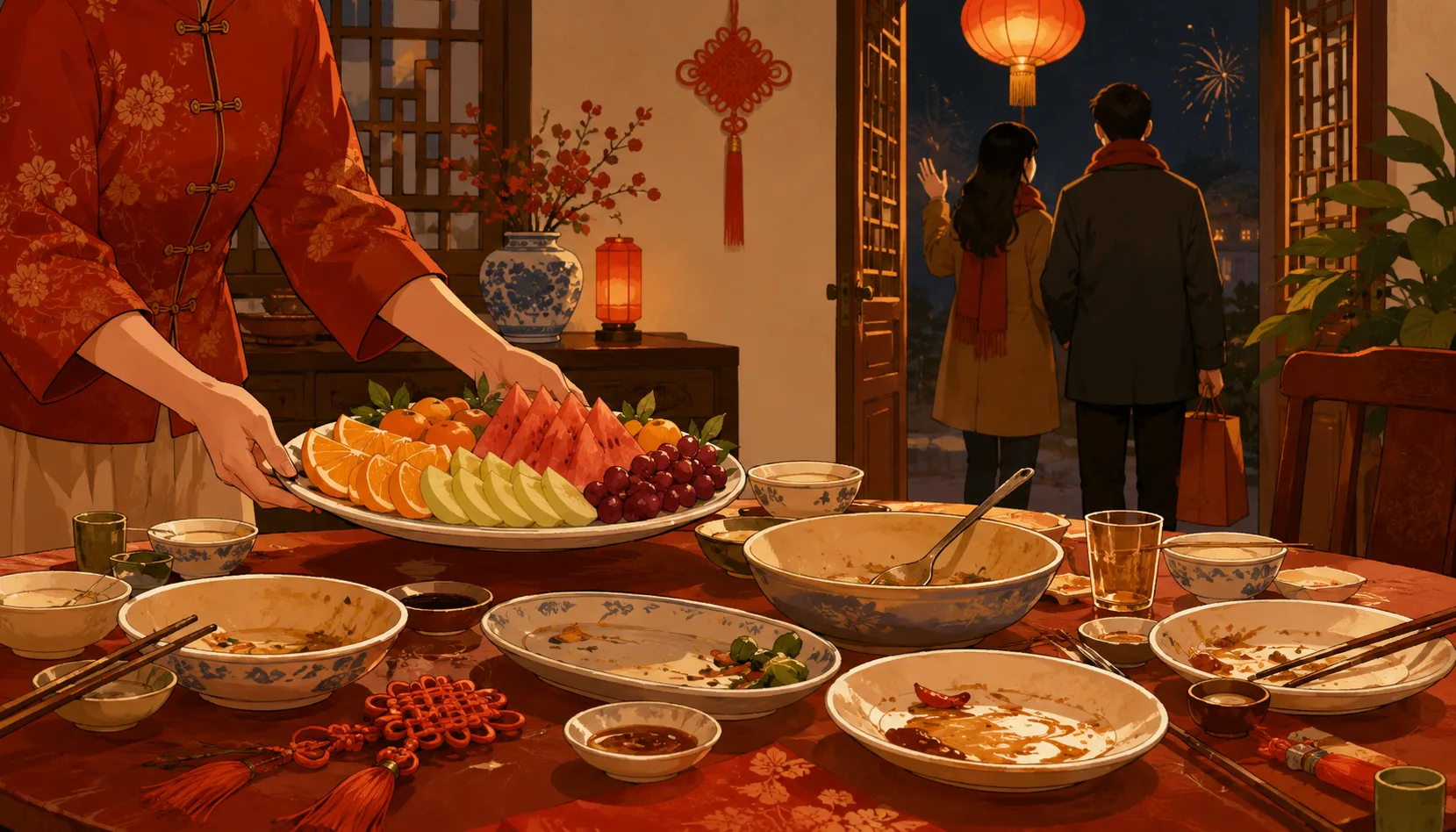
This is the universal Chinese "last call" for dinner guests. When the host brings out a tray of sliced watermelon, a plate of melon cubes, or a small bowl of grapes — this is the fruit platter of departure. Its hidden message: "This is the last dish of the evening. Eat this, then it's time to go."
In British pubs, they ring a bell at last orders. In Chinese homes, they serve fruit.
Signal #2: The Host Keeps Checking the Phone
Frequent, conspicuous phone-checking is not rudeness — it's a polite hint that they have obligations early the next morning.
Signal #3: Long Silences Start Appearing
The animated conversation of earlier has slowed to intermittent exchanges. Topics run dry. The room has that gentle after-dinner quiet.
Signal #4: Dishes Are Being Cleared
The host or their spouse starts quietly collecting empty dishes, returning them to the kitchen. The table is being dismantled.
Signal #5: The Children Have Gone to Bed
If children are present and they've been sent to wash up and sleep, dinner is definitively over for the adults too.
When two or more signals appear, take action. Don't wait for a third or fourth confirmation.
How to Initiate the Goodbye
Stand up. Take the lead. Your host will not. Once you're on your feet, the path is clear.
The Three-Part Exit Speech
A well-structured Chinese goodbye has three components:
- Gratitude + compliment the food:
今天实在太感谢了,菜太好吃了。
(Jīntiān shízài tài gǎnxiè le, cài tài hǎo chī le.)
"Thank you so much for today — the food was truly amazing." - Cite consideration for the host's rest:
时间不早了,不打扰你们休息了。
(Shíjiān bù zǎo le, bù dǎrǎo nǐmen xiūxi le.)
"It's getting late — I don't want to keep you from your rest." - Look toward the future:
我先走了,下次再聚!
(Wǒ xiān zǒu le, xià cì zài jù!)
"I'll head off now — let's get together again soon!"
When the Host Says "Stay a Little Longer!"
Your host will almost certainly say: 哎呀,这么早走干嘛,再坐一会儿嘛! ("Aiya, why leave so early — stay just a bit longer!")
This is courtesy, not a real request. The correct response: smile warmly, continue moving toward the door, and repeat your exit line. Do not sit back down unless there's a genuine reason to.
The Shoe-Changing Ritual at the Door
At the door, put your shoes back on. This can take a moment. Keep the conversation light and warm during the exchange. Thank the host again, specifically mention a dish or moment that you particularly loved. Personal specificity in compliments lands better than generic praise.
Instead of: "Everything was great!"
Try: "That braised pork your mom made — I've been thinking about asking for the recipe."
The Escort Ritual: Don't Fight It
Chinese hosts practice 送客 (sòng kè) — the send-off. Your host will walk you out of the apartment, to the elevator, possibly to the lobby, and sometimes all the way to the street.
This is not awkward. It's a sign of genuine hospitality and respect. Do not insist so strenuously on "no, really, don't bother!" that you turn the gentle escort into a five-minute tug-of-war in the hallway.
At the elevator, turn and say firmly but warmly:
请留步,别送了,快回去休息吧!
(Qǐng liúbù, bié sòng le, kuài huí qù xiūxi ba!)
"Please stop here — no need to see me further. Go back and rest!"
This exact phrase signals outstanding cultural fluency. It acknowledges the send-off ritual while graciously releasing your host from further obligation.
Wait for the host to turn back toward the apartment before you press the elevator button. Do not disappear into the elevator while they're still watching.
The Follow-Up Message: The Final 10%
Within 2 hours of arriving home, send a WeChat message. This step is what separates a guest who made a good impression from one who made a lasting one.
The Perfect Template
我到家了。今天非常开心,[嫂子/阿姨]做的菜太好吃了,期待下次再聚!早点休息。
(Wǒ dào jiā le. Jīntiān fēicháng kāixīn, [sǎozi/āyí] zuò de cài tài hǎo chī le, qīdài xià cì zài jù! Zǎo diǎn xiūxi.)
"I'm home safely. Today was wonderful — [your wife's/auntie's] cooking was amazing. Looking forward to next time! Rest early."
Customize with the name of whoever cooked, and add one specific dish you loved. Mentioning the cook by role (not just "the food") is a small touch that shows real attentiveness.
Reciprocating: The礼尚往来 Rule
Chinese social culture operates on 礼尚往来 (lǐ shàng wǎng lái) — "courtesy demands reciprocity." Within 1–2 months, find a way to return the hospitality.
Options:
- Invite them to your home — Chinese guests are genuinely fascinated by authentic home-cooked Western food. A homemade pasta or steak dinner is memorable.
- Treat them at a restaurant — Book, and quietly pay the bill at the counter before the meal ends. In China, whoever pays first wins the honor of hosting. If you try to pay at the table after eating, a Chinese friend will always outmaneuver you. Get there first.
- Bring a meaningful gift next time you meet — A specialty item from your home country, or something connected to a conversation from that evening.
Decoding the "Come to My Place for Dinner" Invitation
Chinese social speech includes polite phrases that sound like invitations but aren't:
- "Come eat at my place sometime!" — Said at the end of a chance meeting or as a general farewell. This is approximately 70% social courtesy. Respond with 好的好的 and move on.
- "This Saturday — come for dinner!" — Specific date, specific occasion: this is a real invitation. Prepare your gift, check your socks, and go.
The difference: real invitations come with a date, a time, and sometimes a menu hint ("My mom's making dumplings"). Courtesy invitations float freely without attachment to the calendar.
What Chinese People Actually Say
- 我先走了 | wǒ xiān zǒu le | "I'll go first" | Use when you need to leave early; shows consideration for hosts
- 谢谢招待 | xièxiè zhāodài | "Thank you for your hospitality" | Essential phrase to thank the host before leaving
- 失陪了 | shī péi le | "Excuse me for leaving" | Formal expression; shows politeness to remaining guests
2026 Reality Check
2026 Reality Check: The "don't leave first" rule still exists but has softened significantly, especially in urban areas.
Gen Z vs. Older Generations: Younger Chinese (under 30) treat dinner parties more casually—they check phones, wrap up earlier, and don't obsess over protocol. Boomers and Gen X still respect the traditional flow: wait for the host to signal the end, especially at business dinners. The gap is widening.
Beijing/Shanghai vs. Smaller Cities: Tier-1 cities are relaxed. Leaving early after a casual meal is fine. In smaller cities and family gatherings, the old etiquette holds stronger—leaving too soon can still feel rude. Regional hospitality culture remains potent outside the mega-cities.
Bottom line: The rule isn't dead, but it's optional in cosmopolitan contexts. Context, relationship, and setting matter more than ever.
Frequently asked questions
What does it mean when the host brings out fruit at a Chinese dinner?
The fruit platter is the universal signal that the meal is wrapping up. It's the host's polite way of saying 'this is the last course' without directly telling you to leave. Once fruit is served, eat a couple of pieces, then wait 10-15 minutes before initiating your goodbye.
Can I leave a Chinese dinner party before the host stands up?
Actually, you should be the one to stand up first. In Chinese etiquette, the guest initiates the departure—the host will never rush you out. When you see the signs, stand, thank the host, and say your goodbyes. This shows respect and awareness of social cues.
How do I say goodbye in Chinese without being rude?
Use a three-part exit phrase: thank the host for the meal (谢谢招待, xièxie zhāodài), apologize for having to leave (不好意思, bù hǎoyìsi), and express that you enjoyed yourself (今天很开心, jīntiān hěn kāixīn). Keep it warm and brief—long farewells can feel awkward.
What if my host insists I stay longer when I try to leave?
This is a polite ritual, not a real demand. Decline once or twice graciously, repeating that you've had a wonderful time but really must go. If they still insist, you can stay for one more round of tea or fruit, then try again. The host is testing your sincerity, not forcing you to stay.
Is it okay to leave quietly without saying goodbye to everyone?
No, that's considered rude. You must say goodbye to the host individually and, if it's a small gathering, to each guest. For larger banquets, a general goodbye to the table plus a personal word to the host is sufficient. Never slip out unnoticed—it signals you didn't enjoy yourself.
When should I send a follow-up WeChat message after a dinner party?
Send it within 1-2 hours of getting home, or the next morning at the latest. A simple message like '到家了,谢谢招待' (I'm home, thanks for hosting) works perfectly. This confirms you arrived safely and shows gratitude. It's a small gesture that leaves a lasting positive impression.
Try our tools
Related guides

Visiting a Chinese Home: Complete Etiquette Guide for Foreigners
Bring a small gift, arrive 5 minutes late (never early), remove shoes at the door, wait for the host to assign your seat, and let the eldest eat first. Follow t…
Read the guide →
Chinese Phrases for Visiting Someone's Home: Essential Scripts with Pinyin
Key phrases: 打扰了 (dǎ rǎo le) = "Thank you for having me," 一点心意 (yī diǎn xīn yì) = "Just a small token," 请留步 (qǐng liú bù) = "Please don't walk me further out." …
Read the guide →
What to Bring to a Chinese Home for Dinner: Guest Gift Guide for 2026
Never arrive empty-handed at a Chinese home dinner. Safe options: a fruit basket, quality packaged pastries or snacks, good quality tea, or imported wine/spirit…
Read the guide →