Is cutting in line socially unacceptable in China?
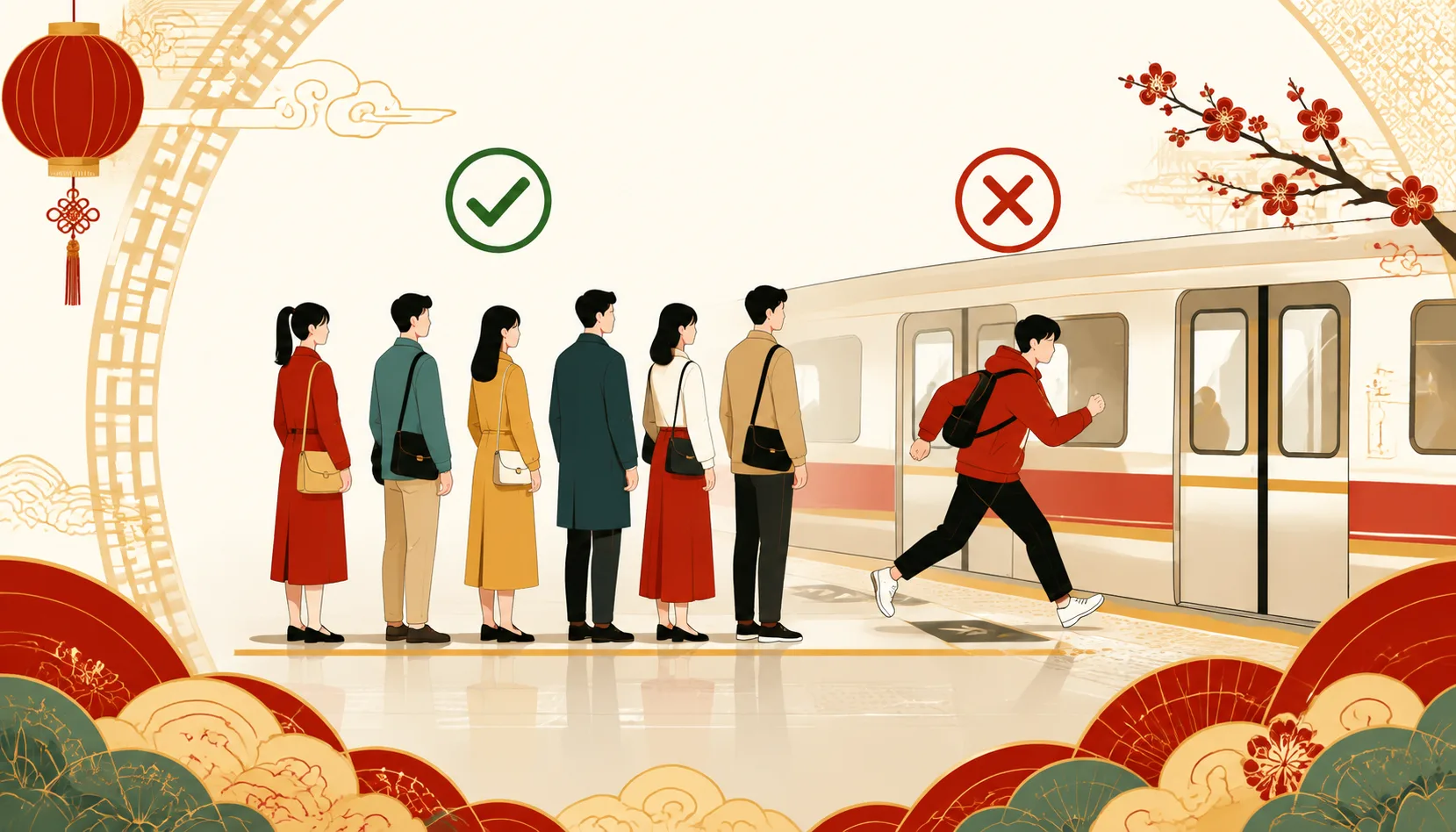
Quick answer
Yes. Cutting in line (插队, chā duì) is widely disliked and increasingly called out in public. Modern China has a strong culture of orderly queuing in cities.
Why This Rule Matters
While queue-jumping was once more common in China, urban culture has shifted strongly toward orderly queuing — especially in metros, hospitals, and government offices. Signs in airports and subway stations explicitly prohibit it. Being caught cutting is now considered embarrassing, not clever.
What You Should Do
- Find the back of the line and join it
- Be patient — everyone else in line has the same wait
- If unsure where the line starts, ask politely
What You Shouldn't Do
- Push past people to get closer to the front
- Use 'I just need to ask one quick question' as an excuse to jump to the front
- Pretend you didn't see the queue
Practical Tips for Foreigners
This rule applies in most social and formal settings across China. When in doubt, watch what your Chinese host or senior colleague does and follow their lead. Breaking this rule once is forgivable — breaking it repeatedly signals a lack of cultural awareness.
Where Queuing Is Strictest vs. More Relaxed
The rules aren't uniform across China. In first-tier cities like Beijing, Shanghai, and Shenzhen, queuing is almost sacred—especially at metro stations, airports, and government offices. People will openly glare or mutter if you push ahead. But in smaller cities or rural markets, especially in places like Chengdu or Kunming, lines can be more fluid. Vendors and customers may cluster around a stall without a clear order. Don't assume that's an invitation to cut in—watch how locals interact. Often, there's a subtle 'first-come, first-served' based on who arrived first and caught the vendor's eye, not who's physically closest. When in doubt, ask, 'Pái duì ma?' (Do we queue?) to clarify the expected behavior.
Real-Life Queue Scenarios
- A British expat in Shanghai tried to slip ahead at a popular brunch spot to ask about the menu. The hostess snapped, 'Pái duì!' and a nearby grandmother shook her head loudly. He learned to ask questions from the back of the line.
- At a hospital in Guangzhou, an American woman joined a crowd near the registration window, thinking it was a free-for-all. A nurse pulled her aside and pointed to the queue marker on the floor—she'd unknowingly cut in front of 20 people who were too polite to say anything but clearly annoyed.
- In a Chengdu tea house, a German visitor stood at the counter while locals chatted in a loose huddle. He assumed it was chaos, but when he ordered, an elderly man tapped his shoulder and said, 'Wǒ xiān lái de' (I came first). The staff had been tracking the order all along.
What Hosts Think But Don't Say
When you cut in line, Chinese colleagues or friends rarely confront you directly—that would cause 'losing face' for both sides. Instead, they'll go quiet, exchange glances, or subtly comment to each other in Chinese. What they're thinking: 'Doesn't he see the line? Is he entitled or just clueless?' In a workplace setting, this can damage your reputation <a href="/business/chinese-business-banquet-etiquette/">more than</a> you'd expect. Your boss might not scold you, but the unspoken judgment lingers. If you accidentally cut in, apologize immediately with 'Duì bù qǐ, wǒ méi kàn dào duì wǔ' (Sorry, I didn't see the line). That repairs the damage. But doing it repeatedly marks you as disrespectful—something that's hard to shake off in a relationship-based culture.
Digital Queuing Is the New Norm
Since 2020, many services have moved to digital queuing systems—hospitals, banks, and even some restaurants use numbered tickets or WeChat mini-programs. If you see a machine dispensing numbers, grab one. Don't just stand near the counter assuming it's first-come, first-served. In Shenzhen's tech parks, it's common for lunch spots to have QR-code queues. Scan, get your number, and wait for the call. Foreigners who ignore these systems often offend locals by physically crowding the counter, not realizing they've bypassed the invisible order. When in doubt, look for a screen showing numbers or ask a staff member, 'Qǐngwèn, xūyào qǔhào ma?' (Do I need to take a number?)
What Chinese People Actually Say
- 别插队 | bié chā duì | Don't cut in line | Direct warning to someone trying to cut in line
- 插队是不礼貌的 | chā duì shì bù lǐmào de | Cutting in line is impolite | Used when explaining or criticizing line-cutting behavior
- 请排队 | qǐng pái duì | Please queue | Polite request to form a proper line
2026 Reality Check
In 2026, queue etiquette in China remains a work in progress. Urbanites generally queue at subway doors, bank ATMs, and restaurant takeout lines, but cutting in line still happens—especially during rush hour or at popular tourist spots.
Gen Z, more globally connected and image-conscious, tends to respect queue norms more visibly, often calling out "排队" (queue) when they see cutting. Older generations, particularly in smaller cities, sometimes view queue-jumping as assertive or smart, not rude.
Beijing and Shanghai have relatively strong queue culture, with younger crowds and visible enforcement. Second-tier cities and rural areas show more variation—queueing is common in modern malls but less so at bus stops or government offices where connections matter more.
Frequently asked questions
Is cutting in line socially unacceptable in China?
Yes, cutting in line (插队, chā duì) is widely disliked and increasingly called out in public. Modern China has a strong culture of orderly queuing in cities.
What should I do if someone cuts in front of me in China?
Stay calm and politely say '请排队' (please queue) or '请排队等候' (please wait in line). Avoid confrontation, as public arguments are frowned upon.
Are there any places in China where queuing rules are more relaxed?
In rural areas or very crowded markets, queuing may be less formal, but it's still best to follow the crowd's flow. In cities, queues are strictly observed at stations, banks, and ticket counters.
How can I politely ask someone to let me go ahead in a queue in China?
If you have an urgent need, say '不好意思,我有急事,能让我先吗?' (Excuse me, I have an emergency, can I go first?). Most people will agree if you're respectful and brief.
Is it okay to queue for someone else in China?
Saving a spot for one person is generally acceptable, but holding a place for multiple people is seen as unfair. Keep it to one person to avoid annoying others.
What are common queue etiquette tips for foreigners in China?
Always stand behind the last person, keep a small gap, and avoid physical contact. In busy places, follow any marked lines or barriers, and never push forward.
Try our tools
Related guides

Public Behavior in China: What Is and Isn't Acceptable
Chinese cities have their own public behavior logic: noise levels are higher than Western norms in some contexts and strictly controlled in others, personal spa…
Read the guide →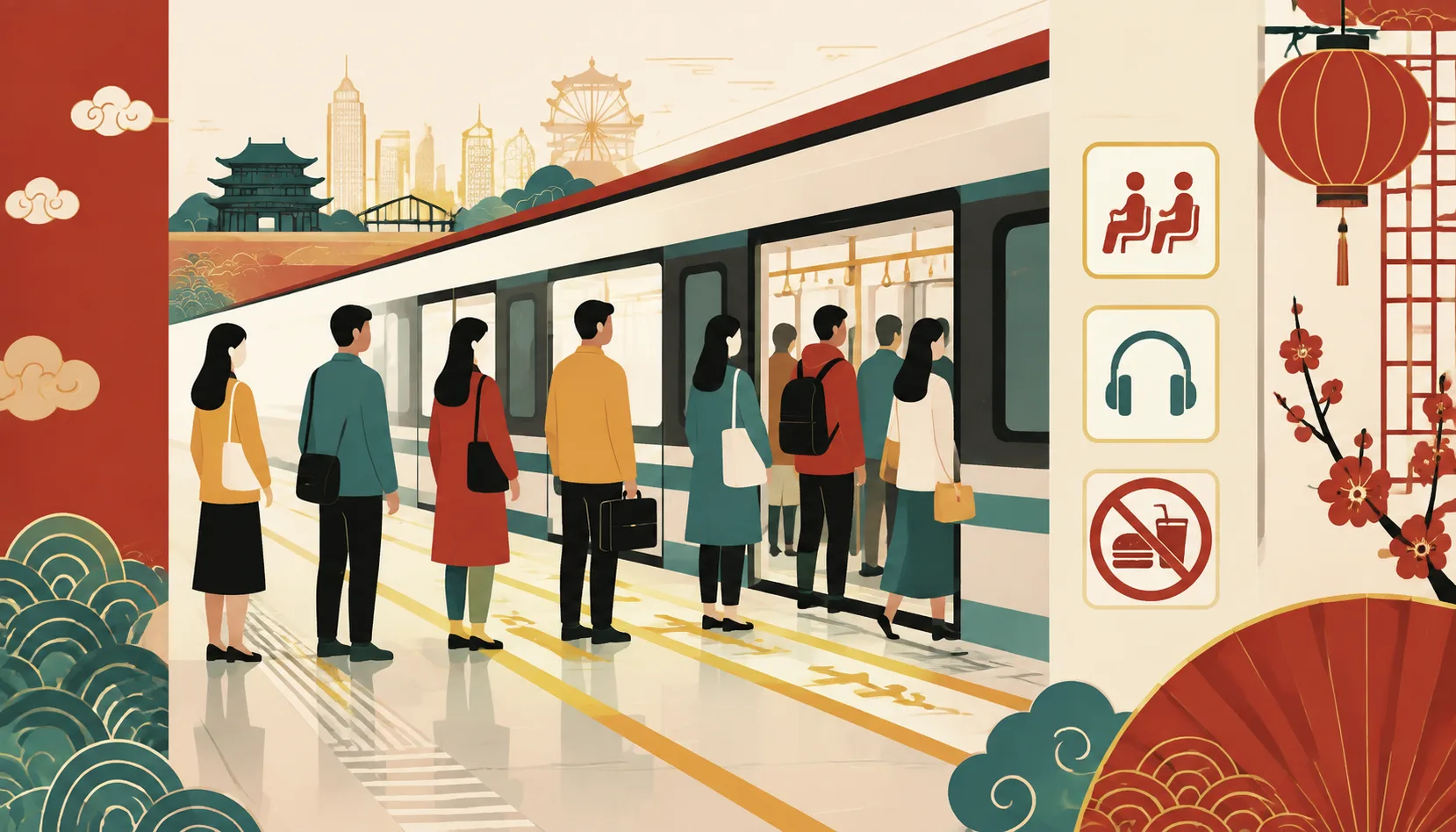
China Subway and Bus Etiquette: The Unwritten Rules
Chinese metro culture has its own logic: people do queue at the painted lines (mostly), crowds at rush hour are extremely dense and this is accepted, phone spea…
Read the guide →
10 Social Mistakes Foreigners Commonly Make in China
The most common mistakes cluster around face (publicly correcting or disagreeing with someone), physical greeting norms (hugging or back-patting people who are …
Read the guide →