Is glancing sideways at someone considered rude in China?
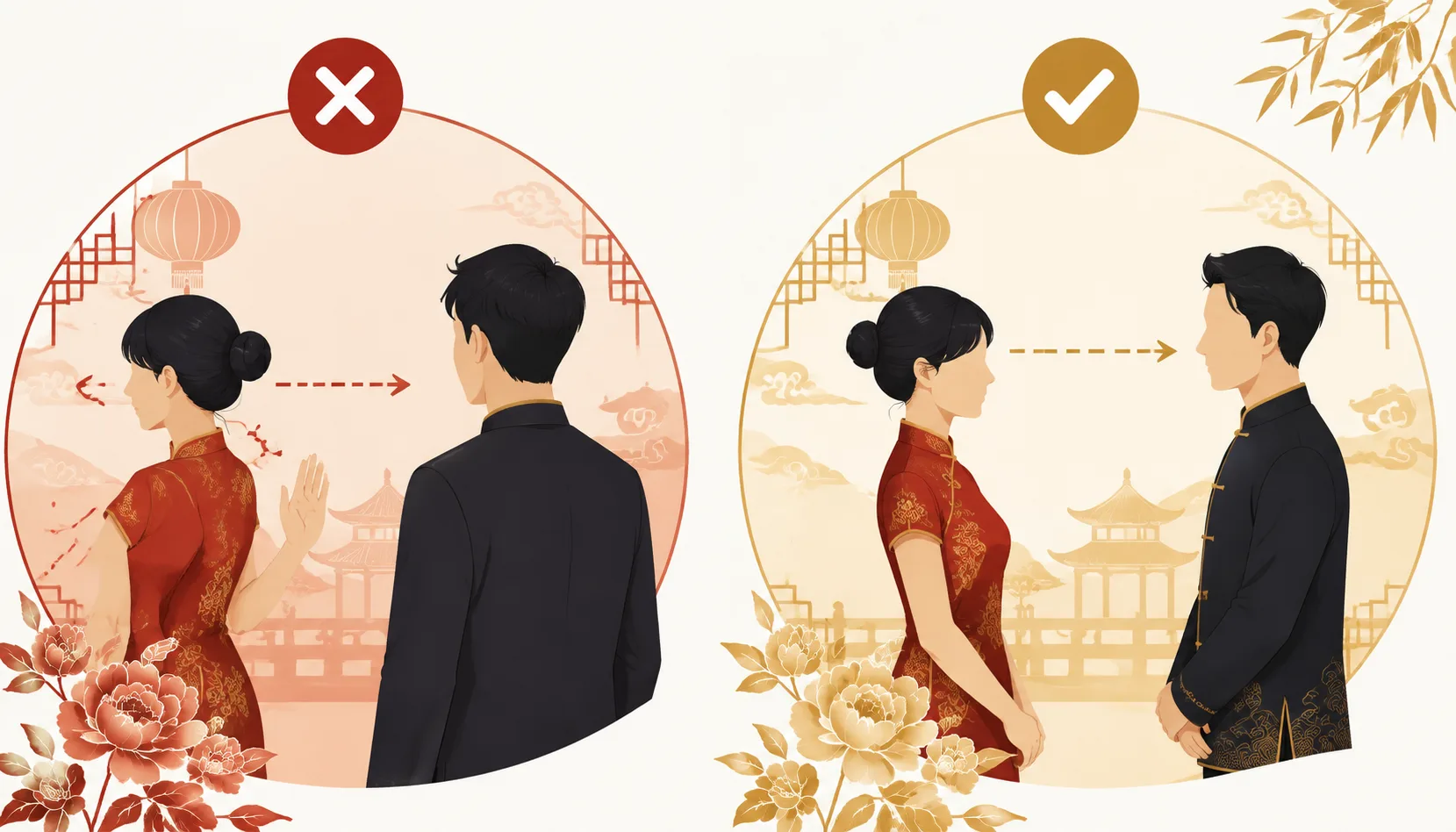
Quick answer
Yes. Looking at someone with a side-eye or raising your eyes without lifting your head signals contempt, condescension, or disinterest.
Why This Rule Matters
The Chinese saying 'yǎn xié xīn bù zhèng' (眼斜心不正, sideways eyes, crooked heart) reflects the traditional belief that eye movement reveals character. Sideways glances are associated with disdain or scheming — it communicates 'I don't think you're worth turning to face.'
What You Should Do
- Make direct, friendly eye contact when speaking with someone
- Look fully at the person when they are speaking — don't look away dismissively
- Nod slightly to acknowledge someone when you make eye contact
What You Shouldn't Do
- Glance sideways at someone without turning to face them
- Look someone up and down with a judgmental expression
- Stare or gawk — sustained staring is also considered rude
Practical Tips for Foreigners
This rule applies in most social and formal settings across China. When in doubt, watch what your Chinese host or senior colleague does and follow their lead. Breaking this rule once is forgivable — breaking it repeatedly signals a lack of cultural awareness.
Why Side-Eye Cuts Deeper in Hierarchical Settings
In Chinese workplaces and family gatherings, hierarchy isn't just structure—it's emotional currency. A sideways glance from a manager to a junior colleague reads as a public verdict: 'You're not worth my full attention.' Unlike in the West, where side-eye might be playful or sarcastic, here it lands as a direct challenge to someone's face (面子, miànzi). The recipient often won't confront you—they'll just remember. That memory resurfaces in meetings, negotiations, or when you need a favor. In state-owned enterprises in Beijing or Shanghai's foreign-invested firms, this silent slight can stall your projects for months without a word ever being spoken.
Real Scenarios: When It Goes Wrong
- A British expat in Shenzhen gave a dismissive side-glance to a factory supervisor during a quality dispute. The supervisor stopped communicating directly and routed all issues through a translator for three weeks—production delays cost the company ¥80,000.
- An American teacher in Chengdu looked sideways at a student's parent during a parent-teacher meeting. The parent later complained to the principal that the teacher was 'arrogant and untrustworthy,' nearly costing her the job.
- In a Guangzhou family dinner, a French consultant glanced sideways at his host's elderly father while checking his phone. The host's mother whispered, 'He doesn't respect our family,' and the business deal quietly fell through.
- A German manager in Suzhou used side-eye to signal impatience during a presentation. The young presenter froze mid-slide, and the entire team avoided the manager for days—no one wanted to be the next target.
Regional Nuances: North vs. South Reactions
Reactions to side-eye aren't uniform across China. In northern cities like Beijing and Tianjin, people are more direct—a recipient might call you out on the spot or make a sarcastic remark, and the tension passes quickly. In the south, especially in Guangdong, Fujian, and Hong Kong, the response is more oblique: people smile, nod, and then quietly exclude you from future invitations or business opportunities. Among younger professionals under 35 in first-tier cities like Shanghai and Hangzhou, side-eye is often shrugged off as a bad habit. But for anyone over 50, or in traditional industries like manufacturing, real estate, or government, the offense lingers. If you work with partners from Taiwan or overseas Chinese communities in Southeast Asia, treat it as a serious breach—they carry the same cultural weight.
The Unspoken Thought Behind the Silence
When you side-eye a Chinese colleague, here's what runs through their mind but never crosses their lips: 'I see you think you're above me. Fine. I'll remember this when you need my help.' They won't tell your boss, won't argue, won't even change their tone. They'll just quietly stop offering you the informal help that makes daily life work—the extra documents, the heads-up about schedule changes, the introduction to the right contact. In China, cooperation runs on guanxi (关系), and guanxi dies in small moments of disrespect. One sideways glance can erase months of relationship-building. The cost isn't immediate; it's the slow drain of opportunities that never come your way.
What Chinese People Actually Say
- 斜眼看待 | xié yǎn kàn dài | to look at someone with suspicion or disdain | Use when describing someone viewing others with distrust or contempt.
- 侧目而视 | cè mù ér shì | to look at someone sideways with disapproval | Formal expression for casting a dismissive sideways glance.
- 不屑一顾 | bù xiè yī gù | to deem not worth a single glance | Describes treating someone as unworthy of attention.
2026 Reality Check
2026 Reality Check: The rule exists in name but fades in practice. Urban Chinese increasingly ignore it.
Gen Z vs. Older Generations: Boomers and Gen X still instinctively avoid the sideways glance—it's wired from the Mao era's emphasis on equality. Gen Z? They glance sideways constantly, especially on metro trains. Dating apps and social media have normalized direct staring or complete indifference. The "humble gaze" feels outdated to them.
Beijing/Shanghai vs. Smaller Cities: Tier-1 cities: fast-paced, everyone minds their own business—dismissive glances are common, almost expected. Smaller cities: older residents still practice the etiquette, but younger locals mimic big-city behavior. The gap is narrowing.
Bottom line: The rule survives mostly in formal settings or among older rural populations. Urban youth see it as old-fashioned. Etiquette follows convenience, not tradition.
Frequently asked questions
Is making eye contact with a stranger in China considered rude?
No, brief eye contact is fine, but prolonged staring or side-eye is seen as disrespectful. Keep your gaze neutral and friendly.
What does a sideways glance mean in Chinese social settings?
It signals contempt, arrogance, or disinterest, especially if combined with a slight head tilt or raised eyebrows. Avoid it in business or casual interactions.
How should I look at someone when talking to them in China?
Face them directly and maintain soft, natural eye contact. Looking down slightly is acceptable for showing respect, especially with elders or superiors.
Can I use a quick glance to check someone out without being rude?
A quick, subtle glance is okay, but avoid lingering or turning your head sideways. If noticed, smile briefly to show harmless intent.
What should I do if I accidentally give someone a side-eye in China?
Apologize quickly with a small nod or smile, and say '不好意思' (excuse me). This usually defuses any negative impression.
Are there situations where side-eye is acceptable in China?
Among close friends, playful side-eye might be tolerated, but in formal or public settings, it's best to avoid it entirely to prevent misunderstandings.
Try our tools
Related guides

10 Social Mistakes Foreigners Commonly Make in China
The most common mistakes cluster around face (publicly correcting or disagreeing with someone), physical greeting norms (hugging or back-patting people who are …
Read the guide →
Ancient Chinese Etiquette Rules: The Unwritten Code Every Foreigner Should Know
China has thousands of years of accumulated social rules — many of them "unwritten" but universally understood. These rules cover everything from how you sit, h…
Read the guide →
Chinese Etiquette Self-Assessment: What Level Are You At?
Chinese social fluency develops in stages: survival level (avoiding obvious offenses), intermediate (reading indirect signals and participating in rituals), and…
Read the guide →