Chinese vs Korean Business Etiquette: Key Differences

Quick answer
While both Chinese and Korean business cultures emphasize hierarchy, respect, and relationship-building (guanxi in China, yeong in Korea), they differ significantly in communication style—Chinese business tends to be more indirect and hierarchical, while Korean business combines formal structure with more direct feedback. Understanding these nuances is essential for foreign executives navigating either market.
Quick Answer
While both Chinese and Korean business cultures emphasize hierarchy, respect, and relationship-building (guanxi in China), they differ significantly in communication style—Chinese business tends to be more indirect and hierarchical, while Korean business is often more formal and structured. Understanding these nuances is essential for foreign executives navigating either market.
DO
- Bring high-quality business cards with you—present them with both hands in both cultures
- Allow time for relationship building before getting down to business
- Address senior executives first and show appropriate deference
- Accept business cards respectfully and study them before putting them away
- Learn basic greetings in the local language (Chinese: nǐ hǎo / Korean: Annyeonghaseyo)
- Follow the seating arrangement in meeting rooms—usually determined by hierarchy
- Bring small gifts for important meetings (avoid white wrapping in China, avoid sets of 4 in Korea)
- Allow your Korean counterpart to pour your drinks at dinner (show appreciation)
DON'T
- Don't write on business cards in front of the giver
- Don't initiate first name usage until explicitly invited
- Don't rush the relationship-building phase—trust must be established first
- Don't be overly aggressive in negotiations in either culture
- Don't refuse food or drink offerings repeatedly—it's considered rude
- Don't discuss business immediately after sitting down in Chinese meetings
- Don't confuse Korean and Chinese business customs—they are distinctly different
- Don't schedule meetings during Lunar New Year or Korean Chuseok period
Why This Matters
For foreign business professionals expanding into East Asian markets, understanding the differences between Chinese and Korean business etiquette is not just a matter of cultural curiosity—it directly impacts deal success, partnership longevity, and professional reputation. Both nations are economic powerhouses, but their business cultures have evolved from fundamentally different historical, philosophical, and social roots.
China, with its 1.4 billion people and the world's second-largest economy, operates on a business culture heavily influenced by Confucian values, collectivism, and the concept of guanxi (关系)—meaning "relationships" or "connections." Korean business, while also rooted in Confucian traditions, has developed its own unique characteristics shaped by rapid industrialization, chaebol (large family-owned business conglomerates) dominance, and a distinctive hierarchical system called nunchi (눈치)—the art of reading the room and understanding social dynamics.
The stakes are high. A foreign executive who treats a Chinese business meeting the same way they would a Korean meeting—or worse, applies Western business norms—risks offending potential partners, losing contracts, or damaging relationships that took months to build. Conversely, those who master these cultural nuances gain significant competitive advantages in both markets.
Perhaps most importantly, the differences between Chinese and Korean business etiquette are often more pronounced than the similarities. While both cultures value respect for hierarchy, formality in initial meetings, and long-term relationship building, the way these values manifest in practice can be dramatically different. Understanding these distinctions allows you to adapt your approach quickly and appropriately, whether you're shaking hands in a Shanghai high-rise or pouring soju in a Seoul boardroom.
Regional and Generational Differences
One of the most overlooked aspects of East Asian business etiquette is how dramatically it can vary by region and generation. Assuming that all Chinese businesspeople behave identically to all Korean businesspeople would be a critical mistake.
In China, the difference between Beijing, Shanghai, and smaller cities is profound. Beijing business culture tends to be more political and relationship-driven, with many deals requiring connections to government officials or state-owned enterprises. Business cards from Beijing executives often include impressive titles and connections. Shanghai, China's financial hub, has developed a more internationally-minded business style—executives there are often more direct, more familiar with Western negotiation tactics, and more focused on practical outcomes than philosophical discussions. In smaller cities and second-tier markets, business relationships tend to be more personal, family-oriented, and trust develops more slowly but often more deeply.
Korea shows similar regional variations. Seoul-based businesses, especially those affiliated with major chaebols like Samsung, LG, or Hyundai, operate with extreme formality and hierarchical precision. Busan and other southern cities tend to have a slightly more relaxed business atmosphere, though respect for hierarchy remains paramount. The difference between doing business in Seoul's Gangnam district versus a regional city can feel like comparing New York to a midwestern American town in terms of pace and formality.
The generational divide is equally significant. In China, executives over 50 (born before China's economic opening) tend to be more formal, more hierarchical in their thinking, and more focused on building personal trust before business discussions. They may prefer traditional Chinese business practices, including elaborate dinners and gift-giving. Chinese Gen Z professionals (born after 1995), however, are often more direct, more comfortable with Western business practices, and more focused on efficiency and results. They may check their phones during meetings, challenge ideas more directly, and prefer coffee over multi-course banquets.
Korean business shows a similar but distinct generational split. Older Korean executives adhere strictly to hierarchical protocols—using formal language (jondaenmal), waiting for seniors to speak first, and following elaborate social rituals. Korean Millennials and Gen Z have begun to challenge some of these traditions, though they still operate within a fundamentally hierarchical framework. The concept of nunchi—reading social situations and adjusting behavior accordingly—remains crucial across generations, but how it manifests has evolved.
For foreign business professionals, this means your approach must be flexible. A meeting with a 60-year-old Beijing factory owner requires different tactics than a meeting with a 30-year-old Shanghai tech entrepreneur. Similarly, a presentation to senior Samsung executives demands more formality than a meeting with a Korean startup founded by younger entrepreneurs.
What Chinese People Actually Say
- "Wǒmen xiān chī diǎnxīn ba" (我们先吃点心吧) — "Let's have some refreshments first" — This is not just hospitality; it's a signal that you'll discuss business after building rapport over food.
- "Zhège shì qíng bǐjiào fùzá" (这个事情比较复杂) — "This matter is quite complex" — This usually means there's a problem or objection they're not comfortable stating directly.
- "Wǒmen yǐhòu zài liáo" (我们以后再聊) — "Let's talk about this later" — Often means they're not convinced or need to consult others; don't push for an immediate answer.
- "Nín kàn zhe bàn ba" (您看着办吧) — "You decide" — This doesn't actually mean you should decide freely; it often means they're leaving the decision to you while retaining the right to blame you if it goes wrong.
- "Wǒmen yǒu jīhuì zài hézuò" (我们有机会再合作) — "We have the opportunity to cooperate again" — This is often a polite way of saying no or that the deal is not progressing.
- "Zhè ge jiàgé hěn nán zuò" (这个价格很难做) — "This price is difficult to do" — This is a negotiation opening, not a final answer; expect to negotiate further.
- "Qǐng gěi wǒmen yìdiǎn shíjiān" (请给我们一点时间) — "Please give us some time" — They need internal consensus; don't pressure for immediate decision.
- "Wǒmen hěn kànzhòng zhège hézuò" (我们很看重这个合作) — "We value this cooperation" — A positive signal indicating genuine interest.
2026 Reality Check
The business landscape in both China and Korea is evolving rapidly, and the etiquette rules that applied five years ago may need adjustment today. Several key trends are reshaping business interactions:
Digital Transformation: WeChat business (WeChat business cards, WeChat pay, WeChat meetings) has become standard in China. Korean businesses have adopted similar digital tools, with KakaoTalk being the dominant platform. Foreign executives should be comfortable conducting substantial business through these apps, including accepting business cards via QR code.
Post-Pandemic Business Etiquette: The COVID-19 pandemic accelerated changes in both markets. Hybrid meetings are now common, and the balance between in-person relationship building and virtual efficiency has shifted. While face-to-face meetings remain important for major deals, video conferences are now widely accepted for ongoing communications.
Younger Leadership: As Gen Z and Millennial professionals move into decision-making positions, business etiquette is becoming more direct in both countries. However, the underlying cultural values of respect, hierarchy, and relationship building remain strong. The key is reading your specific counterpart and adapting accordingly.
International Exposure: Both Chinese and Korean executives who have studied or worked abroad often blend Eastern and Western business practices. They may use first names more quickly, provide more direct feedback, and be more comfortable with Western-style negotiation. However, they still expect foreign partners to demonstrate cultural awareness and respect for local norms.
Key Takeaway: The fundamentals of Chinese and Korean business etiquette—respect for hierarchy, relationship building, patience, and attention to detail—remain as relevant as ever. But successful foreign professionals in 2026 must be adaptable, culturally literate, and able to read their specific counterparts' preferences and expectations. The goal is not to become a cultural expert but to demonstrate genuine respect and willingness to learn, which both Chinese and Korean partners deeply appreciate.
Related guides
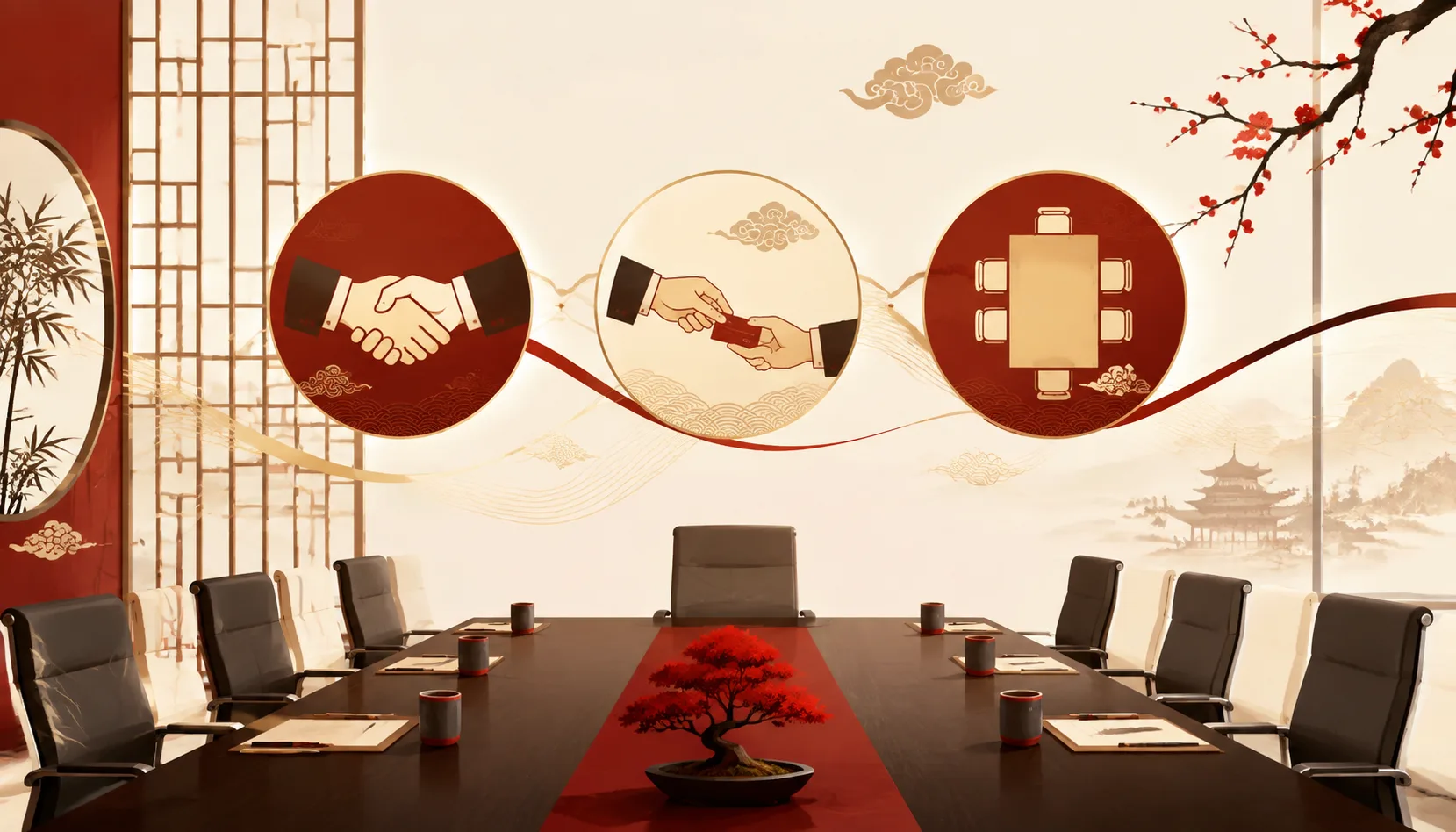
Chinese Business Etiquette Guide 2026: What You Must Know
Chinese business etiquette is easier to navigate when you watch three recurring patterns: relationship-building (guanxi), protecting dignity in public (mianzi),…
Read the guide →
Chinese Business Banquet Protocol: Rules & What Not to Do
A Chinese business banquet is not a meal — it's a trust-building ceremony disguised as dinner. The food is secondary. The goal is to establish that you are a re…
Read the guide →
Chinese Business Communication Style: Indirect Signals
Chinese business communication is high-context: what matters is often what's not said — the tone, the timing, who said it, and what was conspicuously omitted. W…
Read the guide →